The Gilded Thread: Deconstructing the Imperial Legacy of Cloth of Gold
Introduction: A Fabric of Absolute Authority
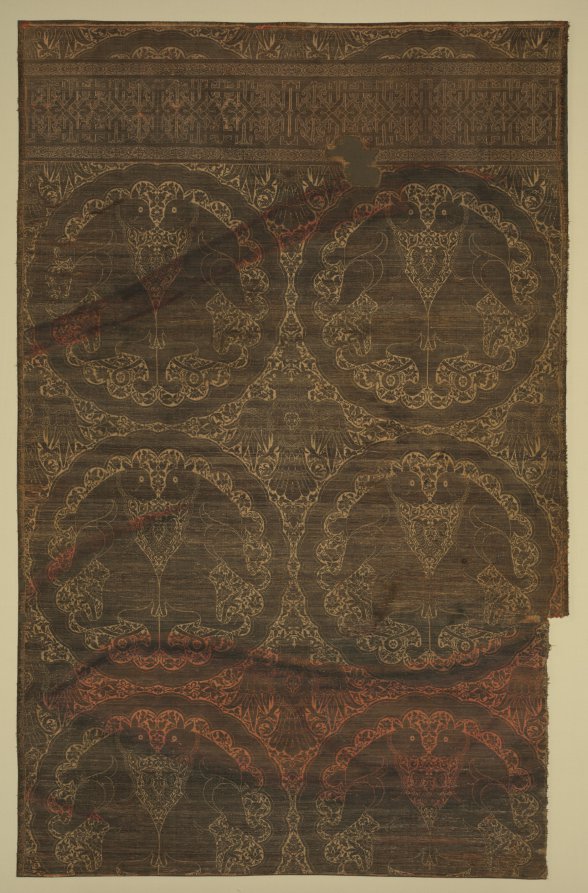
In the hushed, wood-panelled ateliers of Savile Row, where the cut of a jacket is a matter of national importance, we rarely pause to consider the profound lineage of the very fibres we drape. Yet, every bolt of cloth carries a history, and none more so than the extraordinary textile known as *cloth of gold*. This is not merely a fabric; it is a declaration of sovereignty, a woven edict of power that predates the modern suit by millennia. This heritage research artifact examines a specific, singular iteration of this material: a silk ground shot through with metallic threads, bearing the potent iconography of felines and eagles. Our subject is not a mere decorative piece; it is a surviving fragment of imperial ambition, a testament to the absolute control of silk weaving that defined the courts of Byzantium, Sassanid Persia, and the great dynasties of the East.
The materiality of this piece is its first and most crucial testimony. The base is a lustrous, tightly woven silk, likely a twill or a compound weave, providing a supple yet structured foundation. The "gold" is not a simple thread but a gilded membrane—a strip of animal gut or leather, or more commonly, a flattened silver-gilt wire, meticulously wound around a silk core. This technique, known as *filé* or *tiré*, creates a surface of extraordinary brilliance, catching the light with a liquid, molten quality. The weight is substantial; this is a fabric that does not drape so much as it commands. It was never intended for the casual wearer. Its very weight and stiffness speak of ceremonial robes, altar frontals, and the palanquins of emperors.
The Iconography of Dominion: Felines and Eagles
The design is where the true narrative of power unfolds. The feline—typically a lion or a panther—is rendered with a stylised, muscular tension. In the imperial lexicon, the lion represents solar might, royal courage, and the sovereign’s absolute dominion over the terrestrial realm. The eagle, conversely, is the master of the celestial sphere, the intermediary between the mortal king and the divine. When these two motifs are woven together in a single field of gold, they create a heraldic statement of total authority: the emperor is master of all he surveys, both on earth and in the heavens. This pairing is not accidental. It is a deliberate, codified visual language inherited from Achaemenid Persia, refined by the Sassanians, and subsequently absorbed into the Byzantine *officium*, where such patterns became the exclusive property of the imperial household. To wear or display such a cloth was to claim a direct, sanctioned lineage to the divine order of the cosmos.
The technical execution of this iconography is a marvel of pre-industrial engineering. The weaver, working on a drawloom, would have required a second operator to manipulate the hundreds of heddles, lifting the warp threads in precise sequences to create the intricate pattern. The metallic threads, being inelastic and prone to breakage, demanded immense skill to handle without snapping. The density of the weave—often exceeding 100 threads per centimetre—created a fabric that was not only visually stunning but also remarkably durable, a quality befitting objects meant to be heirlooms of state. The precision of the repeat, the sharpness of the animal’s claws, the individual feathers of the eagle’s wing—all speak to a workshop operating at the very pinnacle of human craft, a standard that modern power-loom weaving, for all its efficiency, has never fully replicated.
The Legacy of Imperial Silk Weaving
This cloth is a direct descendant of the great imperial silk workshops. In Constantinople, the *Gynaecea* were state-controlled factories where the production of purple silk and cloth of gold was a closely guarded monopoly. The penalties for unauthorized weaving were severe—often death. This scarcity was the very source of its power. The silk itself, originating from the Far East, was a precious commodity, but the transformation of raw silk into this gilded, icon-laden textile was an act of imperial alchemy. It was a means of converting raw wealth into symbolic capital, a physical manifestation of the state’s ability to command resources, technology, and artistic genius.
The legacy of this weaving tradition is not confined to museum vitrines. It flows directly into the Western tradition of luxury textiles. When the Crusaders sacked Constantinople in 1204, they carried these fabrics back to Europe, where they were used to wrap relics and adorn the altars of cathedrals. The patterns, once the exclusive property of the Byzantine Emperor, were copied and adapted by Italian weavers in Lucca and Venice. The heraldic motifs of lions and eagles became the foundation of European noble coats of arms. The very concept of a "brocade" or a "lamé" fabric, still used in haute couture today, is a direct descendant of this imperial technique.
Materiality and the Modern Eye
For the contemporary designer or the discerning client on Savile Row, this cloth offers a profound lesson in the power of materiality. The modern menswear market is saturated with "luxury" fabrics that are merely expensive. This cloth of gold, however, represents a different category: *authority*. The weight, the sheen, the tactile resistance of the metallic threads—these are not qualities that can be replicated with a printed pattern or a synthetic lurex. They are the result of a process that was, by its very nature, slow, exclusive, and politically charged. To commission a garment from such a cloth today would be an act of profound historical consciousness, a deliberate rejection of fast fashion in favour of a material that carries the weight of empires.
In conclusion, this fragment of silk and gold is far more than a textile. It is a political document, a technical masterpiece, and a philosophical statement on the nature of power. Its felines and eagles are not mere decoration; they are the guardians of a throne, the symbols of a cosmic mandate. The legacy of imperial silk weaving is not a dead art but a living standard. It challenges us to consider what we truly value in the clothes we wear. Do we seek the fleeting approval of the moment, or do we aspire to the enduring, commanding presence of a cloth that was woven to outlast its maker and its monarch? The answer, for those who understand the language of fine cloth, has always been woven into the gold.