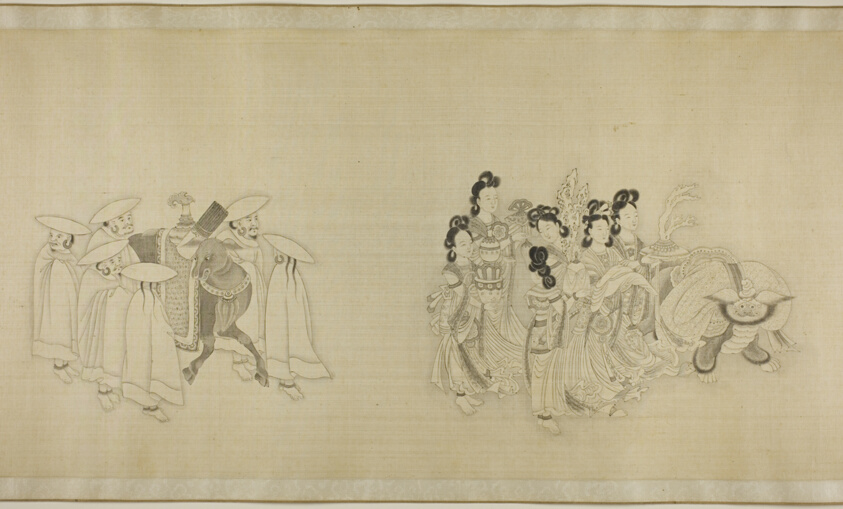
An Artefact of Diplomacy: Interpreting the Material Protocol of the Tribute Handscroll
To engage with this handscroll, Envoys Presenting Tribute, is to handle a masterclass in the articulation of power through material substance. It is, in essence, a sartorial document. The medium is not merely a support for the image; it is the foundational statement. The choice of silk—specifically, a finely woven, heavyweight silk of the highest lustre and tensile integrity—establishes the protocol before a single line of ink is considered. This is not paper. This is a ground that speaks of cultivation, of the silkworm’s meticulous labour, mirrored in the weaver’s craft, and ultimately, in the court’s own cultivated order. The surface possesses a slight, deliberate tooth, a characteristic that governs the behaviour of the ink, allowing for both the crispest delineation and the most atmospheric of washes. It is a surface that demands confidence from the artist’s hand; there is no room for hesitation or correction. Each stroke is a committed gesture, much like the precise cut of a shears through a length of superfine wool.
The Grammar of Line: Fluidity as a Political Instrument
The scroll’s narrative unfolds through a calligraphic line of unassailable elegance. This is where the principle of fluid elegance is most acutely observed. The line is not uniform; it is a breathing, dynamic entity. Observe the drapery of the envoy’s robes: the ink describes the heavy, structured silks of official regalia with a line of unwavering authority, the folds falling with a geometric precision that implies weight and statute. Contrast this with the rendering of distant landscapes or atmospheric haze, where the line dissolves into a soft, wet wash—a technique known as pomo—suggesting vastness and a certain poetic remove. The fluidity here is never careless. It is a controlled, expressive tool. The movement of the brush parallels the prescribed movement of the tribute ceremony itself: a series of deliberate, graceful, and highly formalized gestures. The elegance is in the restraint, in the exactitude of the flourish, not in its extravagance. It is the difference between a flamboyant necktie and a perfectly knotted, understated silk cravat—the latter speaks of a deeper, more assured language of sophistication.
Composition and Hierarchy: The Silent Theatre of the Court
The handscroll format is a deliberate narrative device, a continuous, unfolding theatre. One does not view it all at once; one experiences it through a ritualized, private unrolling, perhaps an arm’s length at a time. This controlled revelation is paramount. The composition is structured with the rhythmic pacing of a Savile Row fitting. The procession of envoys, each group representing a distinct, often remote territory, is arranged not as a chaotic crowd, but as a sequence of sartorial ensembles. There is a clear visual hierarchy. The central figures—the Emperor or his high ministers—are rendered with the most detailed brushwork, the most complex and symbolic patterning on their robes, positioned with the spatial dominance of a commanding peak lapel. The tributary envoys, while meticulously observed, are often shown in attitudes of deferential movement or presentation. The scroll itself becomes a spatial map of the known world, with the court as its immutable centre. The empty spaces—the “negative space” of the silk ground—are as crucial as the inked areas. They are not voids, but rather fields of implied authority, the silent resonance of power that needs no filling. It is the equivalent of the perfect amount of shirt cuff showing beneath a jacket sleeve: a calculated, elegant absence.
Materiality as Enduring Legacy
Ultimately, the artifact’s power resides in the enduring dialogue between its material components. The silk, with its inherent strength and luminosity, is a testament to an advanced, agrarian-based civilization. The ink, ground from pine soot and bound with animal glue, is pure carbon—one of the most stable, archival pigments known to man. The choice of this combination was not accidental; it was an investment in perpetuity. The handscroll was designed to be both an immediate instrument of state ideology and a lasting record for posterity. It is a physical manifesto, asserting that the civilization capable of producing such an object—from the cultivation of the silk worm to the sublime refinement of the brushwork—is a civilization worthy of the tribute it depicts. The fluid elegance captured in its scenes is presented as the natural, effortless outcome of a perfected cultural order.
To conclude, Envoys Presenting Tribute transcends mere pictorial representation. It is a consummate exercise in material rhetoric. Through the authoritative silk ground, the eloquent, fluid line, and the meticulously staged narrative of the handscroll format, it performs the very diplomacy it portrays. It articulates a world order where aesthetic refinement and political power are inextricably woven from the same thread, presenting a vision of empire that is as compelling in its artistry as it is assertive in its authority. It stands as a peerless example of how craft, in its highest form, becomes the most persuasive language of state.