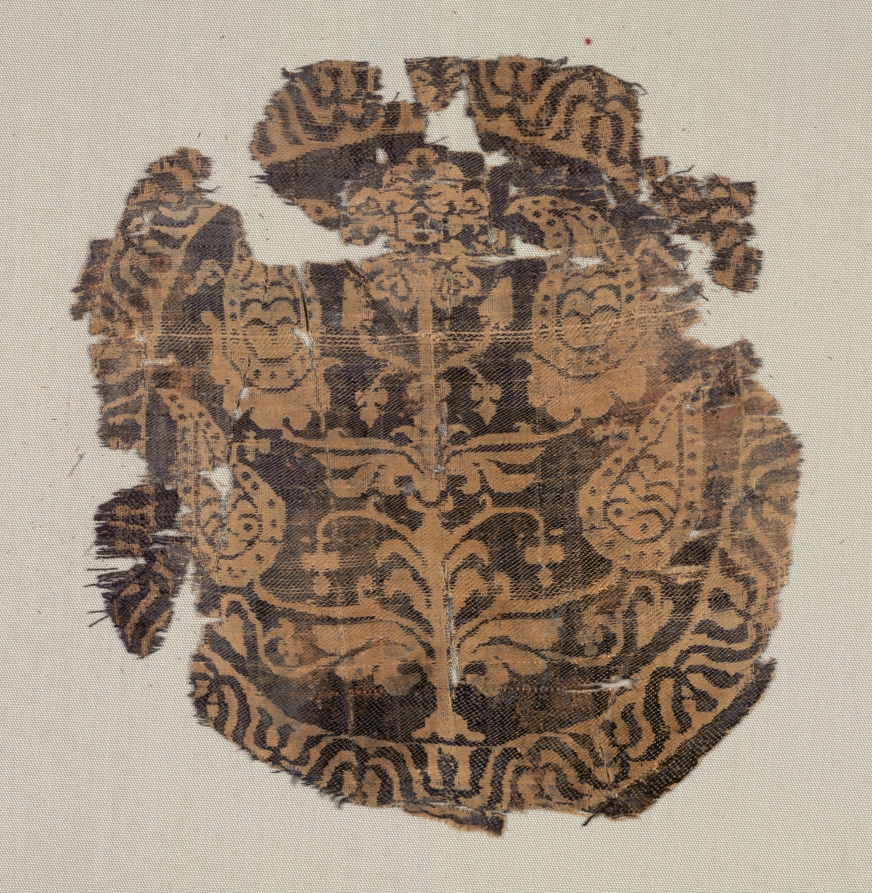
A Study in Imperial Silk: The Roundel with Curvilinear Palmette Tree
In the rarefied atmosphere of London’s Savile Row, where cloth is not merely fabric but biography, one learns to read the weave as a ledger of power, patronage, and precision. The object under examination—a roundel with a curvilinear palmette tree, once affixed to a tunic—is not a simple textile fragment. It is a surviving clause in the legal code of imperial aesthetics. To handle such a piece is to understand that silk, in its highest expression, was never a commodity. It was a statement of sovereignty, stitched with the patience of centuries.
Materiality and the Grammar of Luxury
The materiality of this roundel demands immediate respect. The silk is not the supple, fluid drape of modern haberdashery. This is a warp-faced compound weave, likely a samite or taquete structure, engineered for density and chromatic depth. The thread count is formidable; the weft threads are packed with a discipline that speaks to a loom master’s absolute control. The surface, though aged, retains a subtle lustre—not the brash shine of mercerised cotton, but the quiet, internal glow of sericin-rich filaments that have absorbed centuries of controlled humidity.
Consider the palette. The ground is a deep, oxblood madder—a colour achieved through repeated dyeings of madder root, mordanted with alum. Against this, the curvilinear palmette tree rises in a compound of ivory, faded gold, and a green that has mellowed to the tone of aged bronze. These are not accidental hues. In the imperial ateliers, colour was codified. The red signified earthly authority; the gold, celestial mandate; the green, renewal and the cyclical nature of dynastic rule. The silk itself, imported along the hazardous routes from the East, was a material more precious than bullion. To wear it was to wear a map of trade, conquest, and cultural exchange.
The Curvilinear Palmette: A Motif of Cosmic Order
The central motif—the curvilinear palmette tree—is where the design transcends decoration and enters philosophy. The palmette, a stylised fan of foliage derived from the sacred lotus and date palm, is rendered here not as a static emblem but as a living, breathing organism. The branches curve with an almost calligraphic fluency, each tendril terminating in a spiral that suggests both the unfurling of a fern and the cyclical return of seasons. This is not the rigid, geometric arabesque of later periods. This is a pre-Islamic and early Islamic synthesis, where Hellenistic naturalism meets Sasanian symmetry.
The tree form itself is a symbol of the axis mundi—the cosmic pillar connecting the earthly realm to the divine. In a tunic worn by a courtier or a high-ranking official, this roundel would have been positioned at the chest or the shoulder, effectively placing the wearer within that sacred vertical axis. The curvilinear nature of the design is crucial. Unlike the angular Kufic inscriptions that would dominate later textiles, these curves imply motion, growth, and the organic vitality of the empire itself. The symmetry is bilateral but not static; the eye is invited to travel up the trunk, along the branches, and into the infinite spiral of the palmette’s heart. It is a meditation in thread.
The Legacy of Imperial Silk Weaving
To contextualise this roundel is to understand the institutional machinery behind its creation. Imperial silk weaving was not a cottage industry. It was a state monopoly, managed by bureaucratic elites who oversaw every stage from silkworm cultivation to the final pass of the weaver’s shuttle. The looms were vast, horizontal drawlooms requiring a team of two—a master weaver below and a drawboy above, pulling the heddles according to a complex pattern notation. The margin for error was nil. A single snapped warp thread could ruin a panel that had taken months to prepare.
The legacy of this system is one of extraordinary continuity. The roundel’s design vocabulary—the pearl roundel border, the palmette tree, the symmetrical composition—can be traced from Sasanian Persia through Byzantine and Umayyad workshops. It is a testament to the fact that imperial power is often expressed through the slow, deliberate repetition of established forms. Innovation was not prized for its own sake. Instead, the weaver’s genius lay in the infinitesimal refinement of proportion, the subtle shift in colour balance, the perfect tension between the curvilinear and the geometric.
This particular roundel, likely from the late Sasanian or early Islamic period (circa 6th–8th century CE), represents the apex of that legacy. The silk is of a grade that would have been reserved for the *tiraz*—the royal textile workshops that produced garments for the caliph and his inner circle. The tunic it adorned would have been a garment of investiture, worn during ceremonial audiences or diplomatic receptions. The roundel was not merely decorative; it was a badge of office, a visual declaration that the wearer operated within the imperial gift-economy.
Conservation and the Modern Eye
From the perspective of a modern conservator or a discerning collector on Savile Row, this fragment offers a lesson in patience. The silk is brittle in places, the weft threads have a slight crush, and the colours have softened with age. Yet that is precisely its value. We are not looking at a pristine reproduction. We are looking at a document of use. The slight asymmetry in the left palmette branch suggests a moment of human error corrected by the weaver—a reminder that even imperial production was not machine-perfect. That imperfection is its authenticity.
For the contemporary designer, this roundel is a masterclass in the relationship between structure and ornament. The curvilinear palmette is not applied to the ground; it is woven into it, the two inseparable. This is the antithesis of modern printed textiles, where pattern sits on the surface like a veneer. Here, the pattern is the structure. The silk’s integrity depends on the design’s integrity. One cannot be removed without destroying the other.
Conclusion: A Thread Through Time
In the end, this roundel with its curvilinear palmette tree is a quiet monument. It speaks of looms that no longer exist, of dyers whose recipes are lost, of a political order that has long since dissolved into the sands of history. Yet the silk endures. It endures because it was made with an understanding that true luxury is not loud. It is precise. It is not fleeting. It is the result of a system that valued the slow accumulation of skill over the rapid gratification of novelty.
For those of us who work with cloth daily, this fragment is a benchmark. It reminds us that a garment is not a product. It is a record of the human hand, the imperial will, and the unbroken thread of cultural memory. To wear silk of this lineage is to wear history itself—cut, tailored, and finished with the respect it deserves.