Material Provenance and the Imperial Thread
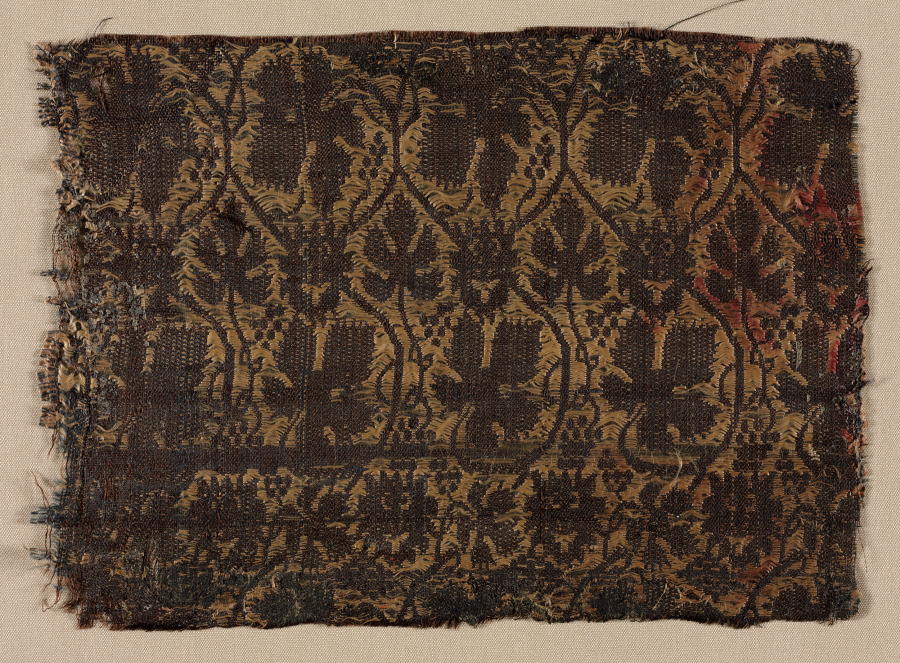
Within the hushed, wood-panelled ateliers of Savile Row, where the tape measure is a sceptre and the chalk mark a covenant, one learns to read cloth not merely as commodity, but as chronicle. The silk fragment before us—a mere palm’s breadth of woven light—demands a more rigorous interrogation than its modest dimensions might suggest. It is not simply a textile; it is a surviving leaf from the ledger of imperial ambition, a tangible residue of a supply chain that once girdled the known world. To handle such a piece is to hold a whisper of the Qing dynasty’s looms, a fragment whose every warp and weft is a testament to a system of production so exacting that it rendered the concept of ‘luxury’ into a state-sponsored discipline.
Materially, this is no ordinary mulberry silk. The filament’s lustre, that particular aqueous sheen that catches the light with a cool, almost metallic authority, speaks to a specific breed of silkworm—likely the *Bombyx mori* cultivated in the Hangzhou and Suzhou prefectures, regions whose output was reserved, under pain of severe sanction, for the Imperial Household. The denier of the thread is remarkably consistent, a uniformity achieved not by modern machinery but by the obsessive hand-selection of cocoons, each one boiled and reeled in a single, unbroken filament that could extend for nearly a kilometre. This is the first lesson of imperial silk: perfection was not an aspiration but a bureaucratic requirement. The fragment’s weave structure, a tightly packed satin ground, reveals a technical mastery that predates the Jacquard loom by centuries. The absence of any discernible slub or irregularity in the yarn suggests the use of a ‘re-reeled’ thread, a double-twist process that imparted a tensile strength and a surface smoothness that modern, chemically softened silks rarely achieve. It is a material engineered for permanence, not for the fleeting whims of fashion.
The Grammar of Imperial Weaving
Context is the loom on which meaning is woven. To view this fragment solely as a piece of fabric is to ignore its political and cosmological DNA. The legacy of imperial silk weaving is not a story of craft alone; it is a narrative of control. From the Han dynasty’s establishment of the Silk Road to the Ming and Qing dynasties’ centralised *Jiangnan* weaving bureaus, silk was the empire’s most potent currency—both economic and symbolic. This fragment, likely a remnant of a larger bolt destined for a ceremonial robe or a court hanging, would have been produced under the aegis of the Imperial Textile Factory in Nanjing or Suzhou. These were not mere workshops; they were vast, state-run manufactories employing thousands of artisans, each confined to a single, hyper-specialised task—one man might spend his entire life tying the intricate knots of a single pattern repeat, another solely responsible for the tension of the warp beam.
The design language embedded in the fragment, though partially obscured by its cutting, is telling. The presence of a subtle, undulating cloud scroll—a *xiangyun* motif—rendered in a slightly raised, supplementary weft, indicates a piece destined for high-ranking court use. The cloud was not merely decorative; it symbolised cosmic energy, good fortune, and the emperor’s role as the intermediary between heaven and earth. The colour, a deep, resonant indigo that has faded to a dignified twilight blue, is equally significant. In the imperial chromatic hierarchy, blue held a position of considerable gravitas, often associated with the heavens and worn by officials of the third rank or above. This was not a colour one purchased; it was a colour one earned. The dye itself, derived from indigofera plants, was a complex, fermentative process that required weeks of careful tending, a chemical alchemy that imbued the fibre with a depth of tone that synthetic dyes cannot replicate. The fragment’s edge, where the selvedge has been cleanly cut, reveals a careful, almost surgical removal—suggesting it was excised from a larger garment or hanging, perhaps repurposed, a common practice in an era where cloth was a store of wealth.
An Enduring Standard of Quality
For the modern practitioner on Savile Row, this fragment offers a profound, if silent, rebuke to the age of disposable fashion. The imperial silk weaver’s obsession with structural integrity—the tight twist of the yarn, the density of the sett, the refusal to cut corners—finds a direct parallel in the construction of a bespoke suit. We speak of a ‘floating’ canvas, of hand-picked armholes, of a lapel that rolls with a natural, unforced grace. These are not affectations; they are engineering principles designed to ensure that the garment improves with age, that it moulds to the wearer’s form and endures for decades. The imperial weaver understood this intrinsically. A silk robe was not a seasonal purchase; it was an heirloom, a piece of portable architecture designed to convey status and to outlast its owner. The fragment’s resilience—its ability to survive centuries of storage, conflict, and neglect—is a testament to the integrity of its construction. It has not rotted or become brittle; it has simply settled into a quieter, more contemplative state.
Moreover, this fragment challenges our contemporary understanding of ‘finish’. The lustre we admire today is often achieved through chemical weighting—the addition of metallic salts to increase drape and sheen, a process that ultimately degrades the fibre. The imperial silk’s glow is intrinsic, a product of the triangular prismatic structure of the fibroin protein itself. It is a finish born of biology and meticulous reeling, not of industrial intervention. To touch it is to feel the difference between a surface that has been polished and a surface that has been grown. In this, it aligns perfectly with the Savile Row ethos of *truth to material*—the belief that the cloth should be allowed to be what it is, at its best, without artificial enhancement. The weaver’s art was to reveal the silk’s innate nobility, not to mask it.
In conclusion, this silk fragment is more than an archaeological curiosity. It is a benchmark. It stands as a silent, rigorous audit of our own standards. It asks us, as custodians of craft, whether we are merely making clothes or whether we are, in the imperial sense, weaving legacies. The answer, for those who have learned to listen to the cloth, is found not in the noise of the market, but in the quiet, unyielding integrity of a single, perfect thread.