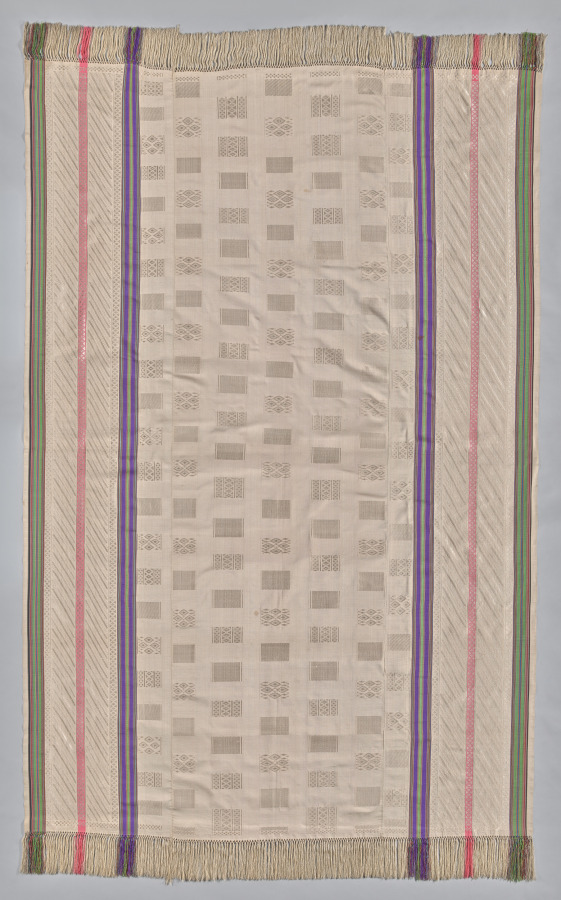
The Wrapper (Lamba Akotifahana): A Study in Imperial Silk Weaving
Introduction: The Fabric of Sovereignty
In the rarefied atmosphere of London’s Savile Row, where tailoring is elevated to an exact science and an art form, one learns to read cloth as a language. The cut of a lapel, the fall of a shoulder—these are but punctuation marks. The true narrative lies in the weave itself. It is with this discerning eye that we approach the Lamba Akotifahana, a ceremonial wrapper from Madagascar, whose materiality is unequivocally silk. This is not merely a garment; it is a document of imperial ambition, a testament to the global circulation of luxury, and a masterclass in the politics of textile production. To understand this wrapper is to understand how a single thread of silk could bind an island kingdom to the wider world, and how a weaver’s loom became a stage for sovereign power.
Materiality and Provenance: The Silk Road to the Indian Ocean
The Lamba Akotifahana is distinguished by its primary fibre: silk. Yet, this is not the domesticated mulberry silk (*Bombyx mori*) of Chinese origin that dominates the European imagination. The finest examples of this wrapper, particularly those from the imperial Merina court of the 19th century, were often woven from wild silk—specifically, the cocoons of the *Borocera madagascariensis* moth, endemic to the island. This indigenous silk, known locally as *landibe*, possesses a unique, slightly coarse, and remarkably lustrous character. It is a material of place, a fibre that carries the very ecology of the highlands within its structure.
However, the imperial context complicates this simple provenance. As the Merina monarchy consolidated power, their demand for prestige goods outstripped local supply. Consequently, the finest *Akotifahana* wrappers began to incorporate imported Chinese silk threads, traded through the Indian Ocean networks that connected Madagascar to the Arabian Peninsula, India, and the Far East. This hybrid materiality is crucial. The wrapper is not a pure, isolated artifact; it is a composite of local resource and global commerce. The weaver’s choice of thread—whether the rugged *landibe* or the finer, imported filament—was a deliberate act, a statement of access to both the ancestral land and the wider world. In this sense, the materiality of the wrapper is a geopolitical statement woven into a wearable form.
Imperial Legacy: The Loom as a Courtly Instrument
The legacy of imperial silk weaving in Madagascar is inextricably linked to the court of Queen Ranavalona I (reigned 1828–1861) and her successors. Under their patronage, the production of the Lamba Akotifahana was transformed from a regional craft into a state-sponsored industry. The Merina court established dedicated weaving workshops, often staffed by skilled artisans who were effectively retained by the crown. This was not a cottage industry; it was a royal manufactory, operating with the same strategic intent as the Gobelins tapestry works in France or the silk mills of Spitalfields under royal charter.
The imperial legacy is most visible in the wrapper’s iconography. The *Akotifahana* is distinguished by its intricate, geometric patterns and its use of supplementary weft floats to create a raised, brocade-like texture. These motifs are not merely decorative. The soamandritsy (the central diamond or lozenge pattern) is a symbol of royal authority and the cosmic order. Other patterns, such as the *vato misy*, reference the stone walls of the Rova (the royal palace complex) in Antananarivo. To wear such a wrapper was to literally carry the architecture and ideology of the state upon one’s shoulders. The silk, whether local or imported, was the medium through which this political theology was rendered tangible. The cloth was a form of soft power, a visual assertion of the monarchy’s divine right and its command over both natural resources and international trade.
Technical Mastery: The Weave of Authority
From a technical standpoint, the construction of a *Lamba Akotifahana* is a feat of extraordinary patience and precision. The warp-faced weave structure, often a variant of a weft-float brocade, requires the weaver to manipulate each supplementary weft thread individually, often over hundreds of warp ends. The result is a fabric that is simultaneously supple and structured, with a tactile surface that invites touch. The raised patterns, often in contrasting colours—indigo, madder red, and natural ivory—create a play of light and shadow that is reminiscent of the finest European damasks.
Yet, unlike the symmetrical, repeat patterns of European silks, the *Akotifahana* often exhibits a directional asymmetry. The primary motif is frequently positioned off-centre, or the border patterns will shift in scale. This is not a flaw; it is a deliberate design philosophy. It reflects a worldview that values the dynamic and the specific over the static and the universal. In the context of the imperial court, this asymmetry served to individualise each garment, ensuring that no two wrappers were identical. This was a crucial distinction: a nobleman’s wrapper was not a uniform but a bespoke commission, tailored to his status and lineage. The weaver, therefore, acted as a couturier, interpreting the client’s social position through the language of silk and thread.
Conservation and Contemporary Relevance
Today, the *Lamba Akotifahana* is a rare and highly prized artifact in museum collections, from the Musée du Quai Branly in Paris to the British Museum in London. Their conservation presents significant challenges. The wild silk is particularly susceptible to light damage and desiccation, requiring careful environmental control. The raised weft floats are also prone to snagging, demanding that the garments be stored flat, on padded supports, to preserve their three-dimensional integrity.
For the modern scholar and connoisseur, the wrapper offers a profound lesson in the anthropology of luxury. It demonstrates that silk is not a monolithic material but a spectrum of possibilities, each with its own cultural and economic biography. The *Lamba Akotifahana* challenges the Eurocentric narrative of silk as a purely Chinese or European commodity. Here, we see a distinct, indigenous tradition of silk weaving that was both inspired by and competitive with global influences. The imperial court of Madagascar did not simply import silk culture; they indigenised it, creating a unique aesthetic that was both deeply local and resolutely cosmopolitan.
Conclusion: A Bespoke Legacy
In closing, the Wrapper (Lamba Akotifahana) stands as a singular achievement in the history of textile arts. Its materiality—the specific qualities of wild and imported silk—is inseparable from its political and social function. It is a garment that was designed to be read, to be decoded by those who understood the subtle grammar of its patterns and the prestige of its fibres. Like a bespoke suit from a master tailor, it was cut and woven not for a generic body, but for a specific individual within a complex hierarchy. The imperial legacy of silk weaving in Madagascar is not merely a historical footnote; it is a living testament to the power of cloth to encode power, to negotiate identity, and to endure as a silent, eloquent witness to a lost kingdom. The thread, once spun, continues to speak.