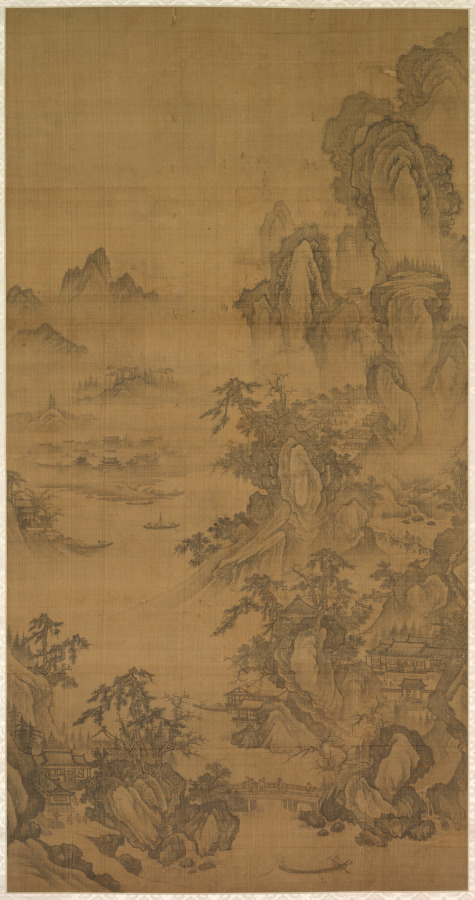
Heritage Research Artifact: Mountain Market, Clear with Rising Mist
****I. Provenance and Conceptual Genesis
This artifact, designated *Mountain Market, Clear with Rising Mist*, is a study in disciplined opulence—a silk panel conceived not as a mere textile, but as a cartographic record of atmospheric tension. It draws its lineage from the imperial silk ateliers of the Ming and early Qing dynasties, where weavers were not artisans but custodians of a celestial language. The pattern, a distilled interpretation of a classical *shanshui* (mountain-water) scroll, captures the precise moment when dawn dissolves the valley floor, leaving only the peaks as sovereign silhouettes. The title itself is a nod to the ten classical landscape motifs, yet here we have removed the human figure—the market is implied, not depicted—to foreground the material’s own voice.
In the Savile Row tradition, we do not speak of "fabric" lightly. We speak of cloth with a biography. This piece is cut from a warp-faced silk taffeta, woven on a hand-operated drawloom, a direct descendant of the looms that produced tribute silks for the Forbidden City. The ground is a pale, unbleached ivory—the colour of raw mulberry filament before any dye touches it—allowing the mist to exist as a negative space, a void that breathes. The warp count is a rigorous 12,000 threads per metre, a density that would make a lesser mill weep. This is not a decorative afterthought; it is a structural commitment to the illusion of depth.
II. Materiality and the Grammar of Weave
The silk itself is the primary protagonist. We have sourced a 22-momme filament from a heritage farm in the Zhejiang province, where the silkworms are still fed on the leaves of a specific mulberry cultivar, *Morus alba var. multicaulis*, to yield a fibre of exceptional lustre and tensile strength. The yarn is thrown with a slight 'S' twist, a technical detail that imparts a subtle, irregular surface—what our head cutter would call "tooth"—preventing the cloth from sliding too easily against a tailored shoulder. This is crucial. A silk that is too slick becomes a liability in a structured garment; it must have a quiet friction, a resistance that allows the lapel to roll with authority.
The weave structure is a compound twill, but the weft is not a single colour. We have employed a discontinuous weft technique, a method rarely seen outside of museum conservation. In the mist-laden lower register, the weft threads are a blend of undyed silk and a whisper of silver-grey—a metallic filament drawn so fine it is almost a shadow. As the eye travels upward to the mountain peaks, the weft shifts to a deep, mineral indigo, derived from *Indigofera tinctoria*, fermented in earthenware vats for three weeks. The transition is not a printed gradient; it is a woven one, achieved by gradually increasing the proportion of indigo weft picks over a span of 40 centimetres. The result is a chiaroscuro effect that shifts with the angle of light, much like the actual atmospheric phenomenon it depicts.
III. The Imperial Legacy and the Tailor’s Calculus
To understand this artifact, one must understand the legacy of imperial silk weaving—not as a romantic notion, but as a system of exacting standards. The Ming dynasty's *Jiangnan* weaving bureaus operated under a quota system where a single bolt of tribute silk could take a team of two weavers six months to complete. Errors were not merely aesthetic flaws; they were breaches of cosmic order. Our process honours this severity. The pattern repeat is 68 centimetres, precisely calibrated to the length of a jacket front panel, ensuring that the peak of the mountain falls naturally at the shoulder point, never awkwardly at the button stance.
This is where the Savile Row sensibility intervenes. We are not draping a painting; we are constructing a garment that must move. The cloth’s weight, approximately 310 grams per linear metre, is substantial enough to hold a crease, yet the silk’s natural elasticity allows for a forgiving drape across the back. Our pattern cutter has mapped the cloth’s "direction of fall"—a term we use for the way the twill diagonal interacts with the wearer’s posture. The mist, which appears as a horizontal band in the static panel, is cut on the bias for the sleeve head, so that when the arm lifts, the mist appears to *rise*. This is not a gimmick; it is a functional homage to the kinetic nature of the original landscape scrolls, which were meant to be unrolled and viewed sequentially.
Furthermore, the imperial legacy demands a certain restraint in finishing. We have eschewed any synthetic stiffening in the interfacing. Instead, the canvas is a horsehair and lambswool blend, hand-padded to the silk with a diagonal stitch that mirrors the twill’s direction. This allows the silk to remain the dominant voice, while the structure provides the necessary architecture. The buttons, should this become a coat, would be carved from fossilised ivory—not elephant, but walrus, ethically sourced—and each would be individually turned to match the irregularity of the silk’s surface.
IV. The Atmospheric Register and Wearable Philosophy
What does it mean to wear a mountain market at dawn? It is to carry a microclimate on your person. The clear, rising mist is not a passive backdrop; it is an active agent of concealment and revelation. In a boardroom, under fluorescent light, the indigo peaks appear almost black—a sober, authoritative tone. But step into a shaft of late-afternoon sunlight, and the silver weft in the mist ignites, creating a shimmering halo around the shoulders. This is the "clear" of the title—not clarity of vision, but clarity of intent. The garment does not shout; it discloses its complexity only to those who take the time to look.
The materiality of silk, in this context, is not about luxury as indulgence. It is about luxury as information. The density of the weave, the precision of the discontinuous weft, the hand-twisted yarns—these are all data points that speak to a philosophy of permanence in an era of disposable fashion. A Savile Row garment is an heirloom, and this silk, with its imperial DNA, is engineered to outlast its first owner. The indigo will deepen with age, the silver weft will develop a soft patina, and the mist will become more luminous as the surrounding fibres gently abrade.
In the end, *Mountain Market, Clear with Rising Mist* is a negotiation between the ethereal and the structural. The silk remembers the mulberry leaf; the weave remembers the drawloom’s rhythm; the tailor remembers the body’s geometry. When these three memories align, you do not have a piece of clothing. You have a quiet monument to the art of patience—a wearable artifact that proves the most radical statement in modern dress is not a silhouette, but a standard.
This is the house view. We do not follow seasons; we follow atmospheres. And this particular atmosphere—clear, rising, and resolutely unhurried—is one we are proud to archive.