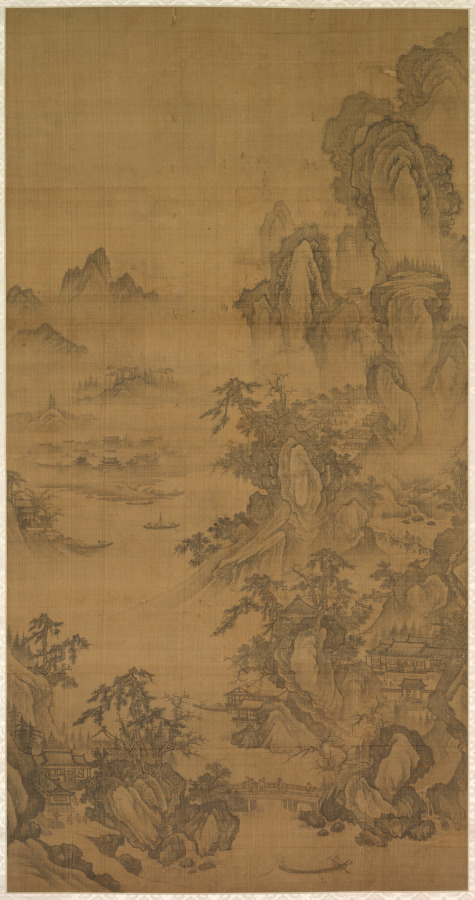
Heritage Research Artifact: Mountain Market, Clear with Rising Mist
In the rarefied atmosphere of London’s Savile Row, where cloth is not merely measured but interpreted, we approach the subject of ‘Mountain Market, Clear with Rising Mist’ with the gravity reserved for a bespoke commission. This is not a print. It is a provenance. The silk before us—a lustrous, weighty twill that falls with the deliberate drape of a well-cut morning coat—carries the memory of dynastic looms and the disciplined hand of the imperial weaver. To understand this artifact is to read a ledger of craftsmanship that predates the modern atelier by centuries.
I. The Material Legacy: Imperial Silk and the Discipline of the Loom
The legacy of imperial silk weaving is one of exacting standards, of a system where the thread itself was a currency of power. For over two millennia, the imperial workshops of China—particularly those of the Ming and Qing dynasties—operated under a mandate of perfection. The mulberry leaves, the silkworm’s cocoon, the reeling of the filament: every stage was supervised by eunuch-officials who reported directly to the throne. This was not art for art’s sake; it was a political and cosmological statement. Silk was the medium through which the Emperor’s mandate to heaven was rendered visible, a textile that carried the weight of state ritual, diplomatic gift, and personal regalia.
For the Savile Row cutter, this context is paramount. The silk we handle today is not a mere derivative of that ancient craft; it is its direct descendant. The twill weave—a diagonal rib that provides both structure and a subtle, shifting sheen—is a technical echo of the robust silks used for court robes. The density of the fabric, its ‘hand’ as we say on the Row, speaks to a reeling process that has remained unchanged in its fundamentals. We are not working with a flimsy, decorative charmeuse. We are working with a cloth that possesses a backbone, a cloth that can be tailored, pressed, and structured to hold a lapel’s roll or a trouser’s crease. The imperial legacy is one of utility disguised as opulence, and this silk honours that paradox.
II. Reading the Scene: Mountain Market, Clear with Rising Mist
The subject matter—a mountain market enveloped in the clarity of dawn’s rising mist—is a classic motif of the literati painting tradition, yet its translation into silk for the Western wardrobe demands a particular hermeneutic. We are not looking at a literal landscape. We are looking at a mood, a moment of atmospheric equilibrium. The ‘mountain market’ suggests commerce, human industry, and the gathering of goods—a fitting metaphor for the trade itself. The ‘clear with rising mist’ is the counterpoint: the moment of revelation, when the fog lifts to reveal the sharp contours of the peaks.
In the hands of a Savile Row designer, this scene is reduced to its essential geometry. The mist is not rendered as a cloud but as a negative space, an area of lighter tonal value that allows the silk’s natural luminosity to breathe. The mountain is a dark, structured mass—perhaps a deep indigo or a charcoal—that grounds the garment. The ‘market’ becomes a subtle pattern of small, repeated motifs: a stylised stall, a gabled roof, the suggestion of a path. These are not pictorial illustrations but abstracted glyphs, woven with the precision of a pinstripe. The effect is one of controlled narrative. From a distance, the cloth reads as a solid, elegant colour. Upon closer inspection, the wearer and the observer are rewarded with a hidden topography, a secret landscape that only reveals itself at conversational distance. This is the essence of understated luxury—a story told in thread, not in shout.
III. The Tailoring Imperative: Structure, Drape, and the Modern Silhouette
Our role at Lauren Fashion Heritage Lab is not merely to preserve but to re-contextualise. The imperial silk was designed for the voluminous, layered robes of the court. Our task is to adapt its inherent properties to the disciplined architecture of the Western suit. The twill’s diagonal structure provides a natural resistance to wrinkling, making it a superior choice for a travel jacket or a summer suit. Its weight—substantial but not heavy—allows for a clean, sharp shoulder line without the need for excessive padding. The cloth should be cut with a slightly softer shoulder, allowing the silk to fall naturally from the collarbone, mimicking the way the mist settles on the mountain ridge.
Consider the garment’s construction. A three-roll-two jacket, with a soft, natural shoulder and a suppressed waist, would honour the fabric’s fluidity. The lapel should be a notch, but cut with a longer, straighter gorge to elongate the torso—a subtle nod to the verticality of the mountain pines. The lining, if any, should be a contrasting silk, perhaps a pale celadon or a muted vermillion, offering a private flash of colour when the jacket is removed. The trousers should be cut with a full, straight leg, allowing the silk to move with the body, never clinging. This is not a cloth for a skinny, restrictive fit. It demands a certain ease, a confidence that comes from knowing the garment is a partner, not a cage.
IV. The Modern Patron: Wearing History with Discretion
The modern patron of this silk is not a costumed re-enactor. They are an individual of discerning taste, someone who understands that true heritage is not about looking backwards but about carrying forward the best of the past into a functional present. They do not require a visible dragon or phoenix to announce their appreciation for Chinese culture. Instead, they choose a cloth that whispers of imperial workshops through its texture, its drape, and its subtle narrative. The ‘Mountain Market’ pattern is a conversation piece for those who know to look, a quiet signal of erudition and global awareness.
This artifact, therefore, is a bridge. It connects the disciplined looms of the Forbidden City to the measuring tapes of Savile Row. It translates the philosophy of the scholar-painter—who sought to capture the ‘spirit resonance’ (qiyun) of a scene—into the language of the tailor, who seeks to capture the spirit resonance of the human form. The rising mist is the breath of the cloth; the clear mountain is its structure. In wearing this silk, one does not merely wear a garment. One wears a curated moment of clarity, a piece of history that has been cut, sewn, and finished to the exacting standards of the world’s most demanding street. It is, in the final analysis, a bespoke meditation on permanence and change, delivered in a fabric that has outlasted empires and will, with proper care, outlast us all. That is the true measure of heritage. That is the commission we accept.