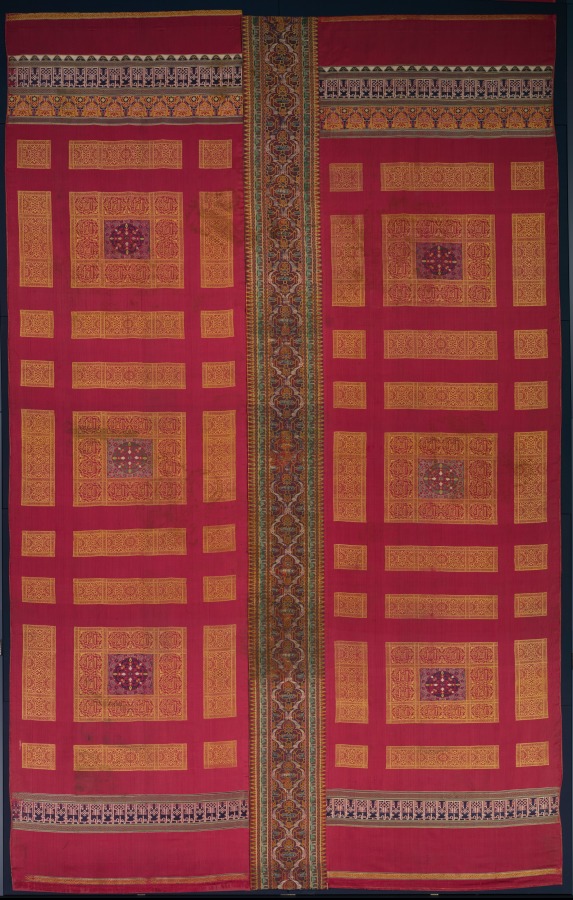
The Alhambra Silk Curtain: A Study in Imperial Thread and Architectural Echo
In the hushed, wood-panelled ateliers of Savile Row, where a tape measure is a sceptre and a basted seam a promise, we speak of cloth as biography. We read a lapel for its drape, a shoulder for its conviction. But rarely do we encounter a textile that speaks not of a single client, but of an entire civilisation’s ambition. Such is the case with the silk curtain from the Alhambra, a fragment of woven light that is less a furnishing and more a frozen decree of empire. To handle its surviving remnants—even through the glass of a museum vitrine—is to feel the pulse of a dynasty that clothed its power in the most delicate of armours.
The materiality is, of course, the first point of interrogation. This is not the crisp, dry silk of a summer tie, nor the lustrous, heavy faille of an evening coat. This is a silk of architectural intent. Its weave is a dense, compound structure—often a lampas or a samite—where the warp and weft interlock with the precision of a mason’s keystone. The yarn itself, reeled from the cocoons of *Bombyx mori*, was cultivated in the *al-Andalus* hinterlands, where the irrigation systems, a Roman inheritance refined by Arab hydrology, created a micro-climate of unparalleled mulberry fertility. The result is a filament of extraordinary tensile strength and a surface that catches light not with a brash gleam, but with a deep, internal glow, akin to the polished plaster of the palace walls themselves. One does not look at this silk; one looks into it, as one looks into the reflective pools of the Court of the Lions.
The Loom as a Legislative Body
To understand this curtain, we must abandon the notion of a solitary artisan. The Nasrid royal *tiraz* workshops—state-run manufactories that predate the great European guilds—were not places of quaint craft. They were instruments of statecraft. The loom, often a drawloom requiring a master and two apprentices, was a machine of encoded power. The patterns woven into the silk are not mere ornament; they are a heraldic language. The repeated epigraphic bands, rendered in a flowing, cursive *naskh* or a more angular *kufic*, are not decorative borders. They are the dynasty’s motto—"Wa la ghalib illa Allah" (There is no victor but God)—woven into the very infrastructure of the object. This is not a slogan; it is a constitutional text, integrated into the domestic sphere with the same gravity that a Savile Row cutter integrates a client’s initials into a pocket lining, but with infinitely higher stakes.
The imperial legacy of silk weaving, of which this curtain is a crowning artifact, is a story of monopolies and migration. The Byzantines guarded their sericulture with a ferocity that borders on the paranoid. The Arabs, through the expansion of the Caliphate, broke that monopoly, carrying the technology westward across North Africa and into Iberia. By the 13th and 14th centuries, the Nasrid Kingdom of Granada was not merely a consumer of luxury; it was a primary producer, a powerhouse whose silks were the hard currency of Mediterranean diplomacy. To receive a bolt of Alhambra silk was to receive a share of the state’s fiscal and spiritual capital. The curtain, therefore, was not simply a hanging to keep out the draught of a Sierra Nevada evening. It was a piece of the crown, a portable fragment of the palace’s sovereignty, designed to be seen by ambassadors, scholars, and poets who would carry its reputation across the known world.
An Architecture of Fabric
The visual language of the curtain is a direct translation of the palace’s stucco and tile work. The same geometric star patterns, the same interlacing polygons that generate infinite complexity from finite shapes, are here rendered in silk. The palette—a deep, madder red, a lapis blue, a gold of un-tarnished thread—mirrors the chromatic harmony of the *alicatado* tiles. This is a deliberate, sophisticated design philosophy. The Alhambra was conceived as a terrestrial paradise, a *jannah* on earth, where water, light, and vegetation were orchestrated into a symphony of sensory delight. The silk curtain was the final movement. It softened the hard geometry of the architecture, introducing a fluid, kinetic element that responded to the movement of air and the flicker of oil lamps. When drawn, it would have transformed a stark, ceremonial hall into a space of intimate, almost confidential, luxury. The rustle of the silk was the whisper of the court.
Consider the technical mastery required. To weave a curtain of this scale—likely several metres in length and width—with such a high density of warp threads (often exceeding 100 threads per centimetre) demands a level of patience and precision that is almost inconceivable to the modern, accelerated sensibility. The weaver was not merely a technician; he was a mathematician, a calligrapher, and a colourist. The pattern had to be perfectly aligned across the vertical seams, a feat achieved through meticulous counting and a system of pattern cords that prefigured the punch-card programming of the Jacquard loom by half a millennium. The curtain is, in essence, an early piece of software, a physical program that dictates the visual output of a complex mechanical system.
The Tailor’s Postscript
For us, on Savile Row, the lesson is one of permanence versus ephemerality. We cut cloth that will last a generation, yet we know it will eventually fray. This silk, however, was designed for eternity, or at least for the eternity of a dynasty’s memory. It was not made to be worn against the skin, but to be worn against the soul of a place. Its legacy is not in the fashion plates of history, but in the very DNA of Western textile production. When the Christian kingdoms of Spain conquered Granada in 1492, they did not destroy the workshops. They inherited them, and the techniques of the Nasrid weavers—the compound weaves, the metallic threads, the epigraphic borders—were absorbed into the nascent luxury industries of Italy and France. The silk curtain of the Alhambra is not a dead relic; it is a living ancestor. Its ghost haunts the velvet of a French court train, the brocade of a Victorian drawing room, and, in a quieter way, the rigorous, structural integrity of a well-made English suit. It reminds us that true luxury is never a fleeting whim. It is the tangible expression of a civilisation’s highest aspirations, woven one thread at a time, with the patience of a saint and the precision of a sovereign.
The curtain endures, not as a fragment of the past, but as a standard against which we measure the ambition of our own cloth. It is a benchmark of what happens when power, faith, and artistry are cut from the same bolt.