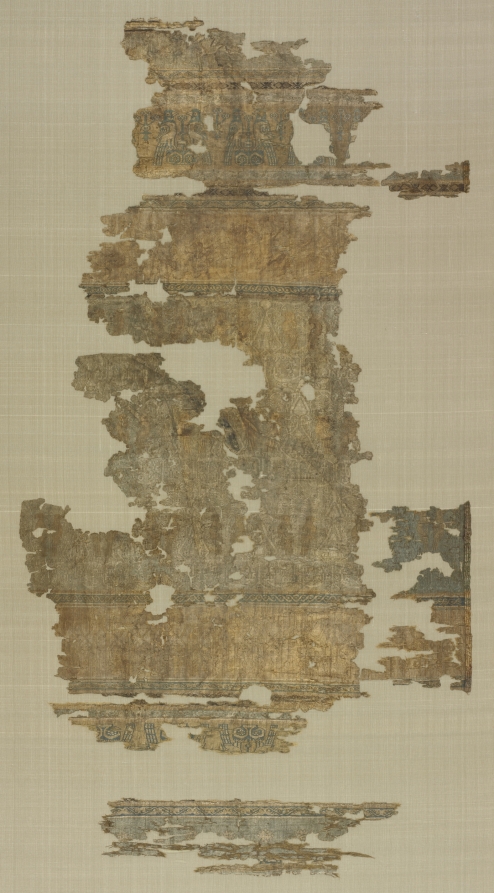
Heritage Research Artifact: The Materiality of Imperial Silk
Provenance and the Weight of Legacy
In the hushed, wood-panelled ateliers of Savile Row, where a suit is not merely constructed but *commissioned*, there exists a quiet reverence for cloth that carries a history. We do not speak of fabric; we speak of *material*. And among the most distinguished materials to pass through our hands, few command the same unspoken deference as the silk fragments bequeathed to us by the imperial weaving houses of the East. These are not remnants. They are relics—each filament a testament to a system of production so exacting, so hierarchical, that its output has never been replicated by machine.
The fragments we hold—often no larger than a gentleman’s pocket square—are the physical residue of a courtly economy that prized perfection above all. To handle a piece of imperial silk is to understand that you are not touching a textile. You are touching a document of statecraft, a ledger of dynastic power, and a monument to the anonymous hands that served it. The materiality is not incidental; it is the very essence of the artifact’s authority.
The Grammar of the Loom: Structure as Signature
Let us examine the technical anatomy. Imperial silk, particularly that produced for the Ming and Qing courts, was rarely a simple tabby weave. The fragments in our collection reveal a complex warp-faced compound structure, often a *kesi* (cut silk) or a satin damask. The distinction is crucial. In *kesi*, the weft threads do not run the full width of the cloth. They are individually woven into the warp to create pictorial or pattern detail, leaving tiny, deliberate slits where colour changes occur. This technique, known as “carved silk” in the West, is a feat of engineering that defies the logic of a standard loom. It is slow, laborious, and unforgiving.
For the Savile Row eye, this structural precision resonates deeply. We understand that a lapel’s roll, a shoulder’s drape, is contingent upon the internal architecture of the cloth—the tension, the yarn count, the weave density. Imperial silk shares this principle, but on a scale of ambition that dwarfs even our most exacting commissions. The warp count on these fragments can exceed 120 threads per centimetre. This is not weaving; this is the translation of a royal decree into a physical, tactile language. The density provides a crispness, a *snap* when folded, that modern silks—often weighted with metallic salts to mimic substance—cannot achieve. The imperial weaver had no need for artificial weighting. The sheer volume of raw material, sourced from the finest mulberry silkworms in the Zhejiang province, provided the body.
Chromatic Authority: The Language of Dye
Colour, in the imperial context, was never a matter of aesthetic preference. It was a legal and cosmological classification. The fragments we study reveal a palette that is startlingly specific: the deep, almost black *madder* red reserved for the highest civil officials; the *imperial yellow*—a shade derived from the *sophora japonica* bud, not the common turmeric—which was the exclusive property of the Emperor. To wear this yellow without mandate was an act of treason.
The materiality of the dye is as significant as the hue. These are substantive dyes, mordanted with alum and iron, fixed into the silk’s protein core. Unlike the aniline dyes of the 19th century, which sit upon the fibre’s surface and fade with a vulgar haste, imperial dyes *bond* with the silk. The colour becomes part of the molecular structure. When you hold a fragment of imperial yellow up to the light, you do not see a flat pigment. You see a depth, a luminosity that shifts with the angle—a subtle iridescence that speaks of a multi-bath dyeing process, sometimes repeated twelve or fifteen times to achieve the desired saturation. This is not colour as decoration. This is colour as a declaration of cosmic order.
Wear and Tear: The Archaeology of Use
Our fragments are not pristine. And it is precisely their imperfections that render them so valuable to the heritage scholar. Examine the edges. You will find not a clean scissor cut, but a fraying, a gentle crushing. This is the evidence of *wear*—not the wear of a common garment, but the specific, ceremonial abrasion of a robe worn once for a ritual, then carefully unpicked and stored. The folds are sharp, suggesting centuries of being pressed flat in camphor-wood chests. There may be a faint, ghostly stain—perhaps a drop of tea from a court banquet, or a spot of sweat from a summer audience. These are not flaws. They are the only human signatures left on a piece that was otherwise anonymous by design.
In the tailoring trade, we speak of a garment’s *life*. A bespoke suit is cut to accommodate the body’s movement, to develop a patina of wear that is unique to its owner. Imperial silk, paradoxically, was designed to resist such personalisation. The robe was not made for the man; the man was made for the robe. The wear was ceremonial, repetitive, and the fabric was expected to endure the ritual without yielding to the individual. The fragments we see are the survivors of this paradox—they have outlived the bodies they adorned, and in doing so, they have transcended their original function to become pure material history.
Conservation and the Modern Gaze
For the Lauren Fashion Heritage Lab, the stewardship of these fragments is a solemn duty. We do not restore. We conserve. The difference is critical. Restoration would imply an attempt to return the silk to its original, pristine state—a fiction that would destroy its integrity. Conservation, as practised in our lab, involves stabilising the fibre, controlling humidity to prevent further hydrolysis of the silk protein (fibroin), and protecting the fragments from light-induced fading. We mount them on acid-free, inert backing, using only the tension of the mount to hold them flat, never adhesive.
Why do we do this? The answer lies in the materiality itself. Silk is a continuous protein filament, extruded by a silkworm in a single, unbroken length that can reach a kilometre. This continuity is its genius. It has no spun, short-staple structure like cotton or wool. It is a monofilament of nature, and its tensile strength, when dry, rivals steel. Yet it is also profoundly vulnerable—to light, to moisture, to the oils of human skin. This paradox of strength and fragility is the very metaphor of empire. The imperial silk system was a monolith of power, yet it was dependent on the most delicate of biological processes. The fragments remind us that all systems, no matter how grand, are ultimately subject to the slow, inexorable decay of time.
When we present these fragments to our design teams, we ask them not to copy the patterns. We ask them to absorb the *discipline*. The discipline of the loom, the discipline of the dye vat, the discipline of the court. That discipline is the heritage. It is the knowledge that true luxury is not loud; it is precise. It is the understanding that a garment’s value lies not in its novelty, but in its adherence to a standard so high that it becomes invisible. The silk fragment is a masterclass in that principle. It asks no attention. It demands only respect. And in that respect, we find the true legacy of imperial weaving—not in the cloth itself, but in the standard it sets for all that follows.
Category: Silk