← BACK TO ARCHIVES
Heritage-Black
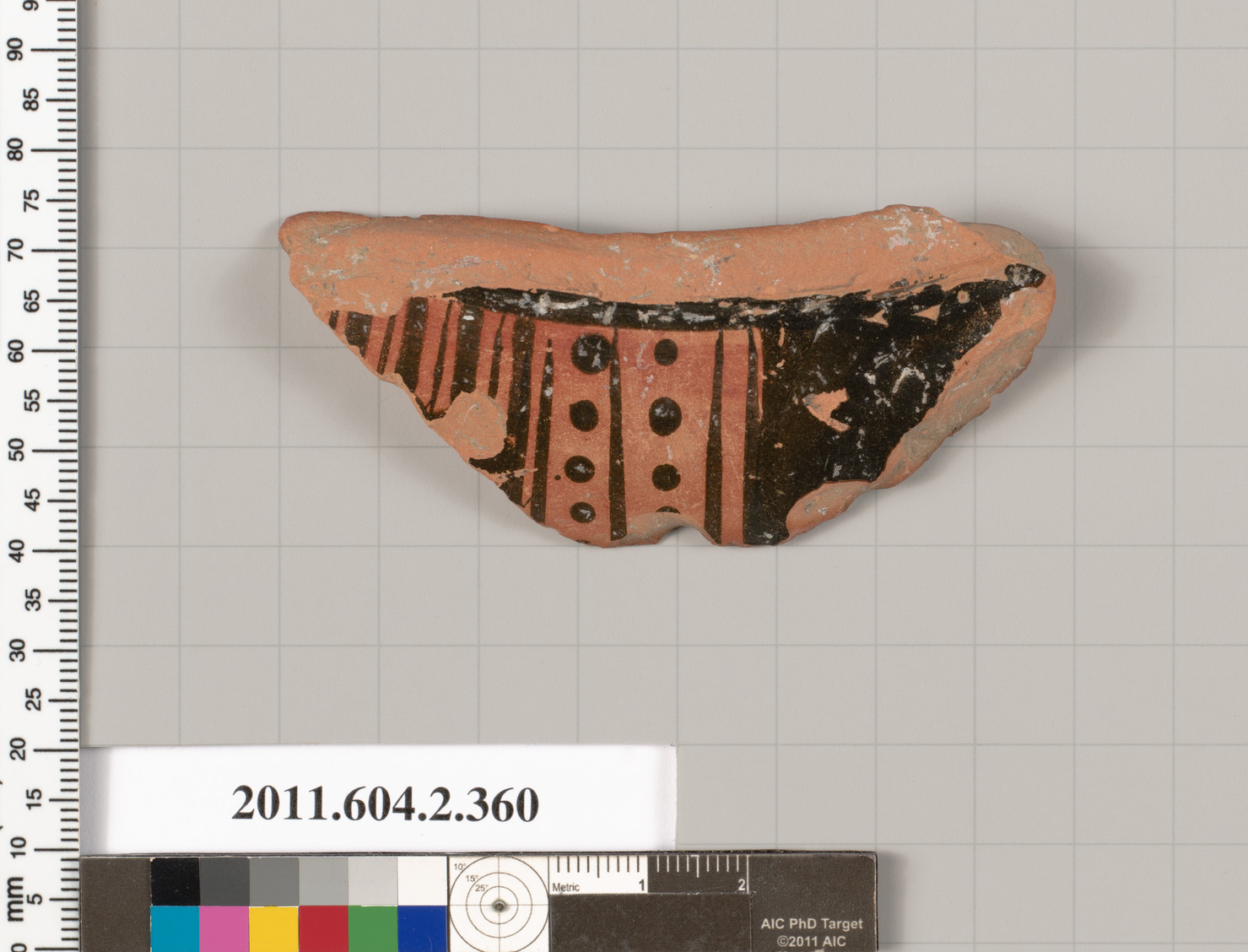
Heritage Synthesis: Terracotta fragment of a column-krater (bowl for mixing wine and water)
Curated on Sep 03, 2026 // Node: LDN-01
The Socratic Krater: Terracotta Fragments and the Architecture of Enduring Silence in 2026 Old Money Silhouettes
The internal genetic code of Lauren Fashion Heritage Lab often speaks in paradoxes: the French Neoclassical instant of Socrates’ hemlock, and the Song-Yuan celadon *meiping*’s carved waves. One freezes time in a theatrical climax; the other dissolves it into rhythmic, tactile eternity. Yet both interrogate the same question: how does civilization transmute the ephemeral into the permanent? The museum artifact before us—a terracotta fragment of an Attic column-krater, a vessel for mixing wine and water—offers a third, more archaic answer. It does not depict a philosophical martyrdom, nor does it abstract the sea into glaze. Instead, it is a broken shard of a utilitarian object, its painted figures now ghostly, its surface scarred by millennia. For the 2026 Old Money silhouette, this fragment is not a decorative reference but a structural manifesto. It instructs us that true luxury is not the preservation of perfection, but the curation of dignified incompleteness—a sartorial philosophy where the garment’s power resides in its ability to absorb time, wear, and silence without losing its architectural integrity.
I. The Krater’s Dialectic: Between the Event and the Vessel
The Attic column-krater was the social epicenter of the Greek symposium—a vessel designed for mixing, dilution, and communal ritual. Its terracotta body, once painted with red-figure scenes of gods or athletes, was not meant for eternity. It was a working object, subject to chips, cracks, and eventual discard. The fragment we hold is a survivor of that utilitarian fate. Unlike David’s canvas, which stages death as a singular, moral spectacle, or the *meiping*, which transforms water’s chaos into a meditative pattern, the krater fragment embodies a *processual* aesthetic. Its broken edges are not tragic; they are evidence of use, of the hands that gripped it, of the wine that stained it. In this, it aligns with the *meiping*’s philosophy of “包浆” (patina)—the idea that beauty accrues through touch and time. But where the celadon vessel smooths its surface into an unbroken, contemplative arc, the krater fragment exposes its internal structure. The break reveals the clay’s coarse grain, the potter’s wheel marks, the uneven firing. This is not a flaw to be hidden but a truth to be acknowledged.
For the Old Money aesthetic of 2026, this dialectic is crucial. The genre has long been accused of a sterile, museum-like perfection—tailoring so sharp it repels human contact. The krater fragment corrects this. It proposes a silhouette that is *constructed* yet *weathered*. Think of a double-breasted jacket in a heavy, undyed wool—its lapels rolled with a precision that recalls Greek fluting, but its surface left slightly napped, slightly irregular, so that light does not glance off it but is absorbed into its depth. The garment is not new; it is *becoming*. Its seams are not hidden but subtly reinforced, like the krater’s visible repair rivets (a common ancient practice). The 2026 Old Money consumer does not buy a garment; she inherits a fragment of a larger, ongoing narrative.
II. Silhouette as Ruin: The Architecture of the Broken Column
The column-krater takes its name from its handles, which mimic the fluted columns of Greek temples. This architectural allusion is the key to translating the fragment into a 2026 silhouette. The column is the ultimate symbol of load-bearing permanence—yet here, it is truncated, broken mid-shaft. The Old Money silhouette must therefore be conceived as a *ruined column*: a structure that asserts verticality, proportion, and classical balance, while simultaneously acknowledging its own incompleteness. This manifests in the cut of a long, flowing coat—perhaps in a heavy, dark cashmere or a matte vicuña—that falls from broad, un-padded shoulders (the krater’s rim) to a hem that is deliberately asymmetrical, or slightly frayed, as if the fabric’s journey was interrupted. The silhouette does not end; it *stops*. This is not deconstruction in the postmodern sense—there is no exposed lining, no deliberate ugliness. Rather, it is a classical ruin: the proportions remain perfect, the lines remain clean, but the termination is abrupt, honest, and deeply moving.
Consider the trousers. A column-krater’s body swells at the belly and tapers to a narrow base. A 2026 Old Money trouser might echo this in a high-waisted, pleated cut that offers fullness through the hip (the krater’s volume) before tapering to a clean, slightly cropped hem that reveals the ankle—the terracotta’s unglazed foot. The fabric should have a dry, mineral hand—a wool flannel with a chalk-stripe that suggests the krater’s painted lines, now faded. The pleats are not pressed to a razor’s edge but allowed to hold a soft, memory-like crease, as if the garment has been folded and stored for a century. This is the “event” of the Socratic death translated into the “vessel” of the *meiping*: the garment does not narrate a moment of triumph, but carries the residue of countless moments, each one a subtle abrasion that adds to its gravitas.
III. Color and Texture: The Terracotta Palette of Restraint
The krater fragment’s palette is limited: the warm, burnt orange of the fired clay, the deep black of the painted figures, and the negative space of the reserved ground. This is a palette of *earth and shadow*, and it must govern the 2026 Old Money color story. We are not speaking of bright, sun-drenched terracotta, but of a *muted*, mineral tone—the color of a shard that has been buried for two thousand years. This translates to a range of “archaeological” neutrals: burnt sienna, umber, ash grey, and a black that is not jet but a deep, charcoal-infused brown-black, like the krater’s painted slip. These colors do not shout; they whisper of provenance. A full look might consist of a terracotta-toned suede shirt jacket, worn over a black, high-neck merino knit, and paired with trousers in a faded, stone-washed grey. The effect is not “earthy” in a bohemian sense, but *stratigraphic*—each layer represents a different era of wear, a different sediment of experience.
Texture is paramount. The krater’s surface is not smooth; it is slightly pitted, granular, tactile. This must be replicated in fabric choice. We reject the high-tech, microfiber finishes that mimic perfection. Instead, we embrace the irregularities of natural fibers: the slubs in a raw silk, the unevenness of a hand-loomed linen, the nubs in a tweed. These imperfections are the sartorial equivalent of the krater’s broken edge. They invite the hand, they demand a slower form of looking. The 2026 Old Money garment is not meant to be photographed under harsh light; it is meant to be experienced in the dim, warm glow of a room, where its subtle variations in texture and tone become a quiet language of authenticity.
IV. The Fragment as a Philosophy of Absence
David’s Socrates points to the heavens, seeking an answer beyond the frame. The *meiping*’s waves roll endlessly, accepting the flux of existence. But the krater fragment does neither. It is an object of *absence*—the missing half of the vessel, the lost figures, the forgotten symposium. Its beauty is in what it refuses to show. This is the ultimate lesson for the 2026 Old Money silhouette. In an age of relentless visibility, of logos and fast fashion, the Old Money garment must be an exercise in withholding. It does not reveal its cost, its brand, or its season. It reveals only its structure—the quality of its seams, the fall of its drape, the integrity of its material. Like the krater fragment, it is a testament to what has been removed.
This translates to a radical reduction in ornamentation. No visible hardware, no embroidered monograms, no contrasting trims. The garment’s “decoration” is its cut and its cloth. A coat’s beauty comes from the precision of its armhole, the curve of its collar, the weight of its hem. A dress’s allure comes from the way its fabric responds to movement, creating a fluid architecture that is both present and evanescent. The wearer becomes the missing figure on the krater—the absent presence that gives the vessel its meaning. The silhouette is not a costume; it is a frame for the individual’s own, ongoing narrative.
V. Conclusion: The Eternal in the Fragmentary
The terracotta fragment teaches us that eternity is not found in the unbroken monument, but in the shard that has survived. It is not the complete krater that moves us, but the piece that hints at the whole, allowing our imagination to reconstruct the symposium, the laughter, the philosophical debate. For 2026, the Old Money silhouette must adopt this fragmentary logic. It must be a garment of classical proportions, constructed with uncompromising rigor, yet designed to accept the patina of life. It must be a vessel for time, not a shield against it. The Socratic moment of crisis and the celadon’s rhythmic acceptance are both present in this terracotta’s silence. The 2026 silhouette, therefore, is not a new creation but a *recovery*—a bringing to light of a buried truth. It is a fragment of a larger, lost language of elegance, and its power lies in its incompleteness, its refusal to be a full statement. It is, in the end, a garment that whispers of what has been and what remains, a wearable ruin that offers not the comfort of permanence, but the deeper comfort of dignified endurance.
Heritage Lab Insight
Genetic Bridge: Archive node focusing on Heritage-Black craftsmanship.