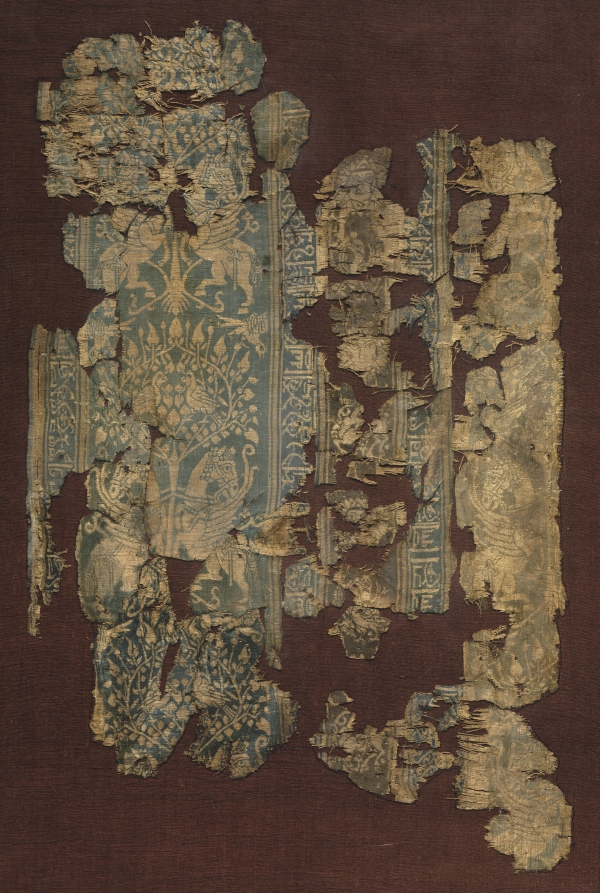
Heritage Research Artifact: The Imperial Silk Fragment
In the hushed, measured world of Savile Row, where cloth is not merely purchased but *commissioned*, where a bolt of fabric carries the weight of a handshake and the promise of decades, we pause to consider a fragment. Not a length destined for a client’s measure, but a remnant—a whisper of a larger, more opulent whole. This silk fragment, a tangible relic of imperial weaving, speaks a language of power, patience, and unparalleled artistry. It is a document, not of ink and parchment, but of filament and dye, and its legacy is stitched into the very foundation of what we consider the finest tailoring in the world.
Materiality: The Architecture of a Thread
To the uninitiated, silk is simply a luxurious texture. To the discerning eye of a heritage specialist, it is an engineering marvel. Our subject—a fragment, perhaps no larger than a gentleman’s pocket square—is a masterclass in this engineering. Its materiality is not a single element but a confluence of them. The base is a filament of mulberry silk, extruded from the cocoon of the *Bombyx mori* moth, a creature so domesticated that it cannot survive without human husbandry. This dependency forged an industry, a culture, and an aesthetic that defined empires.
Yet, the silk thread itself is merely the canvas. The true genius lies in the weave structure. Upon close inspection, one discerns not a simple tabby or twill, but a complex, compound weave—likely a satin ground with a discontinuous supplementary weft. This is the language of imperial brocade. The technique, known in the West as *lampas* or *damasse*, allowed the weaver to introduce gold or silver thread, or a contrasting coloured silk, only where the pattern demanded it. This is not a printed image; it is a structure. The pattern is built, thread by thread, into the very fabric of the cloth. The result is a surface of extraordinary depth, where light plays across the raised weft, creating a shimmering, three-dimensional effect that no flat print can ever replicate.
The fragment’s colour—a deep, resonant indigo or a faded madder red—is not a mere pigment. In the imperial context, colour was semiotic. It denoted rank, season, and ritual purpose. The dyes themselves were derived from natural sources—indigo from the plant, madder from the root, and the most precious of all, a purple extracted from the murex snail, a colour so costly it was reserved for the Emperor alone. The very chemistry of the dye is a testament to a sophisticated understanding of the natural world, a knowledge base that was guarded as fiercely as any state secret.
Context: The Loom as an Instrument of State
To understand this fragment, we must step away from the tailor’s bench and enter the imperial workshop. In dynastic China, and later in the great Ottoman and Byzantine empires, silk weaving was not a cottage industry. It was a strategic national asset. The looms were vast, complex machines, often requiring two or three weavers working in concert, one on top to control the pattern, one below to manipulate the heddles. The drawloom, the precursor to the Jacquard loom, was the most sophisticated piece of technology of its age. It was, in essence, an early form of binary programming, where a series of cords and pulleys, controlled by a "draw boy," determined which warp threads were lifted to create the pattern.
This was not merely craft; it was statecraft. The output of these imperial looms was not for the open market. It was a form of diplomatic currency, a tribute to the gods, and a marker of the Emperor’s divine mandate. The patterns woven into these silks were not arbitrary floral designs. They were a visual lexicon of power. The five-clawed dragon of the Chinese Emperor, the *semnurw* of the Sasanian Persians, the intricate geometric star patterns of the Islamic world—each motif was a coded message of authority, legitimacy, and cosmic order. To wear such a garment was to be draped in the very ideology of the state.
The fragment we hold is a piece of that narrative. It may have been part of a *kesi* tapestry, a silk robe of state, or an altar hanging. Its very survival is a miracle. Silk is a protein fibre, susceptible to light, humidity, and insects. Its presence in our archive suggests a history of careful, perhaps even reverential, storage. It was likely preserved because it was considered too precious to discard, a relic of a golden age, a benchmark of quality that subsequent generations could only aspire to.
Legacy: The Thread to Savile Row
What, then, is the connection between this fragment of imperial grandeur and the understated elegance of a Savile Row suit? The link is not one of direct lineage, but of standard and philosophy. When a Savile Row tailor speaks of a cloth’s "hand," its "drape," or its "body," they are assessing the very qualities that the imperial weaver perfected. The insistence on a high thread count, the use of pure, unadulterated fibres, and the rejection of shortcuts in favour of a structurally sound weave—these are principles inherited from a tradition where cloth was built to last for generations, not seasons.
The imperial silk weaver understood that true luxury is not loud; it is confident. It does not shout; it whispers. The subtle sheen of a high-quality silk, the intricate but understated pattern that only reveals itself upon close inspection, the weight of the cloth that allows it to hang with a perfect, disciplined line—these are the hallmarks of a garment that speaks of its owner’s discernment. This is the antithesis of fast fashion. It is a commitment to permanence in a disposable world.
Our role at the Lauren Fashion Heritage Lab is to act as custodians of this knowledge. We do not simply archive objects; we decode them. We study the materiality to understand the craft, and we study the craft to understand the culture. This silk fragment is not a dead piece of history. It is a living brief. It instructs us on the value of patience, the importance of precision, and the enduring power of a well-made thing. It is the ultimate source material, reminding us that the finest garment ever to leave a Savile Row workroom is, at its heart, a direct descendant of the weaver’s art that produced this fragment—an art that once clothed emperors and now, in its distilled principles, continues to clothe the modern gentleman. The thread is unbroken.