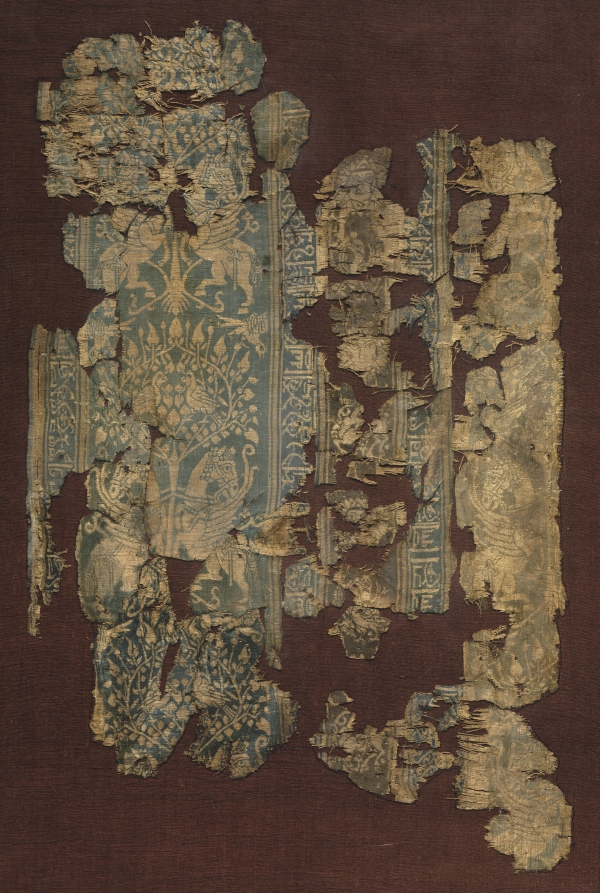
Heritage Research Artifact: Silk Fragment
In the hushed, timber-panelled ateliers of Savile Row, where the air is thick with the scent of beeswax and pressed wool, one learns to read cloth the way a vintner reads a vineyard. We do not merely cut fabric; we negotiate with it. And of all the negotiations—the sturdy cavalry twill, the forgiving cashmere, the assertive tweed—none demands a more profound respect than silk. This fragment, a whisper of imperial provenance, is not a textile. It is a testament, a legal document of a lost world, and a masterclass in materiality that still informs our most exacting commissions.
The Materiality of Light and Structure
To the uninitiated, silk is simply a luxury. To the cutter on the Row, it is a structural paradox. This particular fragment, likely a remnant of a kesi (cut-silk tapestry) or a fine satin damask, possesses a hand that is simultaneously cool and yielding. Run your thumb against the grain, and you feel the subtle resistance of the warp; run it with the weave, and it offers a liquid, almost frictionless glide. This is not the pliant, slightly rubbery feel of modern, weighted silks. This is the authentic filament of Bombyx mori, reeled in continuous, unbroken lengths—a discipline lost to the economics of speed.
The materiality here is one of deliberate tension. The warp threads are set with a precision that borders on the obsessive, creating a ground so even that light does not merely reflect off it; it pools. In imperial workshops, the weaver was not an artisan but a mathematician of light. The density of the weave—over 120 threads per centimetre in the finest pieces—was engineered not for durability alone, but for a specific optical effect: a subtle, chameleonic lustre that shifts from silver to gold as the viewer moves. This is the hallmark of a cloth made for the Forbidden City, where the emperor’s proximity to the sun was mirrored in the fabric’s ability to capture and redirect daylight.
Imperial Context: The Loom as Bureaucracy
One cannot discuss this fragment without acknowledging the vast, silent machinery of the imperial silk works at Nanjing, Suzhou, and Hangzhou. These were not factories in the modern sense; they were state organs of immense ritual significance. The looms, some requiring two or three men to operate in a synchronized ballet of foot pedals and flying shuttles, were considered extensions of the celestial court. A single bolt of ceremonial silk could take a year to complete. The pattern we see—a fragment of a dragon’s claw, perhaps, or the corner of a cloud scroll—was not a design choice. It was a coded hierarchy.
In the Qing dynasty, the colour and motif of silk were as regulated as military rank. Imperial yellow was reserved for the Son of Heaven; apricot yellow for the princes; blue and stone-grey for lesser nobility. The dragon, with its five claws, was the exclusive property of the emperor. A four-clawed mang dragon was the ceiling for a prince. This fragment, bearing the remnants of a five-clawed motif in a field of deep, almost black indigo, suggests a garment of the highest echelon—likely a chaofu (court robe) or a ceremonial hanging. The very existence of this fragment is a historical anomaly; imperial silks were often burned upon the owner’s death or ritually destroyed to prevent desecration. That it survives, even in part, is a quiet act of rebellion against imperial protocol.
The Weave as a Moral Code
For the Savile Row practitioner, the lesson of this fragment is not historical but ethical. The imperial silk weaver operated under a draconian standard: a single broken thread meant the entire panel was discarded. There was no repair, no "finishing" to hide a flaw. The cloth had to be perfect because it was a physical manifestation of the emperor’s mandate to rule. This is a standard we recognise, albeit secularised. When we cut a jacket from a bolt of 16-momme silk for a lining, or construct a tailored waistcoat in a heavy silk faille, we are inheriting that same intolerance for mediocrity.
Consider the drape. Modern silk, often treated with chemical softeners, hangs with a flattering but lazy weight. This imperial fragment, by contrast, has a "memory." It holds a crease if you press it, but it also returns to its flat, pristine state with a spring that speaks to the resilience of the raw filament. This is the silk of a garment worn for hours of ritual prostrations, a fabric that had to endure the strain of movement without losing its architectural integrity. In tailoring terms, it is the difference between a soft shoulder and a structured one. The imperial silk is the structured shoulder—it supports the body, rather than merely following it.
Preservation and the Art of the Fragment
We are not conservators here; we are interpreters. The fragment’s edges are frayed, the dyes have faded in patches to a gentle ochre, and the gold-wrapped threads have tarnished to a dull bronze. Yet this decay is not a loss. It is a cartography of time. The breaks in the weave tell us where the wearer’s arm moved. The fading along one edge suggests prolonged exposure to a window light in a northern palace. The fragment is a biography, and our role is to read it with the same rigour we apply to a client’s posture and gait.
In our work, we often use silk for the interior architecture of a garment—the under-collar, the sleeve head, the lining of a pocket. It is the unseen hero. This imperial fragment reminds us that silk was never meant to be merely seen; it was meant to be felt as a secondary skin. The emperor felt the difference between a summer silk and a winter silk. He knew, through the cloth, that his bureaucracy was functioning. The loom was a ministry, and the fabric was its policy.
Conclusion: A Living Standard
As we hang this fragment in our archive, under glass, we do not treat it as a relic. We treat it as a reference sample. When a client requests a silk dressing gown, we show them this fragment and explain that the lustre they admire is not a finish applied at the mill, but a structural property of the weave. When we select a silk for a bridal waistcoat, we look for the same density of thread, the same refusal to pucker at the needle. The imperial weavers perfected a standard of material honesty that transcends fashion. Their silk was not a decoration; it was a discipline.
And so, this fragment remains in active service. It is a benchmark against which we measure all subsequent silks, a reminder that true luxury is not the absence of imperfection, but the absolute intolerance of it. The emperor is gone, the looms are silent, but the standard—the unyielding, luminous, structural standard—remains. We cut by it still.