← BACK TO ARCHIVES
Silk
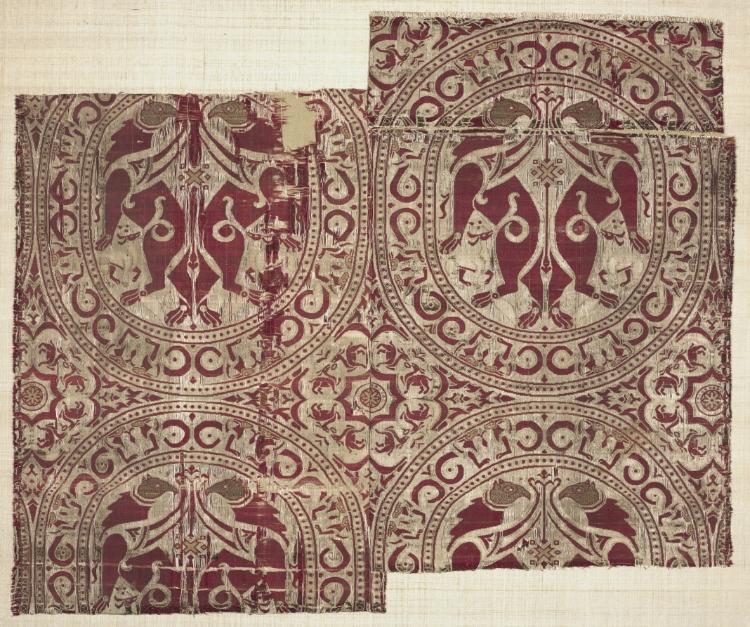
Heritage Synthesis: Lampas with griffins in roundels, from the Reliquary of Saint Librada in Siguenza Cathedral
Curated on Sep 04, 2026 // Node: LDN-01
The Imperial Thread: Deconstructing the Lampas of Saint Librada
In the hushed, stone-veined ambulatory of Siguenza Cathedral, beneath the gilded retable and the weight of seven centuries of devotion, lies a textile that speaks not of Castilian piety alone, but of a far-flung, cosmopolitan power. The lampas with griffins in roundels, preserved as the Reliquary of Saint Librada’s principal vestment, is not merely a relic. It is a document—a woven ledger of imperial ambition, technical virtuosity, and the silent, relentless commerce of the medieval Silk Road. To examine this cloth is to read a dispatch from the workshops of Al-Andalus or, more provocatively, from the looms of Byzantium or Sassanian Persia, filtered through the lens of a Christian kingdom’s appropriation of glory.
Materiality and the Grammar of the Loom
Let us first address the cloth’s physical grammar. The term *lampas* denotes a compound weave structure, a technical achievement that distinguishes it from simpler tabby or twill silks. In a lampas, two or more warp systems and two or more weft systems interlace, creating a ground fabric (often a plain or twill weave) upon which a supplementary, pattern-forming weft floats freely to create the figural design. This is not a tapestry, where wefts are discontinuous; here, the pattern is integral, bound into the structure. The result is a textile of remarkable density and drape—a silk that holds its shape with the authority of brocade yet retains a supple, almost liquid fall.
The materiality is pure silk, *sericum*, the filament of *Bombyx mori*. Its lustre, even after centuries of candle smoke and veneration, retains a ghost of its original sheen. The choice of silk is itself a political statement. In medieval Europe, silk was not a commodity; it was a currency of power, more precious than gold by weight. Its production was a closely guarded secret, monopolized by the Eastern empires. For the Cathedral of Siguenza to possess such a piece—likely a reuse of an earlier, secular or Islamic textile repurposed for liturgical use—signals access to the highest echelons of international trade, either through royal patronage, diplomatic gift, or the plunder of war.
The Iconography of the Griffin: A Symbolic Palimpsest
The griffin, the mythical beast with the body of a lion and the head and wings of an eagle, is the central motif, enclosed within a rigidly geometric roundel. This is a hallmark of the so-called “imperial” silk tradition. The roundel itself is a framing device of immense antiquity, originating in Sassanian Persia (224–651 CE) and transmitted through Byzantine and Islamic intermediaries. It signifies order, cosmic authority, and the encircling embrace of a sovereign power. The griffin, in this context, is not a mere decorative fancy. In Persian and Byzantine iconography, the griffin guards treasure and symbolises divine vigilance. In Christian appropriation, it was reinterpreted as a symbol of Christ’s dual nature—human (lion) and divine (eagle)—and of the resurrection.
Yet, the specific rendering here is crucial. The griffins are not static; they are depicted in a heraldic confrontation or, more commonly, in a symmetrical, mirrored pair flanking a central tree of life or a floral motif. This symmetry is a hallmark of the *samite* and *lampas* weaves produced in the great imperial workshops of Constantinople, Alexandria, and later, the *tiraz* factories of Islamic Spain. The precision of the pattern repeat, the crispness of the griffin’s talons, and the geometric discipline of the roundel suggest a master weaver operating under strict court patronage. This is not folk craft; it is the product of a state-sponsored industry where design was codified and quality was non-negotiable.
The Legacy of Imperial Silk Weaving: From Sassania to Siguenza
To understand the Siguenza lampas, one must trace the lineage of imperial silk weaving. The Sassanian Empire perfected the art of figured silks, establishing a visual vocabulary of royal hunts, winged horses, and mythical beasts within pearl-bordered roundels. When the Arabs conquered Persia, they inherited this tradition, and the *tiraz* workshops of the Umayyad and Abbasid caliphates continued the production, now inscribed with Arabic benedictions. The Byzantine Empire, initially importing Sassanian silks, eventually established its own state monopolies in Constantinople, producing silks that were distributed as diplomatic gifts—the famous *skaramangion* and *paludamentum*—to cement alliances across Christendom.
The Siguenza textile sits at the confluence of these streams. Its technical structure—a true lampas with a twill ground—is more characteristic of later Byzantine or Islamic Spanish production (12th–13th centuries) than of early Sassanian weaves, which were often compound twills. The griffin motif, however, is a direct descendant of the Sassanian repertoire. This suggests a deliberate archaism, a conscious evocation of imperial Rome and Persia by a Christian kingdom seeking to legitimise its own nascent power. By clothing the relics of Saint Librada—a virgin martyr whose legend ties her to the early Christian community of Gaul—in a textile of such overtly imperial pedigree, the clergy of Siguenza were performing a profound act of *translatio imperii*. They were claiming not only the saint’s spiritual authority but also the temporal prestige of the ancient world’s great empires.
Conservation and the Ethics of the Gaze
From a Savile Row perspective—where cloth is judged by its handle, its drape, and the integrity of its construction—this lampas is a masterpiece of tailoring potential. One imagines the weight of the silk, the way it would have fallen in heavy, sculptural folds around the reliquary, catching the light in subtle shifts of tone. The griffins, woven in a slightly raised relief against the ground, would have created a tactile, almost sculptural surface, inviting the touch of the faithful—a touch that, over centuries, has contributed to its current fragility.
The conservation of such a piece is a delicate negotiation between preservation and interpretation. The textile is now too fragile for display in its original, draped form. It is typically mounted flat, under controlled light and humidity, its story told through magnifying glasses and scholarly annotation. This shift from liturgical object to museal artifact is not without loss. We lose the kinetic, performative dimension of the cloth—its rustle, its weight, its role in the drama of the Mass. What we gain is a forensic understanding of its construction, its dyes (likely madder for red, woad or indigo for blue, and a now-faded yellow from weld or saffron), and its provenance.
The ethical question is not whether to display it, but how. We must resist the temptation to view it solely as a beautiful relic of a bygone age. It is a testament to the interconnectedness of the medieval world—a world where a silk woven in a Spanish *tiraz* workshop, using motifs derived from Persian kings, could end up swaddling the bones of a French saint in a Castilian cathedral. It is a reminder that luxury, like power, is never local. It is always a conversation across borders, a negotiation of identity through the language of material.
Conclusion: A Tailored Legacy
In the end, the Lampas with Griffins of Siguenza is more than a textile. It is a tailored argument. It argues for the enduring authority of imperial forms, for the technical supremacy of the silk weaver’s art, and for the ability of a small, provincial cathedral to participate in a global conversation of prestige. Its threads are not merely silk; they are the filaments of history itself—binding Sassanian kings to Byzantine emperors, Islamic caliphs to Christian prelates, and all of them to us, who stand in the cool, dim light of the cathedral and marvel at the audacity of a cloth that dared to clothe eternity. The legacy of imperial silk weaving is not confined to museums; it lives in every fold, every float, every carefully rendered griffin’s eye, whispering of a world where power was woven, quite literally, into the very fabric of being.
Heritage Lab Insight
Lab Insight: CMA Silk Archive Node integration.