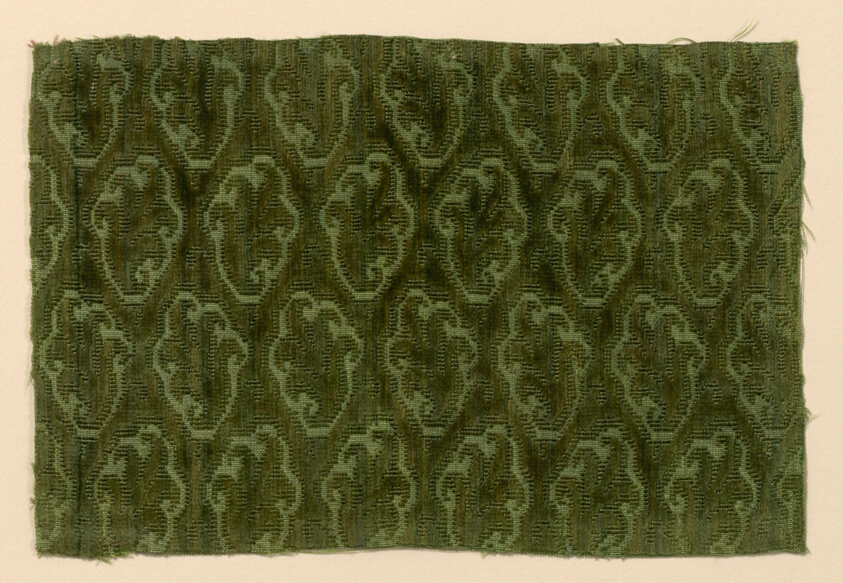
On the Nature of the Fragment: A Disquisition on Velvet
To consider the fragment is to engage in a dialogue with absence. It is an exercise in intellectual reconstruction, a sartorial detective story where the evidence at hand—a swatch, a collar, a disembodied sleeve—must speak volumes about the whole from which it was severed. In the realm of bespoke tailoring, we are accustomed to working with the complete canvas: the full bolt of cloth, the precise measurements of the client, the vision of a finished garment. The fragment, by stark contrast, is a testament to entropy, to the inevitable dissolution of things. Yet, within its frayed boundaries lies a condensed narrative of extraordinary material intelligence. The specimen under consideration—a silk velvet of singular complexity—demands such forensic appreciation.
Material Testimony: A Tripartite Pile
The foundation, as with all matters of substance, is the ground. Here, a plain weave of silk, impeccably balanced, provides the essential scaffold. Its thread count and tension speak of a loom mastered, a weaver’s hand both confident and subtle. Upon this disciplined field operates a more flamboyant regiment: the supplementary pile warps. These are the elements of drama, the variables introduced to create depth, texture, and narrative light.
The genius of this particular fragment lies in its deployment of not one, but three distinct pile treatments within a coherent scheme. The cut velvet stands plush, its fibres sheared to a uniform height to create islands of profound, light-absorbing richness. It is the sartorial equivalent of a low, deliberate baritone—authoritative, warm, and replete with substance. Adjacent, the uncut velvet presents its loops. This is a more resilient, textural expression, catching the light with a series of minute, crystalline highlights. It suggests a robustness, a history of tactile engagement.
Most arresting, however, is the deployment of the voided velvet. Here, the supplementary warp is omitted entirely, allowing the ground cloth to reassert itself in smooth, gleaming plains amidst the topographic relief of the pile. This is not mere decoration; it is negative space employed with the strategic precision of a master cutter’s chalk line. It creates silhouette within the fabric itself, a play of void and volume that precedes the garment’s eventual form. The transition between these three states is not abrupt, but graduated, suggesting a Jacquard mechanism of considerable sophistication—the silent, mechanical brain behind this textile’s eloquent speech.
The Philosophy of Fluidity and Structure
The stated context of "classic silk craftsmanship and fluid elegance" is not a mere descriptor; it is the central paradox the fragment embodies. Silk, in its essence, is the epitome of fluidity. It possesses a natural drape and a luminous quality that speaks of movement, of the body in motion. Velvet, by its very nature, is architecture. It is a constructed, almost built-up surface, weighty with its own luxurious density.
This artifact, therefore, represents a sublime negotiation between these opposing principles. The fluid elegance is inherent in the silk ground and in the very conception of the voided passages, which allow light to flow across the surface as water over a varied bed. The classic craftsmanship is the rigid discipline that makes such fluidity possible: the mathematical warp alignment, the precise control of tension required to form a perfect pile, the flawless shearing of the cut sections. It is the unseen structure that permits the perceived grace. In this, it mirrors the very ethos of Savile Row: a garment of effortless elegance is impossible without the foundation of rigorous, often invisible, structure—the canvas interlining, the hand-padded lapel, the precisely balanced sleeve.
The Fragment as Archive and Proposition
As a heritage artifact, this swatch functions as both archive and proposition. It archives a specific, elevated moment in textile technology and aesthetic ambition. The hand that guided the loom is absent, but its skill is fossilised in the alignment of every thread. The colour, now perhaps faded at the very edges of the fragment, once held a depth known only to dyes derived from specific historical periods and regions. The wear patterns—or their notable absence—on the pile tell a story of use, or perhaps of preservation for a special occasion that never arrived.
Yet, as a proposition, it remains provocatively contemporary. The interplay of texture, the bold use of voided space to create pattern, the sophisticated marriage of matte and shine—these are not historical curiosities. They are a direct challenge to the contemporary designer. How might one translate this tripartite textural language into a modern silhouette? Could the voided velvet define the lines of a neoclassical smoking jacket? Might the contrast between cut and uncut pile articulate the panels of an evening gown, guiding both light and the observer’s eye with impeccable, silent authority?
The fragment, in its incompleteness, is thus liberated from its original, unknown purpose. It becomes a source code, a material manifesto. It asserts that true luxury resides in this very complexity—in the willingness to invest extraordinary craftsmanship into a single square inch of cloth, knowing that its ultimate value will be realised only in its synergy with the human form and the cutter’s art. It is a silent partner in the atelier, reminding us that before a single line is chalked upon the linen, the cloth itself must possess a narrative worthy of the garment it will become. Its elegance is not simply fluid; it is engineered fluidity—the highest achievement of both the loom and the tailoring bench.