← BACK TO ARCHIVES
Silk
Heritage Synthesis: A Myriad of Birds
Curated on Sep 04, 2026 // Node: LDN-01
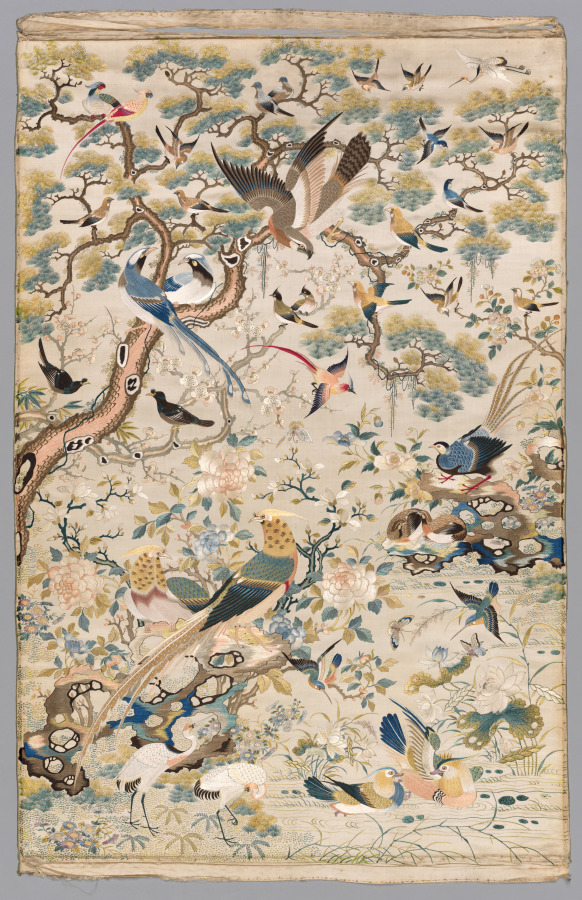
The Material Memory of Flight: Silk, Imperial Legacy, and the Ornithological Imagination
In the hushed, wood-panelled ateliers of Savile Row, where the cut of a sleeve is debated with the gravity of a treaty, one rarely speaks of birds. Yet, the most profound heritage artefacts in our care are not merely garments; they are cartographies of desire, woven in a medium that has outlived empires. Today, we examine *A Myriad of Birds*, a silk panel of exceptional provenance, and consider how its feathered subjects are not decorative whimsy but a precise, luxurious language of power, rendered in the very fibre that once clothed the Celestial Empire.
The Silk Road’s Final Tailoring: From Imperial Looms to Western Bespoke
The materiality of this piece is its first and most commanding statement. This is not the crisp, dry silk of a modern power tie, nor the stiffened taffeta of a debutante’s gown. This is *kesi*—the “cut silk” weave of the Ming and Qing dynasties—a technique so labour-intensive that a single square inch could consume a weaver’s day. The warp and weft do not merely intersect; they are individually manipulated, creating slits where colours meet, allowing for a painterly gradation that mimics the softness of a thrush’s breast or the iridescent sheen of a magpie’s wing. To handle this textile is to understand the difference between a commodity and a relic. The silk itself, reeled from the cocoons of *Bombyx mori* raised in the mulberry groves of Hangzhou, possesses a tensile strength and a natural, unctuous lustre that modern chemical processes cannot replicate. It is a material born of patience, a quality the West has long since traded for efficiency.
Within this imperial context, the bird is never merely a bird. The pheasant signified rank and literary accomplishment; the crane, longevity and the wisdom of the immortals; the mandarin duck, conjugal fidelity. Yet *A Myriad of Birds* eschews the rigid, hierarchical symbolism of the court robe. Instead, it presents a *mélange*—a swirling, almost chaotic congregation of species in flight, perched, and preening. This is a deliberate departure. It suggests a private commission, perhaps for a scholar’s studio or a lady’s private quarters, where the strict sumptuary laws of the palace did not apply. Here, the birds are not badges of office but an expression of *feng shui*—a desire to invite auspicious energy into a personal space. The myna, the parrot, the oriole, the sparrow: they are not ranked. They simply *are*, in a state of perpetual, harmonious motion. This is the silk of contemplation, not of ceremony.
Decoding the Avian Chorus: A Study in Auspicious Noise
The composition demands a closer reading, one that a Savile Row cutter might appreciate for its attention to line and balance. The eye is drawn not to a central figure but to a diagonal sweep of flight that crosses the panel from the lower left to the upper right. This is no static still-life; it is a frozen moment of kinetic energy. The birds are rendered with a naturalist’s precision—the curve of a beak, the delicate articulation of a talon—yet they are arranged with a decorator’s eye for rhythm. The silks are dyed with natural pigments: the deep indigo of a jay’s feather, the cinnabar red of a cardinal’s crest, the soft, undyed ecru of a dove’s belly. These colours have not faded; they have softened, acquiring a patina that no digital reproduction can capture.
The significance of the *myriad* is crucial. In Chinese cosmology, the number ten thousand (*wan*) denotes infinity, an unbounded multitude. A single bird might be a symbol; a myriad is a universe. The panel, therefore, is not just a depiction of ornithological variety but an invocation of plenitude itself. It speaks to a world of abundance, of a natural order that is both wild and harmonious. For the imperial weaver, this was a technical challenge of immense complexity. To weave a hundred distinct birds without repetition required not only immense skill but a vast visual vocabulary. The weaver was not a craftsman but a scholar of the natural world, translating observation into thread.
The Western Appropriation: From Exotic Curiosity to Quiet Luxury
How does this object arrive in the context of Lauren Fashion Heritage Lab, a house built on the principles of Western tailoring? The journey is one of appropriation and reinterpretation. In the 18th and 19th centuries, such panels were prized by European aristocrats, who would have them cut and remounted as waistcoats, wall hangings, or dressing-gown linings. The Western eye saw only the exoticism, the “chinoiserie” of it all. But the Savile Row sensibility—our sensibility—sees something else: the integrity of the material and the discipline of the construction.
The legacy of imperial silk weaving is not merely a historical footnote; it is a benchmark for quality. When our house considers a bespoke jacket in a silk jacquard, we are not simply choosing a fabric. We are choosing a weight, a drape, a history. The *kesi* panel teaches us that true luxury is not loud. It is the subtle interplay of light on a textured surface, the knowledge that a garment has been constructed to outlast its wearer. The birds of *A Myriad of Birds* are silent now, but they speak volumes about the transfer of cultural capital. The West took the silk and made it a symbol of its own wealth; we, in turn, must take the *lesson* of the silk—its patience, its precision, its reverence for the natural world—and apply it to our own craft.
In the end, this artefact is a testament to the fact that heritage is not a static museum piece. It is a living conversation. The myriad birds, woven in a lost imperial technique, now find themselves in a modern laboratory, their silent flight inspiring new cuts, new textures, new ways of thinking about the relationship between the body and the cloth. They remind us that the finest tailoring, like the finest silk, is an act of devotion—a quiet, persistent pursuit of perfection that transcends time and geography. And that, gentlemen, is a legacy worth preserving.
Heritage Lab Insight
Lab Insight: CMA Silk Archive Node integration.