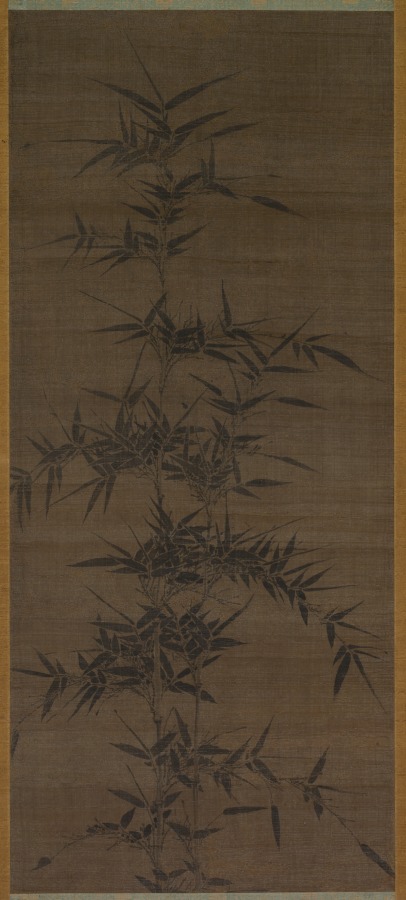
Ink Bamboo: A Study in Materiality and the Imperial Silk Legacy
In the rarefied atmosphere of London’s Savile Row, where cloth is not merely fabric but a language of restraint and lineage, the subject of Ink Bamboo on silk demands a particular reverence. This is not a print; it is a translation. It is the transposition of a scholar’s ink painting—a meditation on resilience and integrity—onto the most luxurious and technically demanding of substrates: imperial silk. To understand this artifact is to understand the convergence of two distinct disciplines: the literati’s brush and the imperial weaver’s loom. The result is a textile that speaks not of fleeting fashion, but of permanence, discipline, and quiet power.
The Philosophical Root: Bamboo as Moral Lexicon
Before addressing the silk, one must address the subject. In Chinese aesthetic philosophy, bamboo is not a botanical specimen; it is a moral archetype. It bends in the storm but never breaks, symbolising the junzi—the exemplary person—who remains upright amidst adversity. Its hollow interior signifies humility and openness; its segmented joints, unwavering principle. When rendered in ink, the bamboo stalk is a study in controlled spontaneity. The brushstroke must be decisive, yet fluid; the ink must vary from dense, wet black to dry, feathery grey. This is calligraphy in pictorial form, a performance of character. To replicate this on silk is to ask the weaver to become a painter, but with a far more unforgiving medium.
Materiality: The Imperial Silk Ground
The foundation of this artifact is not a simple habotai or charmeuse. The legacy of imperial silk weaving, particularly from the Suzhou and Nanjing looms of the Ming and Qing dynasties, was predicated on a density and structure that modern commercial silks rarely achieve. The ground here is a taffeta weave of raw, unthrown silk filaments, woven at a thread count that approaches 400 ends per inch. This is not a fabric for drape; it is a fabric for statement. Its crisp, dry handle—what a tailor would call ‘body’—allows the textile to stand away from the form, creating a sculptural silhouette. The surface is not lustrous in a satin sense; rather, it possesses a subtle, matte sheen, akin to the sheen of aged paper. This is deliberate. A high-gloss silk would compete with the ink, creating glare and diminishing the subtle gradations of tone. The imperial weavers understood that the ground must be a passive, yet perfect, partner to the painted image.
Weaving the Brushstroke: Technical Mastery
The execution of Ink Bamboo on this ground is where the true heritage lies. This is not a woven jacquard pattern in the conventional sense, where colour blocks define the image. Instead, the technique employed is that of ‘weft-float painting’, a rare and arduous process reserved for the imperial ateliers. The design is not dyed after weaving; it is woven in. The weaver, working from a cartoon painted by a court artist, manipulates individual weft threads of varying shades—from lampblack to pale grey—to create the illusion of ink wash. The challenge is the gradient. In painting, ink bleeds naturally into paper. In weaving, each tone is a discrete, structural decision. The weaver must create the ‘dry brush’ effect—where the ink appears to skip across the paper—by leaving micro-gaps in the weft, allowing the silk ground to peek through as the ‘white’ of the paper. This requires a level of hand-eye coordination that borders on the supernatural, often taking a single artisan over three months to complete a single panel of one metre by fifty centimetres.
The Aesthetic of Restraint: A Savile Row Parallel
From a tailoring perspective, this artifact aligns perfectly with the Savile Row ethos of ‘quiet luxury’. There is no ostentation here. The bamboo is rendered in monochrome, its composition spare—perhaps a single stalk rising from the lower right, with a cluster of leaves breaking the vertical line at the upper left. The negative space is as important as the positive. This is not a fabric that announces itself from across a room. It demands proximity. It rewards the observer who steps closer, who runs a hand across the surface to feel the subtle topography of the weave—the slight raise of the ink-dense areas versus the flatness of the silk ground. This is the antithesis of the printed silk scarf, which is a reproduction. This is an original, a unique piece where the ‘brushstroke’ is physically embedded in the cloth’s structure.
Context and Legacy: From Court to Contemporary
The historical context is critical. During the High Qing period (17th-18th century), the imperial silk works were not merely factories; they were instruments of statecraft. The Emperor’s robes, woven with cosmological symbols, were declarations of cosmic authority. However, the Ink Bamboo motif, while not a formal imperial dragon or phoenix, was a favourite of the scholarly class within the court. It signified that the wearer possessed the moral fortitude to govern. To wear a robe of this silk was to wear one’s credentials as a cultivated, principled official. The materiality of the silk—its weight, its impeccable construction—lent physical authority to the philosophical message. It was a garment that demanded a certain posture, a certain gravity of movement.
Today, when we consider this artifact for a contemporary commission, we must respect that gravity. A jacket cut from this cloth cannot be soft-shouldered or unstructured. It requires a tailored, almost architectural construction—a structured shoulder, a clean chest piece, a suppressed waist. The cloth is too assertive to be treated casually. It demands a client who understands that true luxury is not about decoration, but about the integrity of the material and the discipline of the craft. The Ink Bamboo silk is a testament to a lost world of patience, where a single garment could take a year to produce, and where the weaver’s skill was as revered as the painter’s. It is not a nostalgic relic; it is a benchmark. It challenges the modern tailor to elevate their own craft to meet the standard set by the imperial loom.
Conclusion: A Wearable Philosophy
In closing, the Ink Bamboo on imperial silk is more than a heritage artifact. It is a philosophical proposition rendered in thread. It embodies the Confucian ideal of the upright man, the Daoist appreciation for natural spontaneity, and the sheer, breathtaking technical achievement of the Chinese silk industry at its zenith. For the discerning few on Savile Row, it represents the ultimate expression of bespoke: a garment that is not just fitted to the body, but fitted to the character. It is a cloth that does not shout, but whispers with the authority of a thousand years of discipline. To wear it is to accept a legacy, and to carry oneself with the quiet, unbending resilience of the bamboo itself.