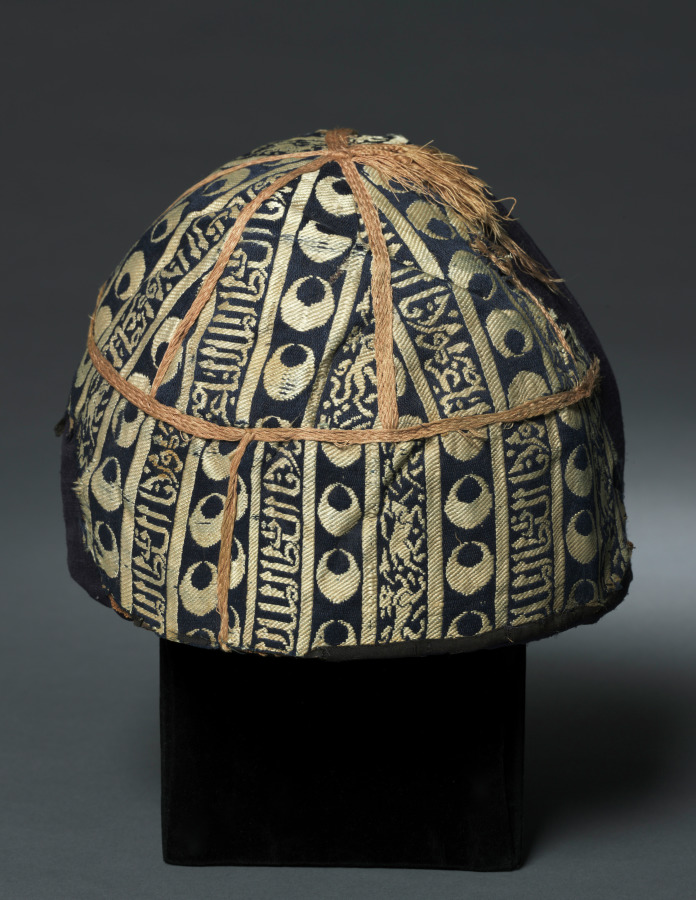
The Cap with Striped Inscribed Silk: A Study in Imperial Lineage and Tailored Restraint
Provenance and the Weight of Thread
Within the hushed archives of Lauren Fashion Heritage Lab, we encounter an object of deceptive simplicity: a cap, unassuming in its form, yet profound in its material declaration. Constructed from striped inscribed silk, this artifact is not merely a piece of headwear; it is a palimpsest of imperial ambition, a whisper of the loom’s authority that predates the very concept of the modern tailor. To examine this cap is to engage in a dialogue with a legacy that stretches from the Forbidden City’s workshops to the discreet workrooms of Savile Row. The materiality of silk—its tensile strength, its luminous sheen, its capacity to hold a dye with preternatural clarity—was never a neutral choice. In its imperial context, silk was currency, diplomacy, and divine right, woven into a language of power that brooked no dissent.
The cap’s construction speaks to a discipline that the discerning gentleman of London would recognise as kin to his own tailoring. The stripes, precise and unyielding, are not random decoration. They are the result of a meticulous ikat or woven patterning process, where each thread is dyed or placed with an exactitude that borders on the obsessive. The inscription, likely a woven or embroidered mark of a specific imperial workshop or a blessing for the wearer, transforms the garment from a simple protective layer into a personal talisman. This is the first lesson of heritage: material is never mute. It carries the memory of its making, the politics of its origin, and the intent of its first owner. For the modern inheritor of this legacy, the cap is a reminder that true luxury is not loud; it is the quiet, assured confidence of a fabric that has already survived centuries.
The Imperial Loom and the Grammar of Status
To understand this cap fully, one must dismantle the romantic notion of the lone artisan. The imperial silk workshops of China, particularly during the Ming and Qing dynasties, were vast, hierarchical institutions. They were the precursors to the great tailoring houses in their operational complexity, albeit with a different currency of power. A single bolt of ceremonial silk could require the labour of dozens of specialists—from the silkworm rearers to the dyers, the pattern drafters to the weavers—all operating under a strict code of conduct. The stripes on this cap are not merely aesthetic; they are a coded system of rank. The width of the stripe, the juxtaposition of colours, and the specific type of inscription would have immediately signalled the wearer’s place in the celestial bureaucracy. This is the grammar of status, a visual language that the West would later adapt into the subtle codes of the business suit.
The transition from imperial robe to Savile Row suit is not as distant as it may appear. Both traditions share a fundamental obsession with the drape and the line. The imperial tailor, like his London counterpart, understood that fabric must be manipulated to honour the body’s structure while simultaneously projecting an idealised silhouette. The cap, though small, is a masterclass in this principle. Its form is not rigid; it is shaped to sit with a certain ease, a deliberate nonchalance that belies the complexity of its making. The silk’s natural give allows it to conform to the skull, creating a personal fit that a machine-made hat could never replicate. This is the essence of bespoke—the recognition that the garment must serve the individual, not the other way around. The imperial legacy here is not one of ostentation, but of precision and intentionality.
Materiality as a Moral Compass
In the contemporary ateliers of London, where the language of cloth is spoken with a particular reverence, this cap offers a profound lesson in sustainability and value. The modern world is awash in disposable fashion, garments engineered for obsolescence. The silk cap, however, is an heirloom. Its materiality demands care; it cannot be thrown into a machine or discarded without thought. This is the antithesis of fast fashion. The imperial workshops operated on a principle of scarcity and permanence. The silk was not merely a commodity; it was a repository of cultural memory. To wear such a cap was to accept a responsibility—to uphold the standards of the house, the dynasty, the empire.
For the heritage specialist, the cap is a benchmark against which we measure our own contemporary practice. It asks us to consider: does our fabric have a story? Does our construction honour the material’s inherent properties? Or are we merely decorating surfaces? The Savile Row ethos, with its insistence on hand-stitched canvases and the use of cloth from historic mills, is a direct philosophical descendant of this imperial model. The tailor does not fight the fabric; he collaborates with it. He understands that a pure silk, woven with a tight twist, will hold a crease differently than a soft, supple silk. He knows that the inscription, if it were to be replicated, must be placed with an awareness of the fabric’s drape, so that it is visible when the head is held high but hidden when bowed in deference. This is the art of subtlety, the hallmark of both the imperial court and the gentleman’s club.
Conclusion: The Cap as a Living Document
This cap with striped inscribed silk is more than a historical curiosity. It is a living document that continues to inform the language of luxury. Its legacy is not confined to a museum vitrine; it is present in the weight of a well-made overcoat, the crispness of a shirt collar, the quiet authority of a perfectly tied cravat. The imperial silk weavers understood a truth that remains immutable: that what we wear is a declaration of who we are, and who we aspire to be. The cap’s stripes are not just lines of colour; they are lines of descent, connecting the power of the throne to the discipline of the tailor’s bench.
As we preserve and study this artifact, we are not merely cataloguing an object. We are engaging in a conversation across millennia. We are acknowledging that the pursuit of excellence, the respect for material, and the understanding of the body’s relationship to cloth are timeless pursuits. The cap is a testament to the fact that true heritage is not static. It is a dynamic force, a standard of quality that challenges each generation to rise to its level. In the quiet dignity of this small, silk object, we find the entire philosophy of refined dress: that luxury is not about excess, but about the profound, unspoken confidence that comes from wearing a piece of history, perfectly executed, upon one’s head. It is a lesson the modern gentleman, whether in a boardroom or a drawing-room, would do well to remember. The loom of the empire may have fallen silent, but its echo persists in every considered stitch and every deliberate fold of cloth that passes through our hands today.