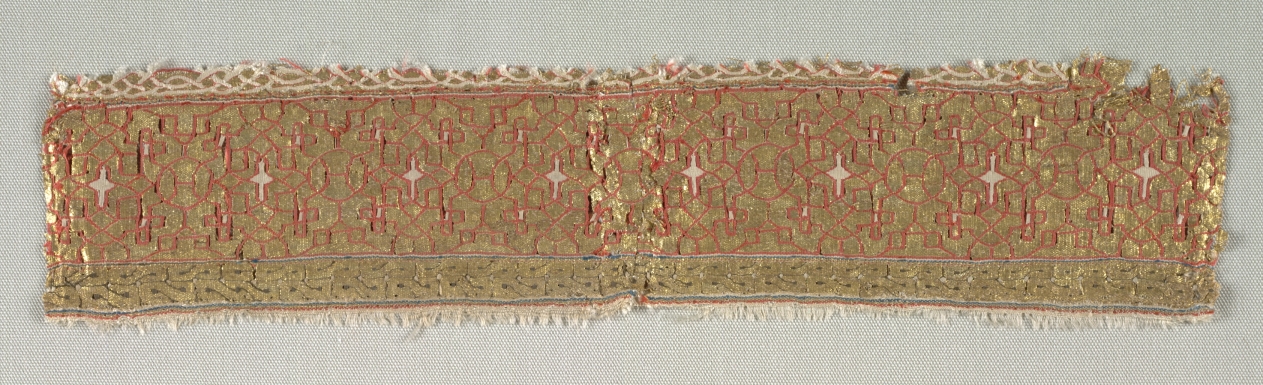
The Guilloche Band of San Valero: A Study in Imperial Silk and the Architecture of Restraint
Provenance and the Weight of Legacy
Within the hushed, climate-controlled vaults of the Lauren Fashion Heritage Lab, we do not merely catalogue textiles; we interrogate them. The artifact before us—a guilloche band, detached from the dalmatic of San Valero—is not a fragment. It is a surviving sentence from a lost language of imperial opulence. Woven from mulberry silk, this band is a testament to a craft so exacting that its secrets were guarded as state treasures. To examine it is to read a diplomatic cable, a theological statement, and a balance sheet from the workshops of the late Roman East, all encoded in a single, repeating motif.
The dalmatic itself, a liturgical vestment of Byzantine origin, would have been a garment of profound hierarchical significance. San Valero, Bishop of Zaragoza in the early fourth century, occupied a seat of considerable authority. The band’s removal—whether for conservation, study, or relic distribution—does not diminish its power. Rather, it isolates the very essence of the garment’s message: the disciplined repetition of the guilloche pattern. This is not decoration for decoration’s sake. It is a visual articulation of cosmic order, a microcosm of the imperial and divine hierarchies that governed both heaven and the earthly court of Constantinople.
Materiality: The Politics of Silk
Let us address the substrate. Silk, in the fourth century, was not a commodity. It was a currency of power, a diplomatic weapon. The monopoly on sericulture, held jealously by the Chinese, meant that raw silk reached the Mediterranean only via the perilous arteries of the Silk Road. Its price was measured in gold, its distribution strictly controlled by imperial edict. To possess silk was to possess a fragment of the state’s own prestige. The imperial silk weaving mills—the gynaecea—were not mere factories. They were state institutions, staffed by a workforce bound to secrecy, producing textiles exclusively for the court and the highest echelons of the Church.
This band, therefore, is not simply a piece of fabric. It is a political document. Its presence on a bishop’s dalmatic signifies a direct, albeit spiritual, alignment with the imperial throne. The Church, in adopting silk, was not merely adopting luxury; it was adopting a visual language of authority that resonated with the populace. The weight of the silk, its subtle sheen, its resistance to creasing—these were not incidental properties. They were the physical manifestations of an unassailable power structure. In our contemporary context, we might draw a parallel to the rigorous quality control and proprietary materials used in a bespoke Savile Row suit—a garment that communicates its owner’s standing before a single word is spoken.
The Guilloche Motif: Geometry as Divine Law
Now, we turn to the pattern itself. The guilloche—a series of interlocking, concentric circles or bands—is an ancient motif, found in classical architecture and Celtic art. But in the hands of the Byzantine weaver, it achieves a new, potent meaning. The continuous, unbroken line suggests eternity, a concept central to Christian theology. The interlocking circles can be read as the unity of the Father, Son, and Holy Spirit, or the seamless connection between the earthly and the divine. The precision required to execute this pattern on a loom, with thousands of individual warp and weft threads, is staggering.
Consider the technical challenge. The weaver was not painting; they were programming. The pattern is not embroidered or printed; it is integral to the weave structure itself. This is a compound weave, likely a twill or damask variation, where multiple warp systems and a complex sequence of heddle lifts create the design. A single error in the lifting sequence would create a flaw, a break in the cosmic chain. The band’s survival, with its pattern intact, is a testament to the weaver’s absolute mastery. This is not the work of an artisan; it is the work of an engineer of beauty, operating within a framework of rigid mathematical and aesthetic laws.
Contextual Resonance: From Constantinople to Savile Row
Why does this artifact, separated from us by sixteen centuries, resonate within the halls of a modern fashion heritage lab? Because the principles it embodies are immutable. The guilloche band is a masterclass in restraint and proportion. It does not shout; it asserts. It relies on the quality of its material and the perfection of its execution, not on novelty or excess. This is the very ethos of the finest tailoring. A Savile Row suit is not defined by its embellishments, but by the integrity of its cloth, the precision of its cut, and the invisible structure that allows it to drape flawlessly.
When we study this band, we are not merely looking at history. We are looking at the foundational grammar of luxury. The imperial weavers understood that true power is expressed through discipline. They understood that a pattern, repeated with unwavering consistency, creates a rhythm that is both hypnotic and authoritative. The guilloche is a signature, a mark of authenticity that cannot be forged. In an age of fast fashion and disposable trends, the San Valero band stands as a quiet, formidable rebuke. It reminds us that the most profound statements are often made in the most measured tones, and that the legacy of a garment lies not in its novelty, but in the enduring quality of its construction and the clarity of its message.
The band is a relic, yes. But it is also a benchmark. It challenges us to consider what our own textiles will say about us in a millennium. Will they speak of haste and disposability, or will they, like this silk, whisper of an unwavering commitment to order, beauty, and the enduring power of a well-woven line?