← BACK TO ARCHIVES
Silk
Heritage Synthesis: Gold-patterned Silk with Falcons and Heraldry
Curated on Sep 07, 2026 // Node: LDN-01
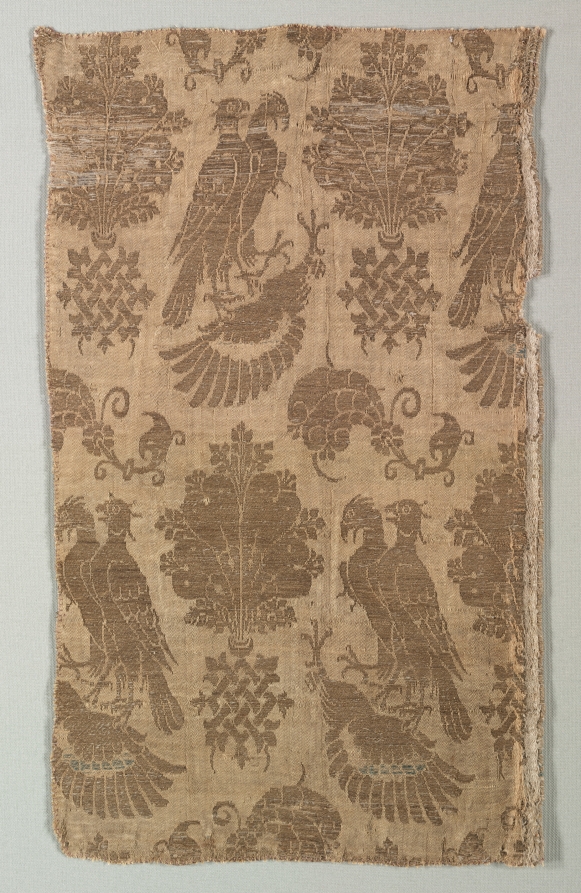
The Weight of Lineage: Gold-Patterned Silk with Falcons and Heraldry
In the hushed, wood-panelled ateliers of Savile Row, where a suit is not merely constructed but *conceived*, we understand that true distinction is never loud. It is felt in the density of a cloth, in the precise fall of a shoulder, in the quiet authority of a pattern that carries centuries of meaning. The artifact under our consideration—a length of gold-patterned silk bearing falcons and heraldic devices—is precisely such a material. It does not speak; it asserts. It does not decorate; it defines. This is not a textile for the merely wealthy. This is a textile for the dynastic.
Materiality: The Grammar of Power in Silk
Let us first address the substrate itself. Silk, in its purest form, is a filament of extraordinary tensile strength and luminous depth. But imperial silk—the kind woven in the great state manufactories of the Ottoman, Persian, or Chinese courts—was never a mere commodity. It was a diplomatic language, a store of value, and a symbol of sovereign prerogative. The *materiality* of this piece is its first argument. The ground is a lustrous, tightly woven silk, likely a satin or a twill, chosen for its ability to catch light in a manner that mimics liquid metal. Upon this ground, the gold is not printed or painted; it is *introduced*—either as a wrapped weft (a fine strip of gilt membrane spun around a silk core) or as a supplementary brocading thread. This is not a superficial gilding. The gold is structural. It is woven *into* the very bone of the cloth, ensuring that the pattern will not fade, crack, or surrender to the decades. It will, like a well-cut jacket, only improve with age, developing a subtle patina that speaks of history rather than neglect.
The weight of this textile is significant. This is not a diaphanous scarf for a summer’s evening. This is a cloth of estate, designed to hang with gravity from a throne, a ceremonial saddle, or the shoulders of a high dignitary. Its heft is a physical manifestation of its status. When you handle such a piece, you are not handling a fabric; you are handling a document of statecraft, a treaty woven in thread.
Iconography: The Falcon and the Shield
Now, to the design. The falcon is a motif of profound pedigree. In the falconry courts of the Mongol khans, the Safavid shahs, and the Holy Roman Emperors, the bird of prey was not merely a hunting companion. It was a symbol of swift justice, of sovereign vision, and of dominion over the skies—and by extension, over all that lay beneath them. The falcon, rendered here in gold thread, is not a passive ornament. Its posture is likely one of alert stillness, wings slightly gathered, head turned—a study in controlled power. This is the essence of the Savile Row ethos: power that is held in reserve, ready to be deployed with devastating precision.
The heraldic devices that accompany the falcons are equally deliberate. A coat of arms, a crest, a monogram—these are not decorative flourishes. They are the visual equivalent of a legal signature. In the context of imperial weaving, the inclusion of specific heraldry transforms the textile from a luxury good into a proprietary object. It declares, without ambiguity, the lineage of the wearer or the commissioning house. The weaver was not an artist expressing personal vision; he was a technician executing a precise commission, bound by the strict protocols of the court. The pattern is a frozen heraldic proclamation, a woven patent of nobility.
Consider the potential origins. The synthesis of Islamic and European heraldic elements suggests a point of cultural confluence—perhaps the Safavid workshops of Isfahan, which produced silks for both the Shah and for European aristocratic clients, or the Ottoman looms of Bursa, which supplied the courts of the Sublime Porte and its vassals. The use of gold, the specific rendering of the falcon, and the complexity of the heraldic charge would allow a specialist to date and attribute the piece with reasonable confidence. But for our purposes, the precise provenance is less critical than the *principle* it embodies: the use of the most precious materials and the most skilled labour to create an object of absolute, unassailable identity.
The Legacy of Imperial Weaving: A Lesson in Restraint
What does this legacy of imperial silk weaving teach us in the contemporary context of bespoke tailoring? It teaches us about the power of *specificity*. In an age of mass production and globalised uniformity, the bespoke garment is a last bastion of the heraldic impulse. When a client commissions a suit from the Row, he is not buying a piece of clothing; he is commissioning a personal standard. The choice of cloth, the cut, the lining, the subtle embroidery of a monogram on a shirt cuff—these are modern acts of heraldry. They declare who the wearer is, and just as importantly, who he is *not*.
The imperial weaver understood that true luxury is not about abundance but about *significance*. Every thread had a purpose. Every motif had a meaning. There was no waste, no superfluous flourish. The gold was not used to blind the observer but to guide the eye toward the emblem of power. This is a discipline we would do well to remember. A Savile Row suit should not shout; it should whisper with the authority of a man who has no need to raise his voice.
The gold-patterned silk with falcons and heraldry is a relic of that discipline. It is a testament to a time when cloth was a carrier of identity, a medium of diplomacy, and a repository of cultural memory. To study it is to be reminded that the finest tailoring is not a craft of covering the body, but of *revealing* the character. The falcon, poised and watchful; the heraldry, precise and unyielding; the gold, a quiet statement of enduring value—these are the elements of a garment that transcends fashion to become legacy.
In the end, this artifact is not merely a piece of silk. It is a lesson in the architecture of authority, woven with the patience of generations. And for those of us who practice the craft of bespoke clothing, it remains the gold standard—a benchmark of what it means to clothe a man not for the season, but for the ages.
Heritage Lab Insight
Lab Insight: CMA Silk Archive Node integration.