← BACK TO ARCHIVES
Silk
Heritage Synthesis: Lampas with dancers and musicians
Curated on Sep 07, 2026 // Node: LDN-01
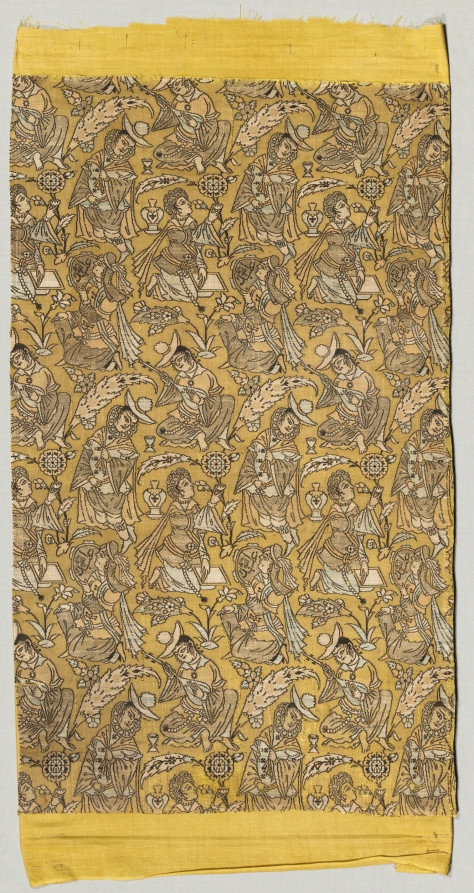
The Imperial Thread: Deconstructing the Lampas of Dancers and Musicians
In the rarefied atmosphere of a Savile Row fitting room, where the cut of a lapel is debated with the gravity of a diplomatic treaty, one seldom pauses to consider the provenance of the cloth itself. Yet, the very fabric that drapes a bespoke dinner jacket or a ceremonial court coat carries within its warp and weft a history far more intricate than the most complex pattern draft. We speak, of course, of the lampas—a compound weave of such structural and artistic sophistication that it represents the apogee of the imperial silk weaver’s art. This artifact, a lampas depicting dancers and musicians, is not merely a textile; it is a frozen symphony, a diplomatic communiqué, and a testament to the unbroken lineage of luxury that defines the very essence of heritage craftsmanship.
Materiality and the Grammar of the Loom
To understand this piece, one must first appreciate the sheer technical audacity of its construction. The lampas weave is a poly-chromatic structure, typically employing two distinct warp systems and two or more weft systems. The ground weave, often a satin or twill, provides the structural foundation, while a supplementary, pattern-forming weft is bound by a second, often finer, warp to create the figurative design. This is not a simple embroidery applied to a ground cloth; it is a fully integrated, compound structure where the image is woven *into* the very DNA of the textile. The materiality of the silk itself is paramount. The lustrous, continuous filaments of *Bombyx mori*—the mulberry silkworm—were reeled with monastic precision. The resulting yarn possessed a tensile strength and a natural, prismatic sheen that no modern synthetic can replicate. In this lampas, the silk’s inherent luminosity is manipulated with genius: the ground satin is woven to catch the light in a subtle, monochromatic shimmer, while the supplementary weft, often in a contrasting hue of gold, ivory, or deep madder, rises from the surface to delineate the figures. The effect is one of bas-relief, a sculptural dimensionality that shifts with the viewer’s angle, much like the play of light on a well-cut worsted.
The Choreography of the Court: Iconography and Power
The iconography of dancers and musicians is not decorative whimsy. Within the context of imperial silk weaving—a tradition that flourished across Byzantine, Sassanian, and later, Chinese and Ottoman courts—such imagery was a deliberate assertion of cosmic and temporal order. The figures, often depicted in rhythmic, stylized poses, are not merely entertaining the court; they are performing the *harmonia mundi*, the music of the spheres that legitimized the emperor’s rule. The musician’s lute or the dancer’s flowing scarf is a visual metaphor for the harmonious governance of the realm. To wear such a textile, or to present it as a diplomatic gift, was to clothe oneself in the very concept of divinely ordained authority. The weaver, therefore, was not an artisan but a political theologian working in thread. The precision of the pattern—the exact curvature of a dancer’s arm, the intricate detailing of a stringed instrument—was a measure of the empire’s technological and artistic supremacy. A flaw in the weave was not a mere defect; it was a crack in the facade of imperial omnipotence. This is the same philosophy that underpins the Savile Row ethos: the relentless pursuit of perfection as a form of quiet, unassailable authority.
A Legacy Woven in Gold: From Imperial Loom to Modern Heritage
The legacy of this imperial weaving tradition is not confined to museum vitrines. It is a direct antecedent to the Western luxury textile industry that emerged in Lyon and, subsequently, informed the grand tailoring houses of London. The technical innovations of the drawloom, and later the Jacquard mechanism—which was, in essence, a mechanization of the pattern-control system used by imperial weavers—were born from the necessity to replicate the complexity of fabrics like this lampas. When a modern tailor selects a silk jacquard for a smoking jacket or a brocade for a waistcoat, he is engaging with a direct technological and aesthetic descendant of this very artifact. The language of luxury remains consistent: the weight of the cloth, the integrity of the weave, the depth of the colour. A connoisseur on Savile Row understands that a fabric’s value lies not in its novelty, but in its adherence to a standard of excellence that has been refined over centuries. This lampas is the ur-text of that standard. It whispers of a time when cloth was commissioned, not purchased; when a single bolt of silk could take a year to produce on a single loom; and when the resulting fabric was worth more than its weight in gold, both literally and symbolically.
Preservation and the Patina of Time
Examining this specific artifact, one notes the subtle shifts in hue—the gentle fading of the madder red to a soft terracotta, the slight dulling of the gilt thread. This is not damage; it is the patina of history. It speaks to the centuries of careful handling, of being draped in ceremonial halls, of being folded and stored in cedar chests. The conservation of such a piece is an act of profound responsibility. It requires a deep understanding of the silk’s chemistry and the weave’s structural vulnerabilities. The goal is not to restore it to a hypothetical pristine state, but to stabilize it, to halt the decay of time while honouring the evidence of its journey. This philosophy mirrors the approach of a master cutter who, when altering a vintage garment, works with the original seams and fabric stress points, respecting the garment’s history rather than erasing it. The lampas is a relic, but it is a living relic. Its threads still hold the tension of the loom, its colours still retain the memory of the dye vat, and its pattern still performs the eternal dance of the court. It is a reminder that true heritage is not static; it is a continuous, tactile conversation between the past and the present, a conversation that we, as custodians of craft, are privileged to continue. The cloth endures, and in its endurance, it defines the very meaning of enduring style.
Heritage Lab Insight
Lab Insight: CMA Silk Archive Node integration.