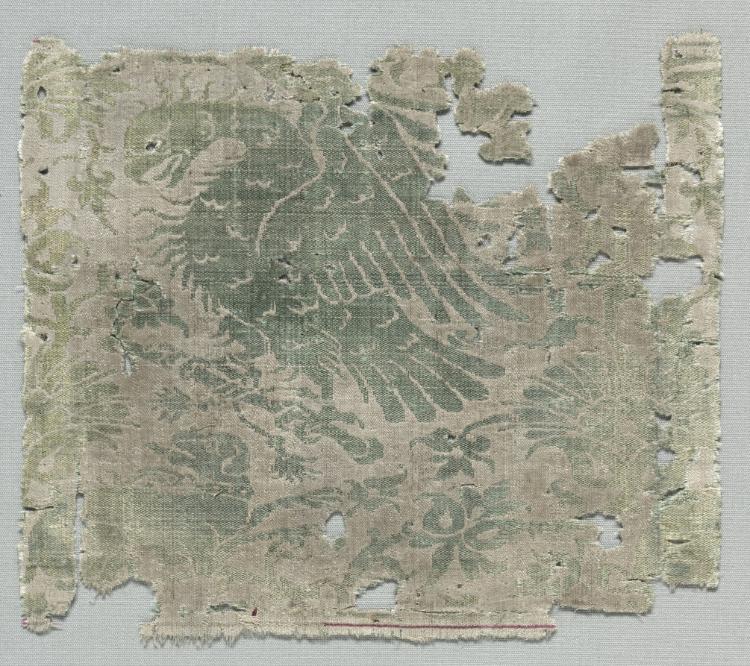
An Examination of Imperial Legacy in a Singular Fragment
One must first dispense with the notion of the textile as mere cloth. To regard this artefact—a fragment of silk, its dimensions modest, its edges frayed by the relentless passage of centuries—as a simple piece of fabric is to profoundly misunderstand its station. It is, rather, a condensed narrative. A physical manifesto of power, aesthetics, and technical dominion. The material, pure silk, is the essential prerequisite; the *raison d'être* and the canvas. But it is the legacy imprinted upon it—the ghost of the imperial loom—that commands our scholarly and sartorial attention. We are not considering a commodity, but a relic of a system where thread was politics, and pattern was proclamation.
The Substrate of Sovereignty
The foundation, as with any endeavour of consequence, is everything. The silk itself, before a single supplementary thread is introduced, speaks of enforced monopoly. In the context of the Chinese imperial courts, particularly during the zeniths of the Tang and Song dynasties, silk was not a textile among many. It was the pre-eminent medium of state. Its production, from the cultivation of the mulberry groves to the hushed, disciplined atmosphere of the official workshops, was a state-controlled enterprise. The fibre’s inherent qualities—its luminous sheen, its formidable tensile strength, its sublime capacity to hold colour—made it the only suitable medium for articulating the cosmology of the empire. This fragment, therefore, begins its life not in a mill, but within a bureaucratic and artistic complex of staggering scale and precision. The hand that eventually drew the design did so with the weight of imperial sanction; the loom upon which it was realized was, in every meaningful sense, an instrument of state.
The Grammar of the Loom: Technique as Tyranny
Upon this impeccable substrate, we encounter the true language of legacy: the weave. Close inspection, under appropriate magnification, is likely to reveal a structure of formidable complexity. We posit the presence of a damask or, more probably, a kesi (slit-tapestry) technique. The distinction is critical. A simple damask, for all its beauty, operates within a binary conversation of warp and weft, creating pattern through light and shadow. The kesi method, however, is an act of pictorial weaving of such meticulousness that it borders on the obsessive. Each colour area is woven with a separate bobbin, building the image as a painter builds a glaze, resulting in a texture that is subtly raised and a reverse side nearly as pristine as the face.
This was not efficiency; it was extravagance codified into technique. The imperial workshops had at their disposal not merely the finest raw silk, but the most profound investment of time—a currency beyond reckoning. The fragment, in its dense, intricate patterning, communicates a silent, potent truth: the empire commanded not only resources, but *time itself*. It could allocate thousands of man-hours to the creation of a single robe, a single hanging. The technical mastery evident in every interlocking thread is a direct expression of administrative power and cultural confidence. It is, in essence, the tyranny of perfection.
Iconography: The Pattern of Order
The narrative woven into this silk fragment is, undoubtedly, one of sanctioned symbolism. Imperial iconography was a closed lexicon, its usage strictly governed by sumptuary laws. One does not find the pastoral or the whimsical here. We must anticipate the presence of the five-clawed dragon (*long*), reserved exclusively for the Son of Heaven, or perhaps the phoenix (*fenghuang*), emblem of the empress. Flanking these central motifs would be a supporting cast of potent symbols: clouds (*xiangyun*), representing celestial fortune; the eternal knot, signalling continuity; or the sacred mountains, embodying stability.
This was not decoration; it was a heraldic system, a visual constitution. To wear or display this silk was to be enveloped in the very ideology of the state. The pattern reinforced a cosmic and social order, reminding all who beheld it—courtier and foreign envoy alike—of the emperor’s pivotal role as the axis between heaven and earth. The fragment, in its partial state, offers a tantalizing glimpse of this totalizing visual language. A single claw, a fragment of a wing, a curl of cloud—these are enough for the informed eye to reconstruct the entire cosmology from which they were excised.
A Legacy Measured in Threads
Today, this fragment exists in silence, divorced from the ceremonial roar it was designed to accompany. Yet, its power is not diminished; it is distilled. It serves as an irreducible core sample of a civilization’s highest aesthetic and technical ambitions. The legacy of imperial silk weaving is not merely one of beautiful things, but of a complete integration of material, technique, and meaning. It established a paradigm where textile was tantamount to text.
This paradigm echoes, centuries later and continents away, in the ateliers of Savile Row and the grand *maisons* of Europe. The insistence on the superlative substrate, the reverence for hand-executed technique (the bespoke stitch, the hand-rolled lapel), and the deployment of a subtle, coded visual language through cut and cloth—these are the direct, if distant, inheritors of the imperial loom’s philosophy. One does not merely wear a length of cloth; one inhabits a legacy. This fragment of silk, therefore, stands as both a terminus and a genesis. It is the physical endpoint of an ancient imperial command, and the enduring benchmark for what it means to imbue material with the profound, ineffable qualities of authority, artistry, and legacy.