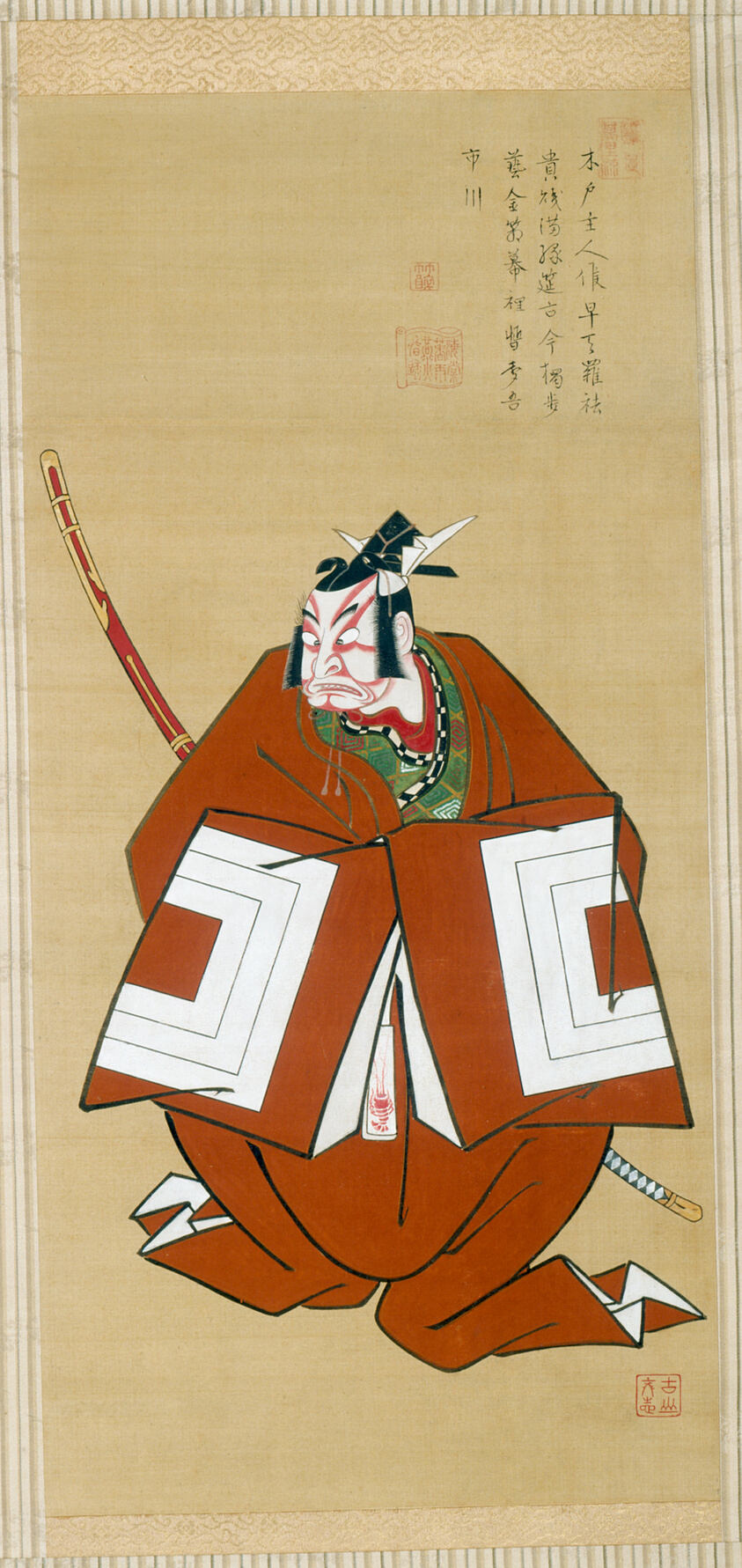
An Examination of Lineage and Line: The Portrait of Ichikawa Danjuro II as Kamakura no Gongorô
In the considered appraisal of heritage, one must distinguish between the mere antique and the artifact of enduring consequence. The former speaks of age alone; the latter, of a narrative continuity, a dialogue between mastery of form and the substance upon which it is rendered. This portrait of Ichikawa Danjuro II, the preeminent kabuki actor of his generation, in the formidable guise of the warrior Kamakura no Gongorô Kagemasa, presents itself not as a simple theatrical record. It is, rather, a definitive statement on the confluence of artistic lineages—a sartorial and performative heritage captured with impeccable discretion upon the most demanding of canvases: silk.
The Foundation: A Ground of Uncompromising Substance
One does not commission a bespoke suit from inferior cloth; the foundation dictates the dignity of the final form. So it is here. The selection of silk as the ground is the first and most critical act of curation. This is not a medium that tolerates indecision or the tentative stroke. Its surface, a testament to generations of sericultural and weaving expertise, possesses a latent luminosity, a cool, receptive sheen that absorbs and subtly refracts pigment. It demands from the artist a certainty of hand, for errors cannot be scrubbed away without consequence. The silk’s inherent fluid elegance is not a quality it lends to the work so much as a quality the work must earn through respect for its character. The craftsmanship in the material’s very weave—the density, the fall, the hand—provides the silent, essential proscenium for the drama to come.
The Art of Implication: Tailoring the Icon
The portrait operates on the principle of sartorial implication, a concept familiar to the finest ateliers. Danjuro II does not merely wear the costume of Gongorô; he is architecturally structured by it. The artist, a master of his own lineage, employs ink and colour not to drown the silk, but to articulate a presence. The sweeping lines of the voluminous kamishimo robes are rendered with a brushstroke that understands drape and weight—the way stiff, patterned silk brocade would fall from a shoulder held in the mie, the actor’s signature pose. The bold, geometric patterns are not flat decoration; they are described with a subtle modulation of tone, suggesting the play of light across the actual woven threads of the garment.
This is portraiture as tailoring. The actor’s physique is defined not by anatomical detail, but by the cut and carriage of his regalia. The fierce, stylized kumadori makeup is applied to the face with the same precision a cutter would employ in crafting a lapel—a sharp, graphic statement that transforms the individual into an icon. Every element, from the grip on the sword hilt to the set of the feet, communicates a narrative of heroic, unyielding potency. The image is a distillation of a performance, a permanent encapsulation of a transient moment of theatrical power, much as a well-cut garment distils the essence of its wearer’s stature.
Provenance and Performance: The Heritage of Presence
The subject himself, Ichikawa Danjuro II, was not an actor in the common sense. He was the curator and chief exponent of the aragoto style—a bombastic, heroic form of kabuki—and the head of a theatrical dynasty. To be painted in this role was to cement a legacy, to stitch one’s name into the continuous fabric of a cultural tradition. The portrait, therefore, serves a dual heritage function. It documents the individual genius of Danjuro II, his particular embodiment of Gongorô. Simultaneously, it reinforces the iconography of the Danjuro line itself, a brand of performative excellence as recognizable and revered as the hallmarks of a master tailor.
The artifact thus becomes a nexus. It connects the heritage of classical Japanese silk craftsmanship, with its centuries-deep knowledge, to the living heritage of the stage. It links the artist’s school of painting to the actor’s school of performance. The silk is the constant, the dignified ground upon which these dynamic lineages momentarily align and are immortalized.
A Concluding Appraisal: The Quiet Authority of the Artifact
In final analysis, this hanging scroll possesses the quiet authority of a truly significant heritage piece. It avoids the vulgarity of overt display. There is no gilding, no excessive ornamentation upon the narrative. Its power derives from the assured marriage of supreme materiality and expressive intent. The silk provides the requisite gravitas, the silent depth against which the vivid, controlled performance of ink and colour is staged.
To engage with it is to understand that heritage is rarely a single thread. It is a warp and weft. Here, the vertical warp is the timeless, technical heritage of the silk itself—the cultivation, the loom, the weaver’s art. The horizontal weft is the dynamic, performative heritage of the Danjuro line, the kabuki theatre, and the painter’s tradition. Woven together on this singular occasion, they produce an artifact of enduring resonance: a portrait that is less a likeness of a man, and more an impeccably fitted embodiment of a legacy. It stands as a testament to the principle that true elegance, whether in cloth, paint, or performance, is always an expression of disciplined power and profound respect for one’s materials.