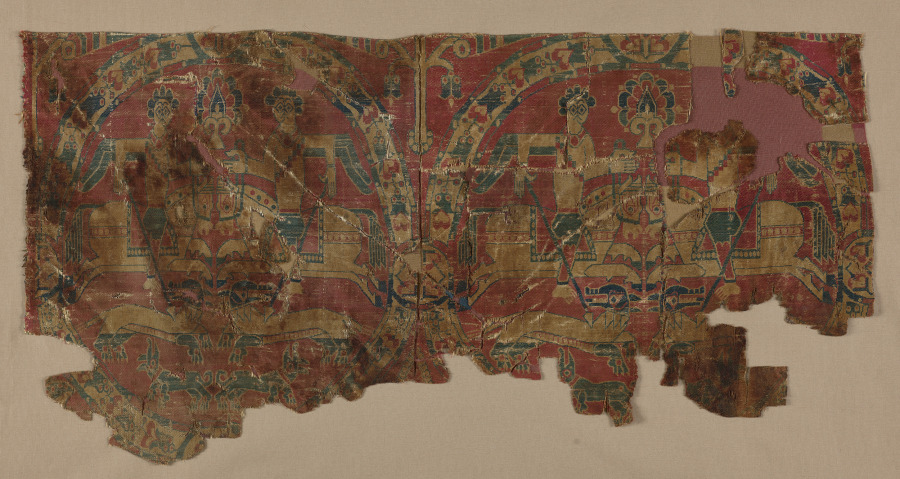
An Examination of the Equestrian Roundel: Imperial Authority Woven in Silk
To comprehend the significance of the silk roundel depicting hunters, one must first appreciate the foundational grammar of the material itself. Silk is not merely a textile; it is a testament to controlled complexity, a language of power articulated through threads of astonishing fineness and resilience. Its very production, from the meticulous cultivation of the Bombyx mori silkworm to the orchestration of vast, state-sanctioned weaving ateliers, was an imperial prerogative. The resultant fabric possessed a luminosity, a tactile sophistication, and an inherent value that rendered it the ultimate substrate for conveying status. To adorn one's person or one's court with such material was to engage in a silent, yet profoundly eloquent, declaration of one's place within a meticulously ordered cosmos. The roundel, or medallion, motif—a contained, repeating emblem—elevated this declaration into a heraldic system, a code of symbols woven into the very fabric of authority.
The Syntax of the Hunt: A Narrative of Dominion
The specific depiction of the hunter within the confines of the roundel is a subject rich with connotation. This is no mere genre scene of pastoral pursuit. Consider the composition: the hunter, invariably mounted, is captured in a moment of dynamic tension—the drawn bow, the poised spear, the focused gaze upon quarry often mythical or regal in its own right (the lion, the griffin, the stag). The circular boundary of the roundel does not constrain the scene but rather frames and concentrates its energy, much as a well-cut bespoke garment frames the form of the wearer, directing the observer’s eye with deliberate intent.
This imagery operates on multiple, simultaneous frequencies. On the most immediate level, it proclaims martial virtue—courage, skill, and equestrian mastery, the foundational virtues of a warrior aristocracy. On another, it serves as a potent metaphor for imperial dominion. The hunter, an analogue for the emperor or king, imposes order upon the chaotic, untamed forces of nature, represented by the beast. His success within the woven sphere mirrors the sovereign's duty to maintain harmony and exert control within the bounded sphere of his empire. The hunt is, therefore, a ritual of kingship, translated from the forest to the loom. The repetition of these roundels across the expanse of a robe or a hanging creates a rhythmic visual field, a relentless assertion of this sovereign principle, echoing the repetitive, disciplined structure of the imperial court itself.
Materiality as Message: The Loom as an Instrument of State
The execution of such complex iconography in silk, specifically in tapestry weave or fine samite, represents a technological and administrative marvel. Imperial silk workshops, such as those of Byzantium, Sassanian Persia, or later, the Ming dynasty, were less akin to craft guilds and more to strategic research departments. They possessed and guarded the proprietary knowledge required for such work: the mastery of dyestuffs yielding the enduring crimson, sapphire, and gold; the engineering of draw-looms capable of translating intricate cartoon designs into flawless textile reality; the coordination of skilled labour across every stage of production.
This material reality imbues the hunter roundel with a further layer of meaning. The cost, exclusivity, and technical virtuosity of the object made it a privileged instrument of statecraft. Bestowal of silks adorned with such symbols was a primary mechanism for reinforcing the political hierarchy. A robe of honour (khil'a), glittering with gold-thread hunters, conferred not just wealth but a tangible fragment of imperial legitimacy upon its recipient. It wove the wearer literally and figuratively into the patron's narrative of power. The durability of silk ensured that this message, unlike a spoken decree or a parchment edict, endured—passing through generations as a physical heirloom of loyalty and favour.
A Legacy in Thread: From Imperial Ateliers to Sartorial Consciousness
The legacy of these imperial silks is profound and curiously perennial. While the explicit language of the hunter roundel may have faded from official regalia, its underlying principles—of symbolic representation, of quality as a language, and of tradition as a living continuum—underpin the most refined expressions of contemporary tailoring. The Savile Row ethos, though separated by centuries and continents from the weavers of Constantinople or Suzhou, operates on a cognate philosophy.
Consider the parallels: the emphasis on provenance and the finest raw materials (British wools, Italian silks) mirrors the imperial monopoly on premium silk. The dedication to craftsmanship, where a garment is the product of a master's hand and eye, sustained over years of apprenticeship, echoes the specialised, secretive knowledge of the loom technicians. Most pertinently, the use of subtle, coded symbols—the regiment stripe of a cavalry twill, the distinct pattern of a Scottish tweed, the specific cut of a lapel—functions as a modern roundel. These are not loud logos, but discreet emblems understood by a cognoscenti, denoting affiliation, tradition, and a place within a certain hierarchy of taste and attainment.
The hunter, frozen in silk, thus transcends his specific historical context. He becomes an archetype of cultivated prowess, a reminder that true authority has always been expressed through a combination of symbolic narrative and material excellence. The imperial workshops understood that to clothe power in beauty and complexity was to make it tangible, enduring, and unquestionably legitimate. In this, they established a precedent that the most discerning tailoring houses of the modern age continue, consciously or not, to honour: that heritage is not merely preserved in archives, but is woven, stitch by deliberate stitch, into the very fabric of the present.