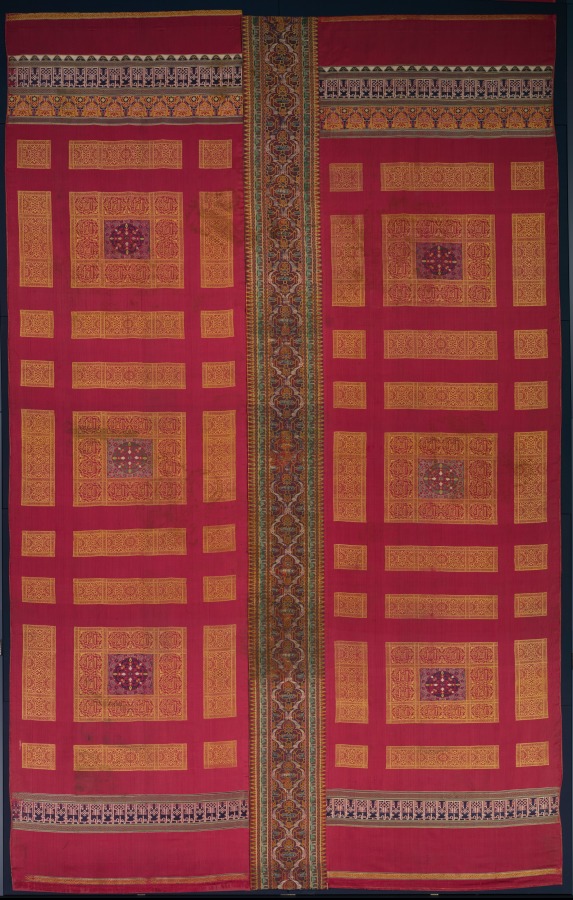
An Examination of a Specimen: The Alhambra Silk Curtain
One must approach this artefact not as a mere decorative textile, but as a definitive statement of power, articulated through the most sophisticated medium of its age. The subject is a silk curtain, or fragment thereof, attributed to the palatial workshops of the Alhambra during the Nasrid dynasty’s zenith. Its materiality—pure silk—is the foundational datum from which all further analysis proceeds. This is not simply fabric; it is the physical manifestation of an imperial supply chain, a technological monopoly, and a visual language of unassailable authority. To comprehend its stature, one must appreciate silk not as a commodity, but as the hard currency of prestige in the medieval Mediterranean theatre.
The Means of Production: A Command Economy in Thread
The existence of this curtain presupposes a formidable and vertically integrated apparatus. The legacy of imperial silk weaving, from Byzantium to Baghdad and thence to Al-Andalus, was one of strictly guarded state control. The sericulture, the dyeing with rare pigments—crimson from kermes, gold from saffron—and the complex operation of the draw-loom, were operations comparable in secrecy and strategic value to a modern atelier’s proprietary tailoring techniques or fabric mills. The Alhambra’s tiraz workshops were less a manufactory and more a research and development bureau for soft power. Every metre produced was a deliberate expenditure of sovereign capital, intended for diplomatic gift, royal vestment, or, as in this case, the adornment of the palace itself. The curtain was, therefore, an instrument of policy. Its very presence in a chamber spoke of the Sultan’s reach, his command of global trade routes stretching to the Silk Roads, and his patronage of consummate technical skill. It was the period’s equivalent of a bespoke superfine wool, woven on a solitary, secret loom in Huddersfield, reserved exclusively for a select clientele of consequence.
Material Intelligence: A Fabric of Inherent Authority
Silk, in this context, possesses an innate material intelligence that lesser fibres cannot replicate. Its luminosity, a product of the triangular prism structure of the filament, captures and refracts light in a manner that animates architectural space. In the subdued, filtered light of the Alhambra’s courtyards and halls, a silk curtain would not hang inert. It would shimmer, its surface alive with the changing diurnal rhythm, transforming a static partition into a dynamic, breathing membrane. This performative quality is deliberate. The curtain manages perception, controlling vistas and modulating atmosphere with a quiet authority. Furthermore, its acoustic properties—dampening reverberation—would have softened the cacophony of courtly life, contributing to an aura of serene, insulated power. The tactile experience, reserved for the privileged few permitted to handle or pass it, reinforced hierarchy through sensory engagement. This is a fabric that communicates through drape, sheen, and handle, much as a superlatively tailored garment communicates through roll, break, and silhouette.
Iconography as Corporate Identity
The decorative schema, invariably geometric interlacing or stylised epigraphic bands—the so-called tiraz inscriptions—demands a particular reading. This is not mere ornament; it is the brand identity of the Nasrid state. The repetitive, infinite patterns, mathematically precise and flawlessly executed, served a dual purpose. Aesthetically, they embodied the Islamic principle of an ordered universe, a visual metaphor for divine and, by extension, royal harmony. Practically, they proclaimed the resources and discipline of the royal workshop. The complexity of the weave, achieving such sharp, continuous patterns in costly silk, was a bravura demonstration of technical capability. It was a statement akin to a flawless hand-stitched buttonhole on a military greatcoat or the imperceptible precision of a draped lapel: a detail that, to the educated eye, speaks volumes about the integrity of the entire enterprise. The inclusion of Arabic script, often bearing the ruler’s name or pious formulae, transformed the textile into a portable and prestigious promulgation of sovereignty, a forerunner to the discreet yet definitive labels sewn into a bespoke suit.
Enduring Legacy: The Continuum of Conspicuous Craft
The ultimate legacy of this imperial silk weaving tradition lies in its enduring paradigm: the strategic deployment of peerless materials and craftsmanship to articulate status and cultivate a lasting heritage. The Alhambra curtain stands as a progenitor to a lineage of luxury defined by scarcity, skill, and symbolic resonance. The principles it embodies—the control of supply, the patronage of advanced technique, and the use of materiality to create an immersive experience of power—are directly analogous to the tenets of the modern heritage luxury house. The silk routes have evolved into global networks for sourcing exceptional cashmere or vicuña. The royal tiraz workshop finds its echo in the ateliers of Savile Row or the maisons d’art of Place Vendôme, where guarded knowledge is passed down through generations. The curtain was, in its essence, a bespoke commission for a palace, designed to impress a discerning international courtly audience. Its value was, and remains, inextricably linked to its provenance, its material integrity, and the silent, formidable statement of its making.
In conclusion, this fragment of silk is a document. It archives a comprehensive worldview where economics, art, politics, and technology were woven into a single, luminous thread. To study it is to understand that true heritage is never passive; it is an active, intelligent deployment of resources to create an object that transcends its function to become an icon of cultural and imperial ambition. Its lesson for the contemporary curator of brand heritage is precise: legacy is not found in nostalgia, but in the unwavering maintenance of standards so high that the object itself becomes indisputable.