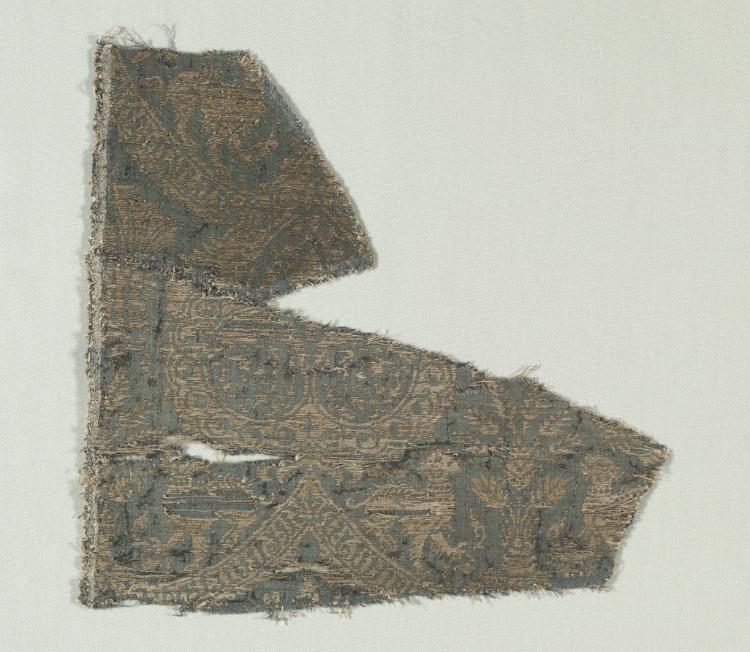
An Examination of a Curious Artefact: Silk with Dogs and Arabic Script in Swaying Bands
Within the archives of imperial textile production, one occasionally encounters a piece that gives the connoisseur pause—a confluence of elements so seemingly discordant that it demands a more rigorous, forensic appreciation. The subject in question, a fragment of silk depicting canines amidst bands of flowing Arabic script, represents precisely such an anomaly. To dismiss it as mere eccentricity would be a profound error. Rather, it stands as a testament to the complex, often politically charged dialogue of aesthetics that characterised the workshops of empire, where materiality was never merely decorative but a sophisticated language of power, faith, and cultural negotiation.
The Foundation: Imperial Silk and the Weight of the Loom
First, one must understand the stage upon which this piece was set. Imperial silk weaving, from Byzantium to Damascus, from Samarkand to the ateliers of the Ming, was never a trivial industry. It was, in essence, a state-controlled enterprise of immense prestige and economic significance. The loom was an instrument of policy. Silk functioned as currency, as diplomatic gift, as liturgical vestment, and as the ultimate sartorial demarcation of rank. The very fibre carries an innate gravity—a sheen that commands light, a density that drapes with authority, a durability that outlasts dynasties. This fragment, therefore, regardless of its specific iconography, begins with a pedigree of solemn consequence. It is a document woven in thread, intended for a gaze accustomed to reading cloth as one would a missive.
Deciphering the Dialectic: Canine and Calligraphy
Herein lies the compelling tension. The depiction of dogs within an Islamic context, particularly on an object of probable luxury, is a nuanced matter. Conventional wisdom notes a general ambivalence towards dogs in many Muslim societies, often regarding them as ritually impure. Yet, this perspective was never monolithic. Hunting dogs, salukis and gazehounds, were frequently celebrated in courtly poetry and miniature painting for their grace, speed, and nobility—attributes of the aristocratic pursuit of the chase. Their presence on this silk likely falls within this exceptional, secular courtly sphere. These are not curs, but creatures of refined lineage, depicted with a stylised vitality that suggests motion within the swaying bands.
Juxtaposed with these animated forms is the supreme art of Arabic calligraphy—the visible word made divine, the primary vehicle for transmitting the Qur’an. To render script in this context is to invoke reverence. The "swaying bands" describe a common decorative motif, the undulating scroll or *thuluth* inscription, often used to carry benedictory phrases, poetry, or the names and titles of a ruler. The script here is not mere pattern; it is semantic content, weaving literal meaning into the fabric’s structure. The dogs, then, do not profane the script; they exist in a parallel register of worldly, princely virtue, framed and compartmentalised by the sacred geometry of the written word. This is a visual dialectic between the spiritual and the temporal, the devotional and the dynastic.
A Hypothesis of Provenance and Purpose
Considering this dialectic allows us to hypothesise a plausible provenance. The most likely patrons for such a bold synthesis are the courts of the Ilkhanate, the Timurids, or later the Safavids—realms where Persianate culture, Islamic faith, and the Central Asian nomadic legacy of the hunt intermingled with singular sophistication. One might envision this silk commissioned for a princely pavilion, a ceremonial robe, or as a diplomatic gift to a foreign court, perhaps even a Christian one where the depiction of animals would be less contentious. It serves as a declaration of identity: a ruler who is both a devout Muslim *and* a scion of a steppe tradition, a patron of the holy arts *and* a master of the chase. The silk becomes a portable assertion of a complex, composite sovereignty.
The technical execution further refines this assessment. The precision required to render clear, legible script in weft-faced compound twill or satin damask is extraordinary. It speaks of a master weaver working from a detailed cartoon, overseen by a court designer intimately aware of the symbolic weight of each element. The dogs are not naturalistic but heraldic, stylised to fit the rhythmic flow of the band. This is not folk art; it is calculated, imperial propaganda in its most refined form.
Legacy and Concluding Reflections
The legacy of this artefact lies in its fearless synthesis. It refuses to be categorised neatly, challenging modern, often reductive, understandings of cultural and religious boundaries. In the hallowed tradition of Savile Row, where a garment’s lineage, cloth, and cut are read as an integrated biography, this silk fragment demands a similar holistic reading. Its materiality—the sumptuous, resilient silk—speaks of commerce and control. Its iconography—the script and the hounds—narrates a story of a courtly identity negotiating multiple heritages. Its very existence is an argument against purity in favour of a more intricate, layered reality.
To conclude, this piece of silk with dogs and Arabic script is far more than a textile curiosity. It is a woven treatise on imperial identity. It demonstrates that heritage is seldom a single, unbroken thread, but rather a masterfully arranged warp and weft of intersecting influences. The dogs, forever coursing through bands of sacred text, remind us that the fabric of history is rich with deliberate, intelligent contradiction, crafted for those with the discernment to look beyond the surface sheen and perceive the profound dialogue within.