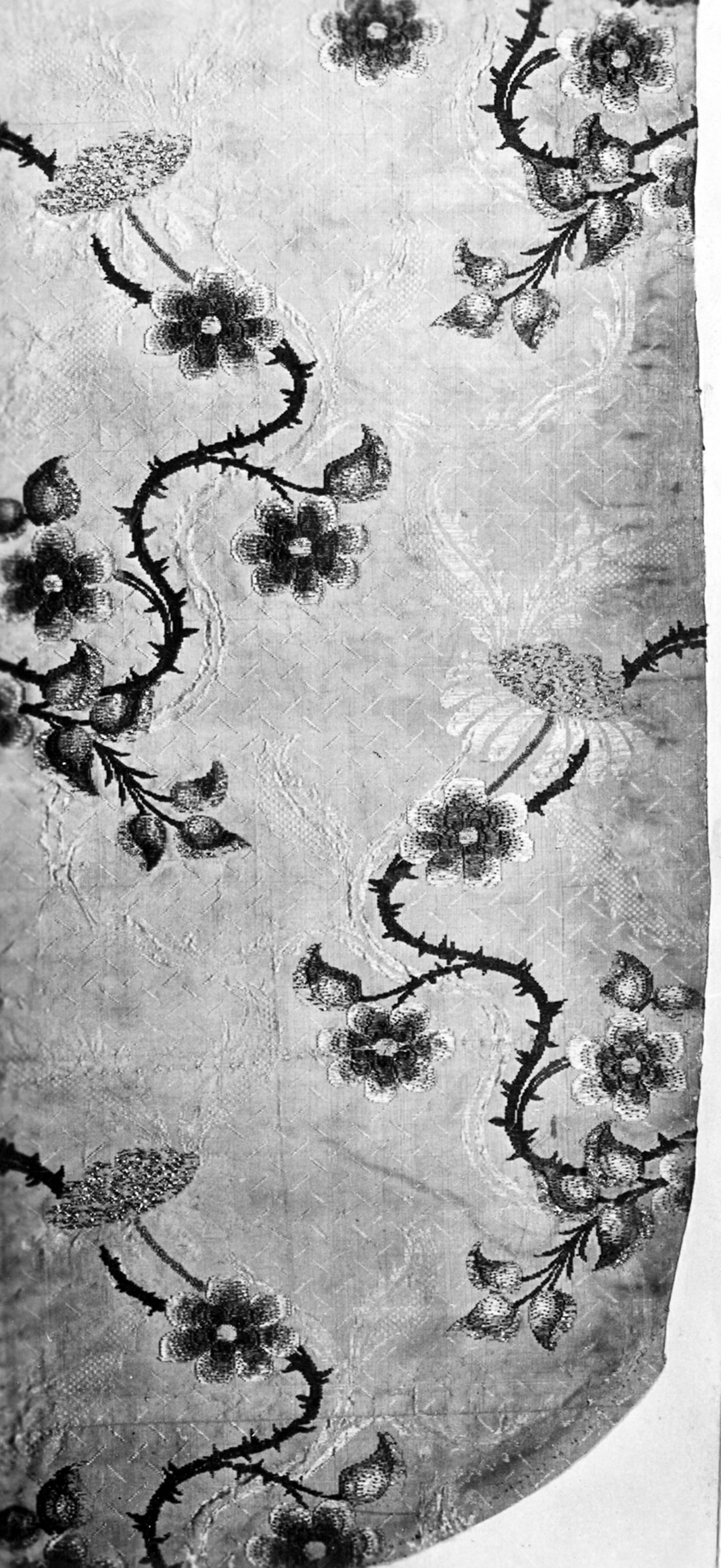
On the Nature of the Fragment: A Disquisition on Material Permanence and Ephemeral Grace
In the considered appraisal of any heritage, one must first reconcile with the inherent tension between the whole and its constituent parts. A complete garment—a gown, a robe, a tailored coat—speaks a declarative language. It announces its purpose, its era, its station. A fragment, by stark and eloquent contrast, whispers. It is a suspended note, a captured breath, a proposition left tantalisingly unresolved. The specimen under examination—a swatch of brocaded plain compound cloth in silk—exists in this state of potent incompletion. It is not a relic of a garment, but rather a testament to the art of the cloth itself, liberated from the transient dictates of fashion to assert its own immutable principles.
The Architecture of Substance: Deconstructing the Compound Cloth
To the untrained eye, it may present merely as a rich, textured silk. To the connoisseur, it is a topographic map of technical ambition. The term ‘plain compound cloth’ denotes a foundational architecture of considerable sophistication. Here, multiple series of warps and wefts are employed not for mere ornament, but for structural integrity and dimensional character. A ground structure, likely a simple tabby, provides the canvas. Upon this, additional binding warps or wefts are introduced, creating a secondary layer that is integral yet distinct. The result is a cloth of substantial body, a deliberate weightiness that possesses what we might term authoritative drape.
This is not the fluid, gossamer silk of chemises or linings. This is silk as building material. It has been engineered, through the ancient logic of the loom, to hold a shape, to define a silhouette, to interact with gravity as a partner rather than a victim. The hand, as we say, is firm. Yet, within that firmness lies the quintessential paradox of the finest silks: a resilient tensile strength that belies a surface of supreme, almost liquid, smoothness. It is this very compound structure that provides the stable, unyielding ground necessary for the brocade’s performance.
The Brocade: A Narrative in Relief
The brocading—the deliberate introduction of a supplementary, often pattern-forming weft—is where the cloth transitions from engineering to art. In this fragment, the brocade is not a mere surface appliqué; it is born from within the matrix of the compound foundation. The pattern, now partially lost to the fragment’s bounds, suggests a disciplined, repeating motif. Perhaps a stylised floral scroll, a geometric fret, or a heraldic device reduced to an intriguing ambiguity.
The raised texture of the brocade against the subdued ground creates a play of light and shadow as deliberate as any Savile Row lapel roll. This is where fluid elegance is not a passive quality, but an active event. As the cloth moves, the brocaded elements catch the light sequentially, creating a low-relief narrative that changes with the wearer’s posture. The elegance is in the controlled revelation, the slow, dignified disclosure of pattern that respects both the cloth and the observer. It speaks of a time when luxury was measured not in logos, but in the patient accretion of such subtle, textural incident.
The Fragment as Philosophical Proposition
And so we return to the central condition of our artifact: its fragmented state. This is not a deficit, but a profound attribute. The complete bolt of cloth implies potential, awaiting the shears of the cutter. The completed garment declares its function. The fragment, however, exists in a pure state of material essence. It allows us to study the dialogue between compound ground and brocaded pattern without the distraction of seam, hem, or fitting.
Its edges are raw, a frank presentation of its woven terminus. They remind us that this splendour was, and is, the product of a grid, a binary system of warp and weft raised to an aesthetic zenith. In its isolation, the fragment becomes a synecdoche for the entire tradition of classic silk craftsmanship. It contains, in microcosm, the entirety of the weaver’s ambition: the structural rigour, the textural poetry, the chromatic harmony (even if now faded), and the pursuit of a beauty that is inherent to the material’s own manipulation.
Furthermore, it invites a contemplation on permanence. Silk, for all its perceived delicacy, is a protein filament of remarkable endurance when cared for. This fragment has outlived its original context—the gown, the furnishings, perhaps even the society that produced it. Yet, the brocade remains crisp, the compound structure intact. It embodies a fluid elegance frozen in time, a captured moment of technical mastery that continues to communicate across centuries.
Conclusion: The Legacy in the Remnant
To hold this fragment is to hold a set of principles. It is a manual of sorts, advocating for integrity of construction as the non-negotiable foundation of beauty. It argues for ornament that is structural, for pattern that emerges from within rather than being imposed from without. Its fluid elegance is not an accident of thin material, but a calculated achievement of complex weaving—a grace earned through discipline.
For the modern practitioner, whether in fashion or beyond, this silk fragment serves as a permanent reminder. In an age of rapid fabrication and superficial effect, it champions depth over display, substance over surface, and the enduring whisper of masterful materiality over the declarative shout of transient style. It is, in its incomplete state, a more complete statement of value than many a whole garment could ever aspire to be. The fragment, therefore, is not a broken thing. It is a concentrate. And in its silent, textured eloquence, it speaks volumes.