On the Substance of Sovereignty: A Disquisition on Brocaded Silk
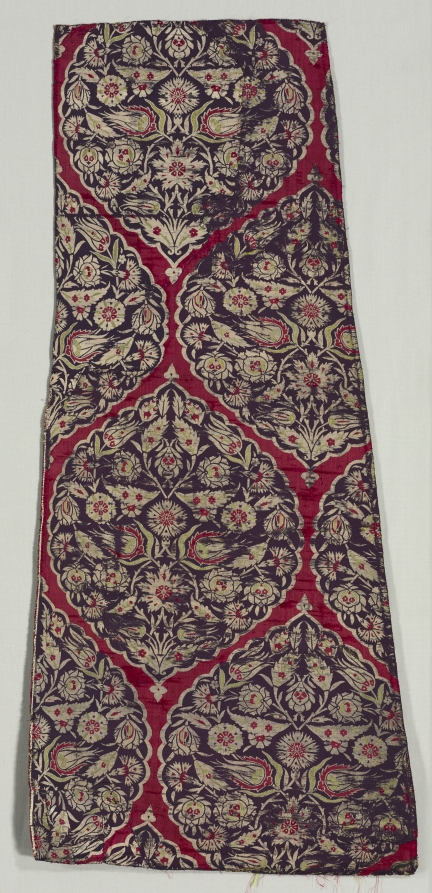
To consider silk is to engage with the very fabric of history, not as metaphor, but as material fact. It is a thread—lustrous, tensile, and formidable—that has, for millennia, bound the narrative of empire, commerce, and aesthetic authority. Our subject here is not merely a textile, but a specific articulation of power: a length of brocaded silk, its ground a profound, resonant crimson, upon which rests a precise, repeating sequence of foliate medallions. This fragment, now resting in the subdued light of the archive, once formed the sleeve or perhaps the panel of an imperial kaftan. Its existence is a testament to a legacy of weaving so exacting, so laden with intention, that it transcends decoration and enters the realm of geopolitical language.
The Loom as Diplomatic Chamber
The first point of analysis must be the brocade itself. This is not embroidery, an application of surface ornament. Brocade is structural, its pattern—in this instance, those foliate medallions—woven into the very being of the cloth by a supplementary weft. The process is one of profound deliberation and immense technical constraint, requiring a draw-loom operated by a master weaver and his assistants. Each medallion, therefore, is not stamped nor printed; it is architected into existence. The motif, a harmonious confluence of stylised blossoms, vines, and perhaps a subtle hint of the celestial, is never merely floral. It is a coded lexicon. In the Ottoman context, from which such a piece likely originates, the tulip, the carnation, the hyacinth, were not simple garden varieties; they were emblems of paradise, of dynastic continuity, and of a divinely ordained natural order over which the Sultan presided. To cloak oneself in this brocade was to don a portable manifestation of the realm’s cultivated perfection.
The Crimson Ground: A Field of Authority
Observe the ground. This particular crimson, achieved through the meticulous application of kermes or later cochineal, is a colour of profound cost and consequence. In an age prior to chemical dyes, the depth and fastness of such a hue spoke volumes of the patron’s reach. It required vast resources—countless insects, skilled dyers, and the purest water—to produce a colour that would not fade to insignificance. It is the colour of vitality, of imperial ceremony, and of a wealth so entrenched it need not announce itself with garishness. The silk thread itself, the foundation, represents the pinnacle of sericulture, a technology guarded with the utmost secrecy by the Chinese for centuries, its eventual dissemination westward a story of industrial espionage rivaling any modern tale. To possess the means to produce silk of this calibre—the filament uniform, the twist consistent, the sheen a subdued fire—was to command a critical node in the global economy of prestige.
The Medallion: A Universe in Microcosm
The foliate medallion pattern is arranged with a rhythmic, infinite repeat. This is a key distinction. It suggests not a narrative scene, but an endless, replicable order. There is a quiet, relentless logic to it, a geometry beneath the flora. The medallion acts as a self-contained universe, a mandala of imperial ideology, which then multiplies across the fabric to create a field of boundless, structured splendour. The kaftan for which this was destined was not tailored in the modern, form-fitting sense. It was a garment of volume and drape, a mobile tent of state. When worn, the medallions would align across the wearer’s back and chest, framing the body with a symmetrical, awe-inspiring grandeur. In motion, the heavy silk would move with a deliberate, rustling cadence, the raised brocade catching the light differentially, causing the pattern to emerge and recede—a calculated performance of luxury.
The Legacy of the Loom: From Imperial Atelier to Savile Row Canvass
The legacy of this imperial silk weaving is not confined to museum vitrines. Its principles resonate in the most refined tailoring traditions of the modern age, not least our own on Savile Row. Consider the ethos: the absolute supremacy of material, the hidden complexity of construction, the language of pattern and cut that communicates belonging and status to a discerning few. The brocaded silk kaftan was, in its essence, a bespoke garment of the highest order, produced within a closed, state-sponsored atelier (the *karkhana*) to exacting personal measurements and specifications for a single, pre-eminent client. The relationship between the imperial patron and the master weaver was one of tacit understanding, of unspoken standards—a relationship mirrored in that between a head cutter and his distinguished client today.
Furthermore, the medallion, abstracted and refined, finds its echo in the discreet patterns of a printed silk lining, the intricate weave of a necktie, or the bold statement of a dressing gown. The understanding that cloth itself carries meaning, that its very texture and drape convey authority, is a direct inheritance from these imperial workshops. We work in wool, gabardine, and flannel where they worked in silk and metal-wrapped thread, but the foundational creed remains: material integrity is non-negotiable, and cut is the final, decisive arbiter of elegance.
Conclusion: The Fabric of History
This fragment of brocaded silk, with its foliate medallions silent upon a crimson field, is therefore far more than a relic. It is a condensed archive. In its warp and weft lie the stories of transcontinental trade routes, of guarded technological secrets, of botanical symbolism, and of the sheer, imposing will to manifest authority through material means. It represents a time when cloth was a primary medium of statecraft, worn upon the body as a direct expression of cosmic and earthly order. To study it is to understand that true luxury is never frivolous; it is the deliberate, masterful application of immense resource and artistry to create an object that speaks, quietly and unequivocally, of power. It is a standard against which all subsequent endeavours in the realm of crafted apparel must, in some small measure, be judged.