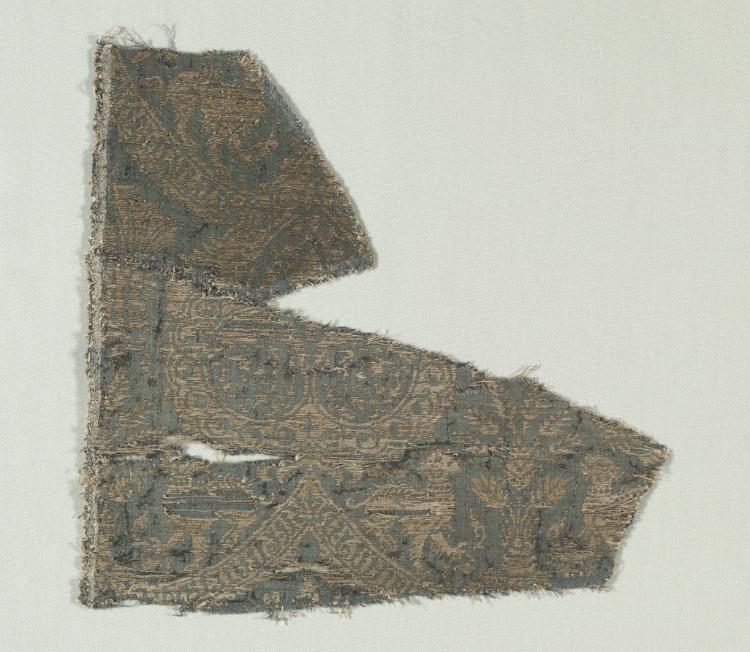
A Scrutiny of the Artefact: Canine Motifs and Kufic Script in Swaying Bands upon a Silk Ground
One approaches this particular fragment not as a mere textile, but as a document. Its very materiality—the warp and weft of cultivated silk—immediately establishes its provenance within the rarefied atmosphere of imperial patronage. This was not a commodity produced for the open market; it was a manifestation of power, a deliberate and costly articulation of authority intended for a milieu where visual language was as potent as the spoken word. The fragment, though perhaps modest in dimension, speaks volumes of the complex dialogues conducted along the arteries of ancient empires, where aesthetics served diplomacy and theology intertwined with zoological fancy.
The Foundation: Imperial Silk and Its Inherent Statement
To comprehend the artefact fully, one must first appreciate the foundation. Silk, in the context from which this piece originates, was never simply a fabric. It was a technology, a currency, and a severe social demarcation. The establishment of imperial silk ateliers—the tiraz workshops of the Islamic empires, for instance—was a strategic enterprise akin to the control of mint or armoury. The production was serialised, the patterns prescribed, and the distribution a carefully managed instrument of royal favour. To bestow a robe of honour (khil'a) woven from such stuff was to bind the recipient in a web of obligation and visible loyalty. Thus, the very ground upon which our dogs and script parade is imbued with a legacy of command. Its sheen, its durability, its tactile superiority were all prelude to the iconographic message awaiting decipherment.
Anomaly and Allegory: The Canine Presence in a Regal Context
The depiction of dogs, therefore, presents a fascinating and somewhat subversive intellectual puzzle. Within the cultural sphere suggested by the Arabic script, the canine was often viewed with ambivalence—useful as a hunter or guardian, but ritually impure. Its prominent, repeated figuration on a luxury textile destined for elite circles is consequently provocative. This is not the work of an atelier errant in its symbolism; it is far too deliberate. We must dismiss any notion of the decorative for its own sake.
Two interpretations present themselves, each reflecting a facet of imperial self-fashioning. The first is allegorical. The dog, particularly the sleek hunting hound (salūqī), was a steadfast companion of the aristocracy, a symbol of fidelity, nobility, and the martial pursuit of the chase—a pursuit that was itself a metaphor for kingship and the subjugation of chaos. To adorn silk with such motifs was to project these virtues onto the wearer. The second interpretation is more expansive, hinting at the syncretic nature of empire. The swaying bands that cradle the creatures may trace their lineage to earlier Sasanian or even Central Asian textile traditions, where paired animals in medallions were commonplace. The adoption and re-contextualisation of this form speak to an imperial confidence, an ability to absorb, reframe, and display a visual vocabulary from conquered or traded-with realms, thereby asserting dominion over their cultural output as well as their territories.
The Architecture of the Word: Kufic Script as Ornament and Ordinance
Interwoven with this zoological pageant is the stark, geometric authority of Arabic script, most likely in an early Kufic style. Here, text is not mere inscription; it is architectural ornament. The letters, with their verticals like pillars and horizontals like beams, form a band of immense graphic power. They are, undoubtedly, a benediction—a baraka—bestowed upon the recipient. Common formulae include invocations of prosperity, glory, or the often-encountered phrase from the tiraz repertoire: “Blessings from God to the wearer.”
However, its function transcends the talismanic. The script acts as the ultimate authenticator. It is the “label” of the imperial atelier, a guarantee of quality and origin. More profoundly, its very presence sacralises the ground it occupies and, by daring extension, the canine motifs it accompanies. It elevates the narrative from a possible scene of mere hunting to a divinely sanctioned order, where the natural world (the hound) operates within a framework blessed by the celestial. The text and image are not in conflict; they are in concert, one lending spiritual gravity to the other, and in turn, being animated by its vitality.
The Dynamics of the "Swaying Band": A Masterful Conceit
The composition’s genius lies in its motion. The description “swaying bands” is apt, suggesting a rhythmic, undulating framework that carries both script and beast. This is not a static, heraldic presentation. The band itself, likely a flowing ribbon or vine-like form, implies continuity, endlessness, and cyclicality—concepts dear to imperial ideology, which posited the reign as part of an eternal order. The dogs, captured mid-stride within these undulating confines, appear to move with a purposeful grace. The script, rigid in its individual letterforms, seems to drift upon the wave of the band. The entire effect is one of controlled dynamism, a frozen yet perceptible rhythm that speaks of a universe in harmonious, obedient motion around a central, imperial axis.
In final analysis, this silk fragment is a consummate piece of political communication. It utilises the supreme luxury material of its age to craft a message that is at once pious and powerful, traditional and assimilative. The dog, an earthly companion, is rendered noble through its context. The Word, divine in origin, is rendered tangible through its masterful execution. Together, upon their swaying, endless bands, they dance a silent ballet of authority, a testament to the fact that in the legacy of imperial weaving, the thread was never just thread; it was the filament from which the image of empire itself was spun.