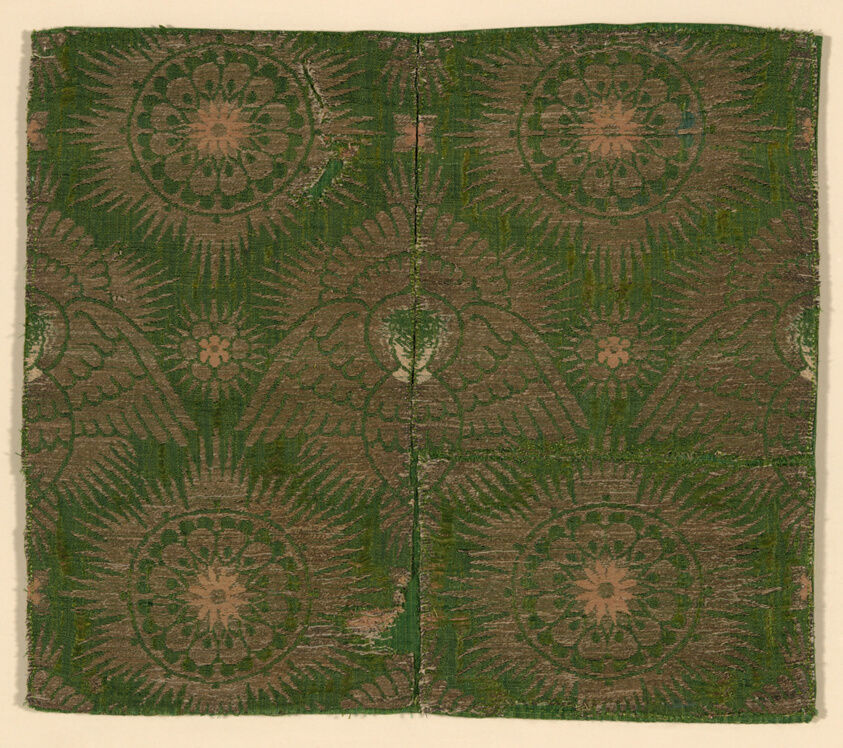
A Fragment: On the Persistence of Excellence
In the considered estimation of this house, true heritage is rarely presented as a complete narrative. It is, rather, encountered in fragments—a whisper of technique, a glimpse of a hand’s movement, a singular, enduring material truth. The artifact under examination, a fragment of silk and gilt-animal-substrate-wrapped linen, presents not as a relic of a finished garment, but as a foundational statement. It is a manifesto in miniature, asserting principles of construction, material integrity, and aesthetic intent that transcend the mere sum of its threads. To analyse this fragment is to engage in a dialogue with the very bedrock of classic silk craftsmanship and its pursuit of fluid elegance.
Deconstruction of a Code: The Twill Weave as Constitutional Framework
The foundation, a twill weave, is the first and most critical signature. This is not the simple, egalitarian plain weave of common cloth. The twill, with its diagonal rib—a subtle, continuous line of ascent—imparts inherent resilience, a superior draping quality, and a surface that engages with light in a graduated, sophisticated manner. It is the sartorial equivalent of a Savile Row canvassing: an underlying architecture designed for longevity and dynamic, three-dimensional form. The choice of twill is a declaration that the finished article must move with, not merely upon, the body. It is the technical precursor to fluidity.
This foundational weave is then elevated—complicated and enriched—by the introduction of secondary binding warps and supplementary patterning wefts. This is where craft distinguishes itself from mere manufacture. The secondary warps bind the structure, providing internal reinforcement without sacrificing pliability, much as a skilled tailor will employ hidden stitches to control a roll line or a lapel. The supplementary wefts are the discretionary flourish, the element of narrative. They are not essential to the cloth’s integrity, but are absolutely vital to its character. They are the silk’s equivalent of pick-stitching: a deliberate, skilled addition that speaks of surplus—surplus of effort, surplus of imagination, surplus of resource.
The Alchemy of Material: Silk and Gilt-Substrate
Materiality is where principle becomes palpable. The primary silk embodies the quintessential virtues of the classic: a natural filament of unparalleled strength, luminosity, and tactile pleasure. It is hygroscopic, temperature-regulating, and possesses a natural affinity for rich, penetrating dye. Silk is not a passive substrate; it is an active participant in the dialogue of elegance.
Its partner here, the gilt-animal-substrate-wrapped linen, demands particular scrutiny. This is not a simple metallic thread. The core—likely fine linen or parchment—provides a robust, flexible spine. This substrate is then meticulously wrapped with a thin strip of animal membrane, itself subjected to the gilding process, before being finally wound onto the thread. The result is a patterning element of extraordinary depth and nuance. The linen core ensures durability and prevents the brittleness of solid metal; the animal substrate provides a receptive, organic base for the gold; the gilding itself catches the light not with the garish, uniform glare of modern imitation, but with a warm, variable, and living sparkle. This is opulence achieved through complexity and layered skill, not through brute material excess. It speaks of a world where luxury was understood as the application of profound skill to noble materials.
The Synthesis: Fluid Elegance as a Constructed Ideal
The context provided—“Classic silk craftsmanship and fluid elegance”—is not a mere description but the fragment’s ultimate thesis. Fluid elegance is not an accident of a lightweight cloth. It is a constructed condition, engineered through the very interplay of elements we dissect here.
The twill weave provides the foundational drape. The silk offers the sensual, flowing hand. The complex interlacings of secondary warps and supplementary wefts create a cloth with a memory—a textile that will fall back into its intended lines, that resists crumpling, and that carries its embellishment as an inherent quality, not a superficial appliqué. The gilt thread, woven in, becomes structurally integral, its sparkle emerging from within the fabric’s depth as the wearer moves. This is elegance in motion, a visual and tactile phenomenon that changes with perspective and posture. It is the antithesis of static, rigid adornment.
To hold this fragment is to understand that the great heritage of silk craftsmanship is a heritage of intelligent construction. Every thread has a purpose; every technical decision serves a broader aesthetic and functional ambition. The fragment, in its incomplete state, powerfully refutes the notion that elegance is merely a surface effect. It reveals elegance as the final, visible expression of a deep material and structural logic.
Conclusion: The Fragment as Permanent Reference
In conclusion, this artifact, though a fragment, stands as a complete pedagogical object. It encodes the immutable principles of its category: the strategic use of weave for drape and resilience, the hierarchical deployment of threads for structure and narrative, and the alchemical combination of materials to achieve a luxury that is both sensuous and intelligent. Its context—fluid elegance—is shown to be the result of this precise, calculated orchestration.
For a contemporary house of heritage, such a fragment serves as a permanent reference. It is a reminder that before a sketch is drawn, before a pattern is cut, the dialogue with the cloth itself is paramount. It asserts that innovation, to be meaningful, must first comprehend the foundational truths of material and method. The fragment does not simply represent a past technique; it continues to articulate a standard. In the silent language of its twill lines and gilt threads, it issues a continuous, quiet challenge: to build, from the fibre up, garments worthy of the principles it so eloquently embodies.