On the Arboreal Patron: The Plum in Imperial Silk
To consider the plum tree—Prunus mume—in the context of imperial silk is to engage with a dialogue of profound subtlety and coded resilience. It is not the ostentatious peony, nor the regal dragon, that commands our attention here. Rather, it is this most scholarly of blossoms, rendered in the supreme technical language of silk, that offers a masterclass in the articulation of legacy through material. The plum’s journey from a hardy winter branch to a motif of sovereign virtue on the loom represents a pinnacle of cultural tailoring, where narrative is not merely printed upon the surface but woven into the very structure of the garment.
The Foundation: A Fabric of Authority
First, one must appreciate the stage upon which this drama unfolds. Imperial silk weaving, particularly as perfected in the workshops of Suzhou and Nanjing for the Ming and Qing courts, was not an industry; it was a regimented, state-sanctioned sacrament. The silks themselves—kesi (slit-tapestry), satin weaves of impossible density, brocades interlaced with gold-wrapped thread—were the physical manifestation of celestial order and earthly power. The weight, the sheen, the intricate play of light across a complex weave: these were the prescribed tools for communicating hierarchy. To clothe an idea in such material was to grant it immediate gravitas. Into this rarefied lexicon, the plum tree was introduced not as mere decoration, but as a philosophical statement.
The Motif Decoded: Virtue Woven In
The plum blossom, flowering defiantly on gnarled branches at the tail end of winter, became a rich metaphor for the ideal Confucian scholar-official—and, by elegant extension, the emperor himself. Its symbolism is tripartite, each facet demanding a specific interpretation from the weaver’s hand.
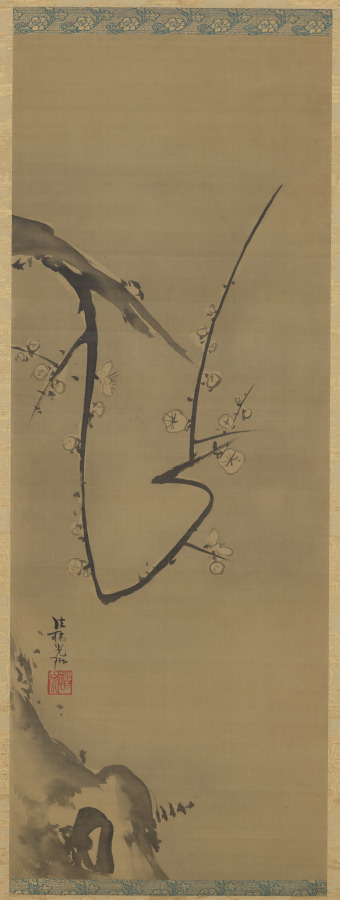
Resilience and Integrity: The blossom’s ability to thrive in harsh conditions translated to steadfastness in service. In silk, this was conveyed through the stark elegance of monochrome kesi tapestries, where the plum branch was rendered in varying shades of ink-wash grey, its form defined not by colour but by the exquisite painstaking of discontinuous wefts. The texture of the bark, the delicate points of the buds, were achieved through minute shifts in the weave’s direction, a testament to endurance in craftsmanship mirroring the virtue depicted.
Hope and Renewal: As a herald of spring, the plum signified renewal and the cyclical promise of a just reign. This aspect called for the splendour of polychrome brocades. Here, the weaver’s palette might introduce the faintest blush of pink to a petal, using dyed silk threads so fine their colour seems breathed onto the surface. Against grounds of deep blue or imperial yellow, these blossoms were not simply patterns; they were intricate, raised architectures of thread, catching the light with each movement to signal the dawning of a new season of prosperity.
Purity and Nobility: The delicate, five-petalled flower, often emerging from seemingly lifeless wood, spoke of unsullied character and latent potential. This was frequently expressed in the context of the "Three Friends of Winter"—the plum, pine, and bamboo—a recurring triumvirate on scholar’s robes and court accoutrements. Woven together, these motifs created a fabric of interlocking virtues. The silk satin ground, smooth and unblemished as a frozen pond, served as the perfect foil for the crisp, geometric embroidery or brocaded details, each element standing in clear, honourable relief.
The Tailored Legacy: From Loom to Protocol
The ultimate expression of this heritage lies in its application. A court robe (jifu or chaofu) adorned with plum motifs was not a casual selection. It was a deliberate sartorial communiqué. The placement was paramount: a scattering of blossoms across the hem might suggest a grounding in virtue; a bold, ascending branch on the chest, a declaration of unwavering principle. The density of the weave and the inclusion of precious metal threads calibrated the message’s formality, suitable for an audience, a sacrifice, or a private moment of reflection.
This was bespoke symbolism of the highest order. The imperial workshops operated on principles not unlike those of a latter-day Savile Row atelier: absolute precision, understanding of tradition, and a nuanced reading of the client’s required persona. Every stitch, every pass of the shuttle, was a conscious act of legacy-building. The silk was the medium, but the plum was the argument—a silent, eloquent thesis on the character of the wearer and the enduring values of the state he embodied.
Conclusion: A Continuing Thread
The legacy of the plum tree in imperial silk weaving endures not as a relic, but as a benchmark of integrated design. It demonstrates that true heritage in material culture is achieved when symbol, substance, and execution are inseparably fused. The silk provided the authority and the tactile luxury; the plum provided the narrative depth and moral compass. Together, under the exacting standards of the imperial ateliers, they created artifacts that transcended fashion to become woven ideology. To study them today is to understand that the most powerful statements are often made not with volume, but with the quiet, impeccable assurance of a blossom on a branch, rendered in the unforgiving, glorious medium of silk. It is, in the final estimation, a lesson in quiet power—perfectly cut, and impeccably finished.