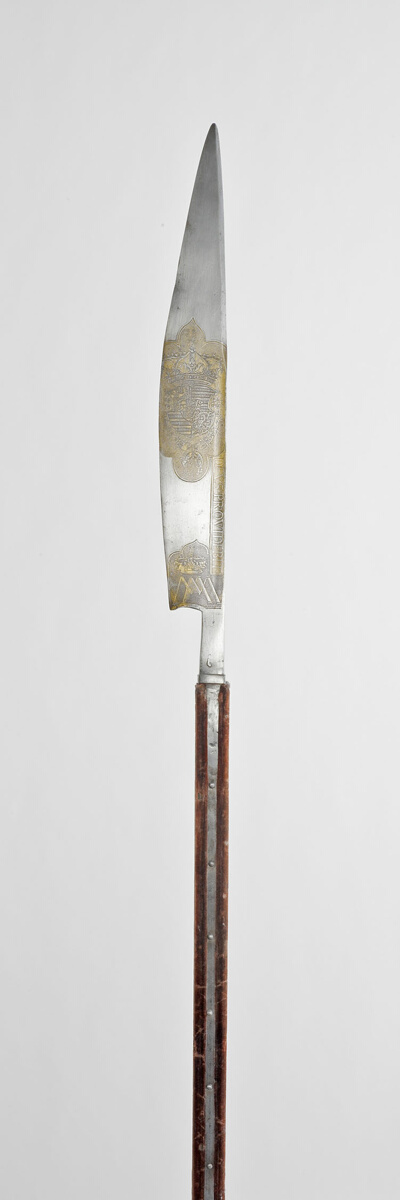
An Armoured Proposition: The Glaive as a Sartorial Statement
To consider the glaive—a weapon of undoubted martial utility—within the context of silk and Savile Row may, at first glance, appear a profound incongruity. Yet, to dismiss this as mere paradox is to misunderstand the fundamental principles of bespoke craftsmanship and the language of power dressing in its most literal form. The artefact in question, a glaive commissioned for the bodyguard of His Majesty Maximilian II, King of Hungary and Bohemia, later Holy Roman Emperor, represents not a crude tool of war, but a meticulously considered uniform accessory. Its materiality—steel, iron, gilding, oak, and, pivotally, silk velvet—speaks to a hierarchy of aesthetics where security and spectacle are inseparably tailored.
The Canvas: Steel as the Foundation Cloth
Every superior garment begins with its foundational cloth. Here, the steel of the blade and the iron of the socket serve as the robust, worsted suiting of the piece. It is a material chosen for its inherent properties: resilience, a capacity for taking a lethal edge, and a certain gravitas. The smith’s work—forging, tapering, fullering—is the equivalent of the cutter’s shears, sculpting form from raw potential. The blade’s elongated, elegant curve is not merely functional for slashing; it is a line of authority, a sweeping silhouette that commands space much as a well-cut frock coat commands a room. This is the armature upon which all further embellishment, all statements of status, are mounted.
The Bespoke Details: Gilding and the Grammar of Status
Upon this stern foundation, a vocabulary of distinction is inscribed. The application of gilding to the steel is the precise analogue to hand-stitched buttonholes or a discreet silk lining. It is a deliberate, non-utilitarian expenditure. The gold’s purpose is refractive, catching the light in courtly chambers or during ceremonial processions, transforming the weapon from an instrument of violence into a beacon of allegiance and imperial favour. It communicates a clear message: the bearer is no common soldiery, but an extension of the Emperor’s own magnificence. Each stroke of gilt is a considered detail, a flourish that speaks of a patronage willing to invest in the minutiae of appearance, for appearance is itself a form of power.
The Haft: Oak and the Question of Grain
The oak haft introduces the element of organic materiality. Like the selection of a specific grain of wood for a walking cane or a gunstock, the choice of oak is both practical and symbolic. Its density and strength provide the necessary counterbalance and durability. Yet, in its polished, tactile surface, one perceives the care taken in its finishing. It is shaped to fit the hand, its surface smoothed to prevent friction—an ergonomic consideration that mirrors the comfort sought in the drape of a tailored sleeve. It is the element that bridges the lethal business of the blade with the human scale of the bearer, a firm, reliable grip on duty.
The Master Stroke: Silk Velvet as the Ultimate Trim
Here we arrive at the crux of the matter: the silk velvet. To encase the base of the blade’s socket in this most sumptuous of textiles is the master stroke that elevates the entire composition from militaria to heritage artefact. Silk velvet is the ultimate expression of fluid elegance and classic craftsmanship. Its production is an alchemy of patience and skill, its surface a play of light and shadow, of depth and lustre. The application of velvet to the glaive is an act of sartorial defiance, a bold declaration that even in the realm of arms, the codes of the court prevail.
This is not mere decoration; it is a strategic deployment of texture. The cold, unforgiving gleam of steel is deliberately contrasted with the warm, absorbent pile of the velvet. It softens the weapon’s profile at a critical junction, creating a visual and tactile transition. More importantly, it imports a universe of meaning. Silk velvet was the preserve of the highest echelons, its wear and use often governed by sumptuary laws. By adorning the bodyguard’s glaive with it, the imperial household effectively liveryed the weapon itself. The bearer becomes a mobile standard of the Habsburg aesthetic, his very armament swathed in a material that denotes luxury, authority, and a civilisation refined enough to cloak its strength in beauty.
Conclusion: A Coherent Ensemble of Power
Thus, the glaive emerges as a coherent ensemble. The steel blade is the sharp, structured silhouette. The gilding is the discreet, costly embellishment. The oak haft is the finely-fitted foundation. And the silk velvet is the exquisite, statement-making trim that ties the composition together, referencing the broader tapestry of courtly dress and imperial iconography. For the bodyguard of Maximilian II, a ruler known for his intellectual curiosity and a court that balanced martial vigour with Renaissance humanism, this weapon was a key component of his uniform.
It proclaimed that he was protected by the most advanced metallurgy, served a patron of immense wealth, and operated within a sphere where elegance was never sacrificed to efficacy. In the same manner that a Savile Row suit provides its wearer with the confidence of impeccable construction and unassailable style, this glaive equipped its bearer with both a formidable tool and an unimpeachable credential. It remains a testament to the principle that true authority lies in the seamless integration of strength and refinement, where even the instruments of protection are cut from a cloth of the utmost distinction.