On the Sutherland: A Treatise in Silk
To engage with the Sutherland is to engage with a principle. It is not merely a garment, but a proposition in cloth—a statement of fluid authority, achieved through the most demanding of textile arts. Its essence, its very raison d'être, is rooted in a specific and exalted materiality: silk, executed in a satin weave foundation, complicated and given profound depth by twill-interlaced secondary warps and the strategic deployment of supplementary patterning wefts. This is not decoration; it is structural rhetoric.
The Foundation: Satin Weave as a Philosophical Starting Point
The satin weave is the silent, impeccable host of this endeavour. Characterised by its warp-faced construction, where the weft threads are strategically obscured, it produces that signature, unbroken luminous surface. This is the "broadcloth" of the silk world—a flawless, reflective plane that speaks of restraint and confidence. It provides the Sutherland with its foundational fluid elegance, a drape that is both weighty and supple, falling from the shoulder with the quiet certainty of a pronouncement rather than the mere accident of gravity. The handle is cool, dense, and possessed of a substantive liquidity; it does not cling, but moves with the wearer, creating an aura rather than an outline. This is the non-negotiable canvas.
The Architecture of Depth: Warp and Weft as Deliberate Complication
Where a lesser commission would rest upon this laurel, the Sutherland introduces complication—and thus, character. The introduction of secondary binding warps, interlaced in a twill formation, is the first masterstroke. Twill, the weave of cavalry and resilience, is here subordinated to a supporting role. These secondary warps bind the structure from within, providing a hidden skeleton of resilience. They are the unseen foundations of a Savile Row coat—the haircloth, the pad-stitching—translated into the language of the loom. This integration ensures that the silk's languor is underpinned by a latent tensile strength, preventing the elegance from devolving into mere languidness.
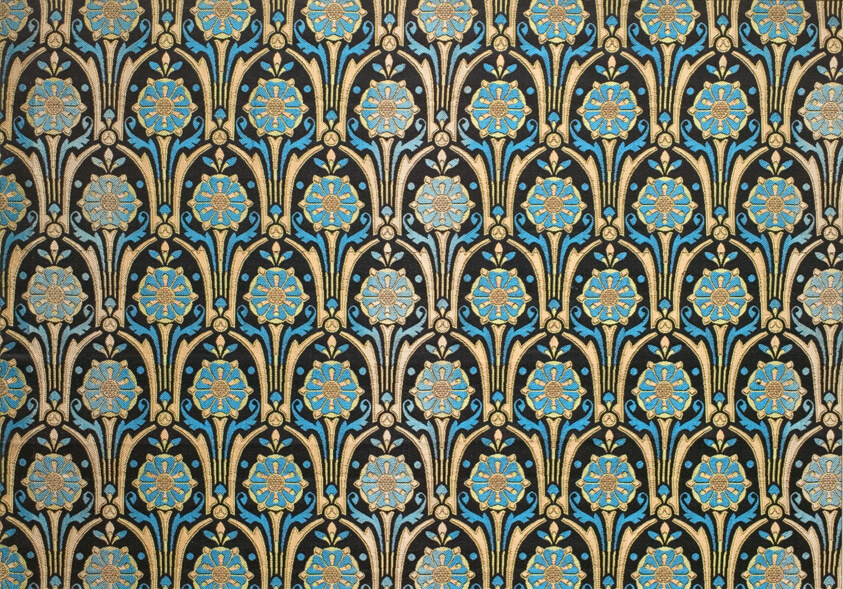
Then, the supplementary patterning wefts. These are the discretionary elements, the bespoke flourishes woven into the very fabric of being. They are not printed, nor embroidered upon the surface—such would be a later, and lesser, application. They are integral, lifted from the same bobbin but deployed with strategic intent to create a subtle, tonal pattern—a mere suggestion of a shadow stripe, a crest, a discrete geometric motif. They lie in wait within the fabric's matrix, revealing themselves only under certain light or with particular movement. This is the hallmark of true, classic silk craftsmanship: ornament that is structural, luxury that is inherent, not applied.
Context and Consequence: The Sutherland in the Canon
To understand the Sutherland's context is to understand the evolution of tailored luxury. It exists at the confluence of two mighty rivers: the classic silk craftsmanship of European ateliers—think of Spitalfields and Lyon—and the sartorial discipline of the London bespoke tradition. It takes the opulence of the cravat or the waistcoat and scales it to the gravitas of the lounge coat or the dressing gown. This is silk for the drawing room, not the ballroom; for the club, not the court. Its fluidity is controlled, its sheen moderated by the complexity of its weave into a soft, patinated glow.
The consequence of this material synthesis is a garment of profound versatility and unshakeable propriety. It possesses a formal ease, capable of presiding over an evening without announcing it. The Sutherland, in this specific silk articulation, does not shout. It insists. It is appropriate where brocade would be theatrical, and substantial where plain silk would be frivolous. It is, in the final analysis, armour for the civilised man—pliable, beautiful, but constructed with undeniable rigour.
A Concluding Note on Permanence
In an age of accelerated fashion and diminished substance, the Sutherland in this precise specification stands as a rebuttal. Its materiality is its message. The satin ground offers sublime surface; the twill-interlaced warps provide unseen integrity; the supplementary wefts whisper of considered detail. Together, they form a textile that is greater than the sum of its threads—a fabric with a biography, waiting to be tailored into a garment with a legacy. It is not a seasonal fancy, but a permanent addition to the cultivated wardrobe. To commission it is to express a belief in the enduring dialogue between material intelligence and sartorial form. It is, quite simply, how silk grows up.