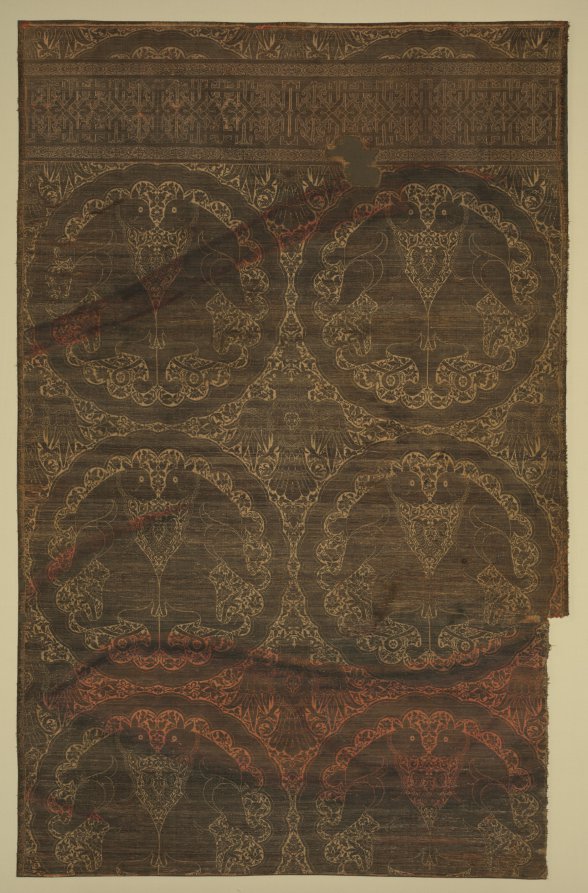
A Fabric of Sovereignty: On the Cloth of Gold with Felines and Eagles
To comprehend the artefact in question—a fragment of cloth-of-gold, its warp of silk, its weft of gilt membrane or thread, depicting in meticulous, raised detail a procession of leonine forms and raptorial birds—one must first dismiss the modern conception of fabric as mere covering. This is not textile in the pedestrian sense. It is, rather, a deliberate and consummate expression of terrestrial power, rendered in filament and foil. Its materiality is its first and most profound statement: silk, the ultimate luxury commodity, whose very production was for centuries a state secret guarded by Imperial China, and whose movement westward defined the routes of empire, diplomacy, and espionage. To clothe oneself in silk was to announce one’s position at the apex of the known world’s economic and cultural networks. To augment it with gold was to transcend even that rarefied plane, entering the realm of the semi-divine, where light itself was woven into one’s vestments.
The Loom as Throne: Imperial Patronage and the Weaving Ateliers
The legacy of imperial silk weaving is not one of anonymous craftsmanship, but of centralised, often palatial, industry. From the Byzantine gynaecea and the Islamic tiraz workshops to the formidable state-run factories of the Ming and Qing dynasties, the production of such cloth was a sovereign prerogative. The design, far from being decorative whimsy, was heraldic, talismanic, and strictly regulated. The specific juxtaposition of felines—likely qilin or imperial lions—with eagles, or possibly phoenixes (fenghuang), suggests a synthesis of symbolic languages. It speaks to an empire confident enough to amalgamate motifs of terrestrial dominion (the feline, master of the land) with celestial authority (the raptor, master of the skies). This is not folk art; it is a visual manifesto of universal rule, commissioned by a court that saw its dominion as encompassing all under heaven. The technical execution—the precision of the drawloom, the subtlety of the colour gradations in the silk, the secure integration of the gold thread—stands as testament to generations of weavers whose skill was honed to an instrument of state propaganda.
A Language Woven in Thread: Heraldry Without Borders
Consider the semiotics of the bestiary presented. The feline, in both Eastern and Western imperial traditions, represents courage, majesty, and unassailable strength. The eagle, from Rome to Byzantium to the Holy Roman Empire, has always been the symbol of zenithal power, foresight, and martial victory. To marry them in a single cloth is to engage in a form of diplomatic rhetoric understood by courts from Constantinople to Chang'an. This fragment would never have been intended for the open market. It was currency of a higher order: a gift between monarchs to signify profound respect or strategic alliance; a vestment for coronations or sacred rites, elevating the wearer to a priest-king status; or a lavish display within a throne room, where the very walls whispered of the empire’s reach and resources. The light playing upon its gold-wefted surfaces would have been deliberately calculated, a performance of radiance meant to dazzle ambassadors and overawe subjects.
The Uncompromising Nature of Legacy
The preservation of such a piece today presents a conundrum. Its fragility is inherent; silk degrades, gold tarnishes. Yet, its survival in any form is a stark reminder of the intensity of human ambition. We examine it now under museum lighting, a world away from the torchlit halls for which it was conceived. Its power, however, remains undimmed, if one knows how to look. The legacy of imperial silk weaving is a legacy of absolute standards. There was no concession to cost-effectiveness, no dilution of design for easier production. The brief was simply to realise the vision of the court, irrespective of the months of labour, the fortunes in raw material, or the astronomical skill required. It is this uncompromising pursuit of a material ideal that connects the ethos of the imperial atelier to other, later traditions of summit-level craftsmanship—notably, the dedication of the Savile Row tailor, for whom cloth is but the beginning of a dialogue with form, lineage, and personal authority.
Conclusion: A Fragment as Testament
Ultimately, this cloth-of-gold with its felines and eagles is more than a relic. It is a concentrated essay on authority, made tactile. Every thread, every gleam, was a conscious choice in the articulation of power. The silk speaks of control over vast, intricate supply chains and the possession of arcane technical knowledge. The gold proclaims inexhaustible wealth. The iconography asserts a dominion both earthly and celestial. In holding this fragment, one does not merely touch fabric; one handles the physical residue of a worldview in which magnificence was not an indulgence, but a political and spiritual necessity. The imperial looms may have fallen silent, but the language they wove—a language of excellence, symbolism, and sovereign intent—remains eloquently, unforgettably, encoded in this splendid, silent testament.