On the Material Imperative: Silk as the Unyielding Substrate of Empire
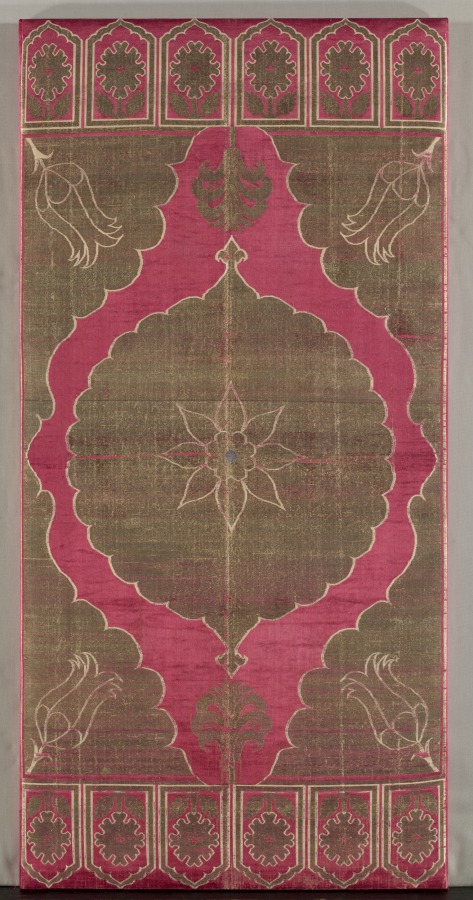
To engage with silk of this calibre is to confront not merely a textile, but the very fabric of imperial ambition. It is a material that refuses the passive nomenclature of 'medium'; it is, rather, an active agent in the theatre of power. The legacy of imperial silk weaving is one of enforced exclusivity, a deliberate and often brutal consolidation of technical mastery, aesthetic dictation, and economic control. The brocaded cushion cover and its Iranian striped silk surround, while now domestic artefacts, are direct descendants of this complex and coercive system. Their materiality—the cultivated filament of the Bombyx mori—was the non-negotiable starting point, a biological secret guarded with the same fervour as state papers. Its possession and manipulation signified not just wealth, but a form of sovereignty.
The Brocade: A Testament to Command Performance
Consider the brocaded cushion cover. The term 'brocade' itself, from the Italian broccato, meaning 'embossed cloth', belies the sheer administrative weight of its production. This was not weaving as cottage industry; it was a command performance orchestrated within imperial ateliers. The intricate pattern—likely floral, possibly involving the complex interplay of lotus and peony motifs speaking to a syncretic Sino-Central Asian visual language—is an act of material domination. Each supplementary weft of coloured or metallic thread, painstakingly interlaced to form the raised design, represents a formidable investment in labour, time, and specialised loom technology.
The aesthetic is one of controlled density. There is no empty space, no field left to silence. Every inch of the silk ground is marshalled into service, declaring an abundance so profound it can afford to bury its own costly foundation. This is the visual rhetoric of the court: an overwhelming display meant to quiet dissent through sheer splendour. The cushion, once placed within a divan or upon a throne, transforms from a mere object of comfort into a heraldic plaque, a portable standard of the regime’s reach and its capacity to render beauty into a disciplined, repeatable protocol.
The Striped Surround: The Grammar of Order and Movement
In counterpoint, the Iranian striped silk presents a different, though no less potent, imperial grammar. Here, the statement is one of rhythm, regularity, and traversable space. The stripes—whether bold bands of colour or subtle variations in weave—speak to a nomadic and mercantile heritage refined into a courtly idiom. This is the silk of the Safavid or earlier Persian empires, realms whose power was built on the control of trade routes, the arterial networks of the Silk Road itself.
The stripe is a rational, almost bureaucratic, motif. It implies measure, order, and infinite extension. It does not dazzle with singular, centralised motifs like the brocade, but with a relentless, elegant continuity. As a surround, it frames the brocaded centrepiece, acting as both a border and a conduit. It suggests the administrative machinery that made the centrepiece possible: the caravansaries secured, the dyes taxed and regulated, the weavers organised into guilds under royal patronage. The material, though identical in its fundamental nature to the brocade, is deployed with a different strategic intelligence. It is the silk of the court’s curtains, its robes of state, its diplomatic gifts—always implying motion, connection, and the systematic management of distance.
A Conjoined Legacy: The Dialectic of Imperial Display
Analysed together, these two artefacts enact the essential dialectic of imperial silk. The brocaded centre represents the centripetal force of empire: drawing all resources, skill, and attention to a fixed, glorious point—the throne, the emperor, the singular symbol. The Iranian striped surround embodies the centrifugal force: the projection of power along lines of trade, diplomacy, and cultural influence. One is about concentrated awe; the other, about pervasive influence.
This was a legacy built on formidable material constraint. The sericulture process, from mulberry grove to finished loom, required a climate-controlled, monopolised infrastructure. The colours—crimson from cochineal or kermes, deep blues from indigo, vibrant yellows from saffron—were themselves commodities of empire, their sources often guarded secrets. The resulting silks were less products than currency of the elite, used in tributary systems, dynastic marriages, and ecclesiastical vestments to cement alliances and demonstrate divinely sanctioned authority.
Conclusion: Beyond Ornament, Into Archive
To regard these pieces now as merely decorative is to misunderstand their fundamental nature. They are, in the most rigorous sense, archival documents wrought in thread. The brocaded cushion cover is a transcript of technical absolutism; the striped silk, a ledger of managed exchange. Their material, silk, was the indispensable precondition—the only substance capable of holding such high-resolution political information with commensurate lustre and durability.
The legacy they carry is thus twofold. It is a testament to human ingenuity at its most refined, capable of transforming a caterpillar’s cocoon into the ultimate symbol of cultivated power. Simultaneously, it is a record of the systems of control, appropriation, and hierarchical display that such ingenuity was enlisted to serve. In the quiet dignity of their preservation, they continue to speak, not of a lost gentility, but of the formidable, demanding, and utterly material realities of imperial ambition. The sheen on the silk is, forever, the gloss of authority.