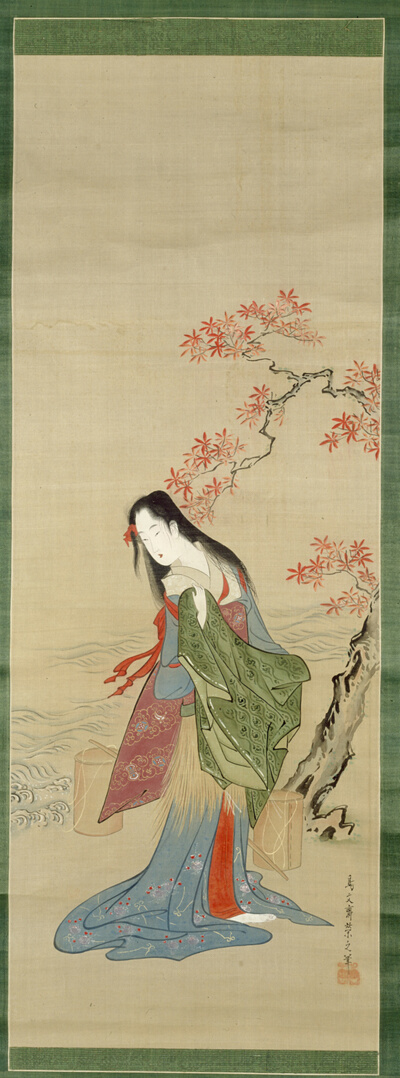
An Examination of Line, Legacy, and Liquid Form: The Salt Maidens of Matsukaze
To engage with the hanging scroll depicting Matsukaze with Yukihira's Coat is to undertake a study in the profound dialogue between material and narrative. The substrate is not merely a support; it is the very essence of the tale. Silk, in its highest expression, possesses a luminosity and a receptive quality for pigment that paper cannot emulate. It is a demanding partner, unforgiving of hesitation, requiring from the master artisan a certainty of stroke and a deep understanding of how ink and mineral colours will settle into its fine, tensile weave. The resulting artifact speaks not of rustic immediacy, but of a cultivated, enduring elegance—a visual equivalent to the finest bespoke tailoring, where the hand of the craftsman is evident in the flawless drape and the integrity of the form.
The Foundation: Silk as the Constitutive Canvas
Before a single line is drawn, the silk establishes the parameters of excellence. Like the foundational canvassing and horsehair cloth of a Savile Row coat, which provides structure and longevity, the prepared silk ground offers a surface of impeccable smoothness and subtle sheen. This preparation is a silent art in itself, involving sizing and priming to achieve a perfect balance: it must be absorbent enough to hold the pigment permanently, yet resistant enough to prevent uncontrolled bleeding. The choice of silk dictates a certain formality, a gravity, elevating the subject from mere illustration to a preserved moment of cultural memory. Its inherent strength allows for the creation of vast, unbroken washes of tone—the grey skies and muted shores of the Suma coast—while its delicacy permits the most infinitesimal rendering of a single strand of hair, damp with sea spray or tears.
The Cut and Drapery: Line Defining Emotion
The narrative core of the piece—the poignant confusion of the salt maiden Matsukaze, who mistakes a traveller’s coat for the ghost of her beloved Yukihira—is communicated through a masterful deployment of line that would be the envy of any master cutter. The robes of the figures are not simply drawn; they are tailored by the brush. Observe the flow of the garments. The lines describing the folds are not haphazard; they follow the implied anatomy beneath, articulating a posture of yearning, of mistaken embrace. The drape of Yukihira’s forgotten court robe, the central objective correlative of the scene, is rendered with a fluid elegance that suggests both its weight as a material object and its unbearable lightness as a spectral token.
This is where the principle of sprezzatura—studied carelessness—finds its Eastern analogue. The lines appear effortless, spontaneous, capturing the wind-swept immediacy of the shore. Yet, each is deliberate, placed to guide the viewer’s eye and to sculpt form from the void. The calligraphic confidence required mirrors the precise, unwavering hand that guides shears through superfine woolens; a single errant stroke, like a misplaced cut, cannot be undone. The fluidity of the line-work becomes the visual metaphor for the fluidity of Matsukaze’s own reality, the boundary between memory and present perception dissolving as completely as ink into silk.
The Palette and Patina: A Grammar of Restraint
The colour scheme, as in the most distinguished wardrobe, operates on a grammar of restraint and symbolic potency. The palette is largely subdued: the soft greys of twilight, the muted browns of the earth, the pale ochre of the sand. Against this sombre ground, notes of colour are applied with the strategic discretion of a silk pocket square or a lining of vibrant paisley. The subtle mineral greens and blues of the maidens’ robes speak of their elemental, maritime world. The possible faint blush on a cheek, or the richer hue of the court coat, are accentuations, not dominants.
This restrained application allows the materiality of the silk itself to participate in the visual effect. The white of the silk, left untouched, becomes the mist over the water, the glow of the moon, the pallor of a grief-stricken face. The pigments, often derived from ground minerals and precious stones, settle into the silk with a depth and slight granularity that machine-made inks cannot replicate. Over centuries, a gentle patina—a craquelure of time—may develop, not unlike the wear on the elbow of a cherished tweed jacket. This does not diminish the artifact; it authenticates its journey through time, adding a layer of narrative to its physical presence.
Conclusion: A Garment of Memory
Ultimately, Matsukaze with Yukihira's Coat transcends its function as a pictorial scene. It is a heritage artifact of the highest order, where every technical decision serves the emotional and philosophical weight of the Noh drama it depicts. The silk is the silent witness, the line is the articulate gesture, and the colour is the subdued emotional register. Together, they craft a vision of longing that is as tangible as it is ethereal.
To appreciate it fully is to understand that the salt maiden’s tragedy is woven into the very fibres of its being. The coat she clings to is an illusion, a memory given false form. Yet, the scroll itself is the real, enduring garment—a meticulously crafted, bespoke vessel for that memory, preserving its fluid elegance and profound pathos with the immutable dignity of silk, ink, and masterful hand. It stands as a testament to the principle that true luxury, in art as in attire, lies not in ostentation, but in the perfect, resonant harmony of material, form, and profound human sentiment.