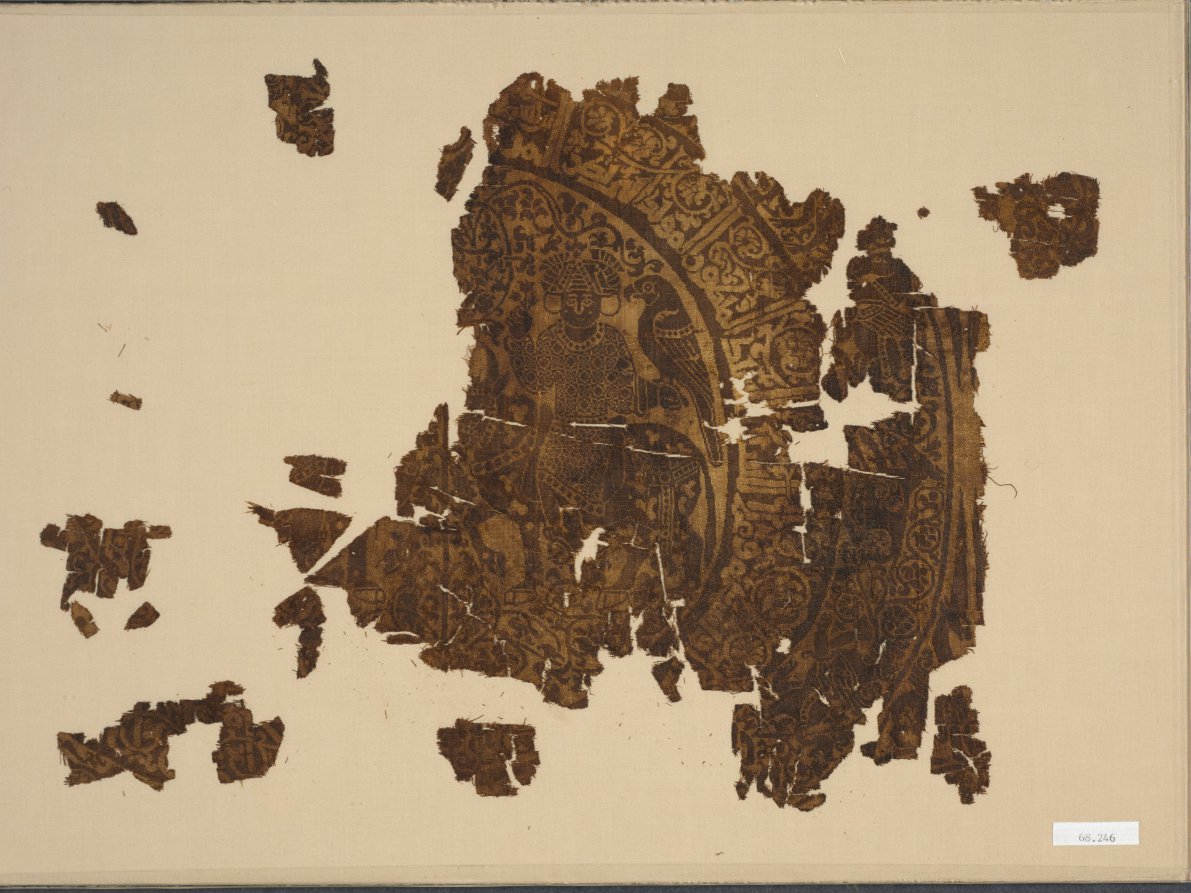
A Fragment of Dominion: Falconry, Bovine Mounts, and the Loom of Empire
To consider this fragment—a mere tessera in the vast mosaic of imperial textile history—is to engage with a narrative woven not merely from filament, but from sheer political will. The artifact in question, a rondel of silk depicting a falconer astride a bull, presents a confluence of symbols so deliberate, so audacious in its material execution, that it transcends mere ornamentation. It is, in essence, a statement of governance rendered in weft and warp. The very substrate, silk, is the first and most non-negotiable declaration. This is not the wool of the pastoralist nor the linen of the agrarian; this is the luxury filament of statecraft, the currency of diplomacy, and the definitive product of the most sophisticated, state-monopolised industrial complex the pre-modern world ever devised: the imperial silk atelier.
The Grammar of Power in the Rondel
The iconography demands a forensic appreciation. The falconer, the ultimate symbol of cultivated control over nature’s wild aristocracy, is here removed from the expected, the noble steed. The horse signifies speed, martial agility, and a recognised hierarchy of chivalry. The bull, however, is an entity of an entirely different order. It is raw, terrestrial power, fertility incarnate, and a profound challenge to subjugate. To place the figure of controlled aerial dominion upon this embodiment of brute earthbound force is an act of profound metaphorical ambition. It communicates not just rule, but the taming of the very foundational, chaotic energies of the realm. The falcon’s gaze, presumably fixed on a horizon beyond the frame, suggests far-reaching vision and the pursuit of objectives unseen by the common man, while its master sits in improbable, steadfast command of the beast beneath.
This rondel is not a standalone portrait; it is a repeat. It is the core unit of a larger pattern, designed to tessellate across the expanse of a robe or a hanging. The implication is critical: this motif of total mastery is not a singular event, but a perpetual, endless condition. Wherever the fabric falls, the message is replicated, enveloping the wearer or adorning the space in a field of asserted, rhythmic control. The repeat pattern is the aesthetic language of bureaucratic, systematic authority.
The Loom as an Instrument of State
Here, we must turn to the materiality, for the message is inseparable from the medium. Imperial silk weaving was never a cottage industry. It was a closely guarded, technologically advanced state secret, its workshops often situated within palace precincts or tightly administered imperial cities. The designs—such as this falconer and bull—were decreed from the centre, vetted by court iconographers whose role was akin to that of a senior policy advisor. The execution required the coordination of master weavers, dyers skilled in producing the most stable and costly of hues (think of the lost lacquers and gold threads that likely accompanied this fragment), and a supply chain that stretched from mulberry groves to the loom.
The production of such a textile was an economic and logistical manifesto. It demonstrated the empire’s capacity to marshal expertise, capital, and raw materials towards an object of supreme, non-utilitarian value. To bestow such a fabric was to bestow a piece of the empire’s operational soul—a reward that cemented allegiance far more effectively than coin. To wear it was to cloak oneself in the very apparatus of imperial power, to become a walking testament to its reach and sophistication.
A Legacy in Filament
The legacy of this imperial silk-weaving complex is twofold. Firstly, it established a canonical language of power. The motifs—mythical beasts, scenes of unimpeachable authority, symbols of cosmic order—became a visual vocabulary recognised across diplomatic corridors. A gift of silks could communicate intent, hierarchy, and favour without a word being spoken. Secondly, and perhaps more profoundly, it set an unassailable standard of quality. The density of the weave, the precision of the drawloom patterning, the enduring brilliance of the dyes: these became the benchmarks against which all other textile endeavours were measured. They were the silent, tactile proof of civilisational pre-eminence.
This fragment, therefore, is far more than a curious depiction. It is a compacted thesis on imperial ideology. The falconer on the bull is the central argument: the civilised, strategic mind commanding the foundational power of the land. The silk is the authoritative paper upon which it is written. The repeat pattern is the dissemination of this doctrine. To hold it is to understand that in the ateliers of empire, the loom was as potent a tool as the sceptre, and the textile it produced was not mere finery, but woven policy.