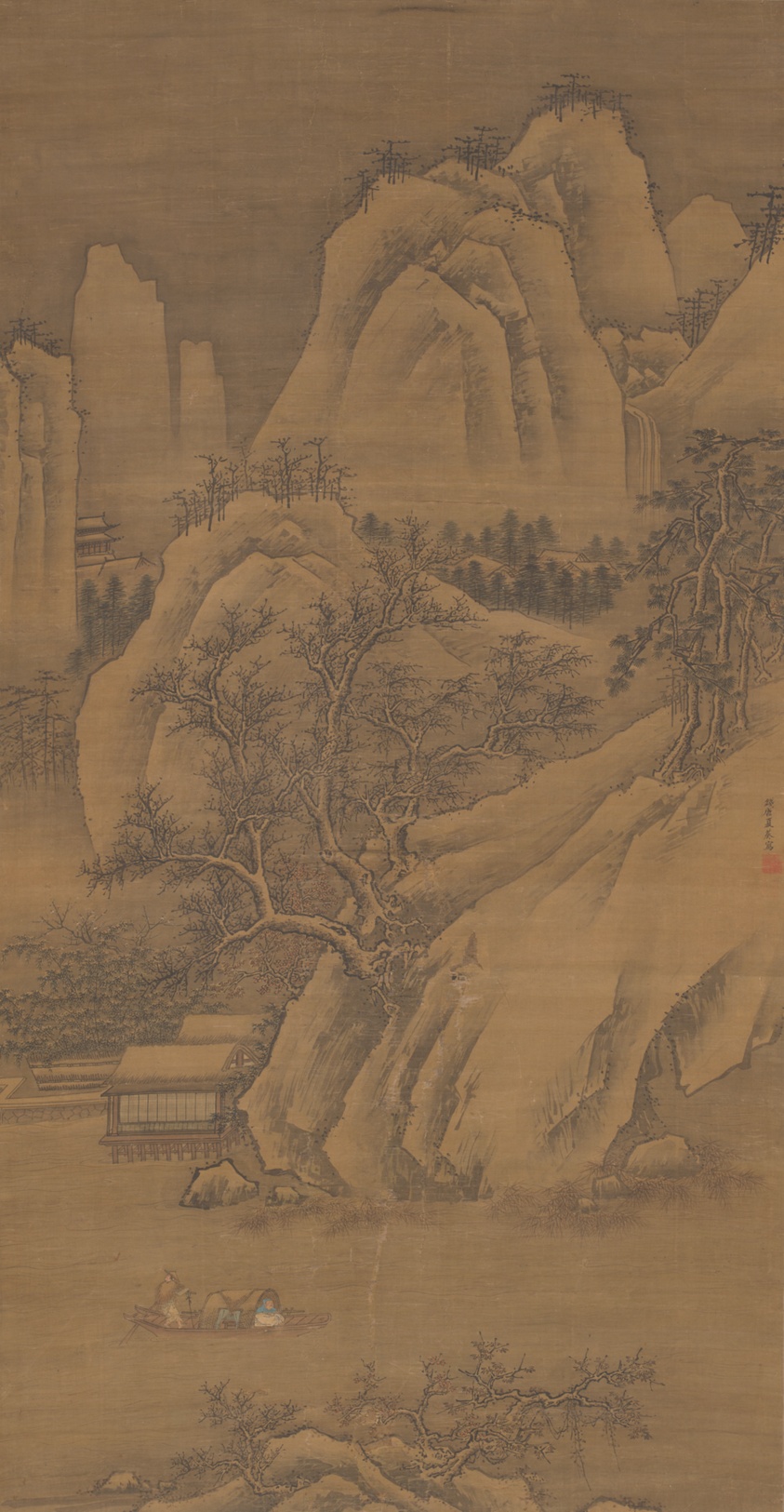
An Examination of Sartorial Solitude: The Fabric of Introspection in "Visiting Dai Kui on a Snowy Night"
In the rarefied world of bespoke creation, whether one deals in the exquisite drape of a length of hand-woven silk or the architectural precision of a canvassed jacket, the paramount consideration is the dialogue between material, form, and intent. The hanging scroll "Visiting Dai Kui on a Snowy Night" stands as a profound artefact within this tradition. Executed in ink and colours upon silk, the very foundation of its being is a testament to a heritage of material excellence. Silk, in this context, is far more than a mere substrate; it is the silent, essential partner to the artist’s hand. Its fine, luminous grain accepts the ink with a softness that paper cannot emulate, allowing for gradients of wash that suggest the chill dampness of night air and the muffling embrace of falling snow. The slight resistance of the fibre demands a confident, fluid stroke, a mastery of touch not dissimilar to that required by a master cutter wielding his shears through a precious cloth. The resulting work is not merely a depiction of an anecdote, but a crafted object wherein the materiality of silk is integral to the conveyance of atmosphere and ethos.
The Narrative Cut: Deconstructing the Patron's Whim
The scene derives from the Shishuo Xinyu, a chronicle of cultivated eccentricity amongst the Six Dynasties elite. The scholar-official Wang Huizhi, awakening from wine to a world transformed by snow, is seized by a sudden desire to visit his friend, the reclusive musician Dai Kui. He embarks on a night-long journey by boat, only to arrive at Dai’s door and, without dismounting, turn back. His explanation, "I came on the impulse of my delight; now the impulse is spent, why should I see him?" is a statement of breathtaking, almost aristocratic, self-possession.
This is not a narrative of social obligation, but of a sovereign individual honouring a personal aesthetic impulse to its pure, and logically absurd, conclusion. In the lexicon of Savile Row, we might consider this the ultimate expression of a garment made for oneself alone—a suit commissioned not for an audience, but for the private satisfaction of perfect articulation, worn in the solitude of one’s own library. The journey is the purpose; the destination, irrelevant. The painting captures not the social encounter, but the integrity of the caprice itself, a concept as finely tailored and self-contained as a midnight blue smoking jacket.
Fluid Elegance: The Line as a Master Tailor's Chalk
The scroll’s visual language speaks directly to principles of fluid elegance. The composition, we presume, likely employs the rhythmic, calligraphic line of the *baimiao* style to define its forms, a technique demanding the absolute economy and confidence of a master tailor’s chalk mark on cloth. There is no room for hesitation; each stroke must be purposeful, defining structure and movement in one gesture. The landscape elements—the skeletal trees, the contours of the riverbank, the gentle swell of the hills—are not rendered with topographic literalism, but suggested with a series of refined, essential strokes. This is the sartorial equivalent of suppressing unnecessary detail, of allowing the natural drape of the material to suggest the form beneath, rather than constricting it with overt structure.
The use of colour, sparingly applied over ink washes on the silk, would function like discreet elements of bespoke haberdashery—a silk knot cufflink, a discreet pocket welt in a contrasting hue. It is not for broad spectacle, but for nuanced accentuation, to highlight a focal point or deepen a mood. The cold, muted blues and whites of the snow-laden night serve to isolate the figure, perhaps in his boat, framing his solitary pursuit against the vast, quiet emptiness of the world. This isolation is not loneliness; it is the cultivated space in which a gentleman’s individuality breathes.
Context and Craftsmanship: The Silent Canvass
The classic silk craftsmanship underpinning this artefact provides its silent authority. The preparation of the silk, its sizing, its seamless expanse, represents a foundational craft without which the artist’s vision could not be fully realised. This is the unseen work of the linen canvasser, the buttonhole maker who works on the inside of the sleeve, the meticulous padding of the lapel—all performed to an exacting standard that the wearer or viewer may never consciously note, but upon which the entire integrity of the piece depends. The silk’s durability has allowed the work to traverse centuries, much as a well-maintained tweed overcoat becomes a companion for life, accruing patina and narrative.
The hanging scroll format itself imposes a discipline of verticality and contemplation. The viewer engages with it in a manner both physical and reverent, unrolling it downward to reveal the narrative progression from the frozen, perhaps mist-shrouded banks, down to the water, and finally to the solitary vessel. This controlled revelation is a ceremony of viewing, akin to the careful unwrapping of a garment from its mothproof cloth, an act that anticipates and respects the object within.
In final analysis, "Visiting Dai Kui on a Snowy Night" transcends its specific literary reference to articulate a universal principle of refined existence. It champions the sovereignty of the cultivated impulse, the beauty of the journey over the arrival, and the profound elegance of an action performed for its own intrinsic logic, free from external validation. Rendered upon the supreme material of heritage luxury—silk—through strokes of fluid mastery, it stands as a permanent testament to the idea that true style, in life as in art, is an internal compass, followed with conviction even through the deepest, most silent of nights.