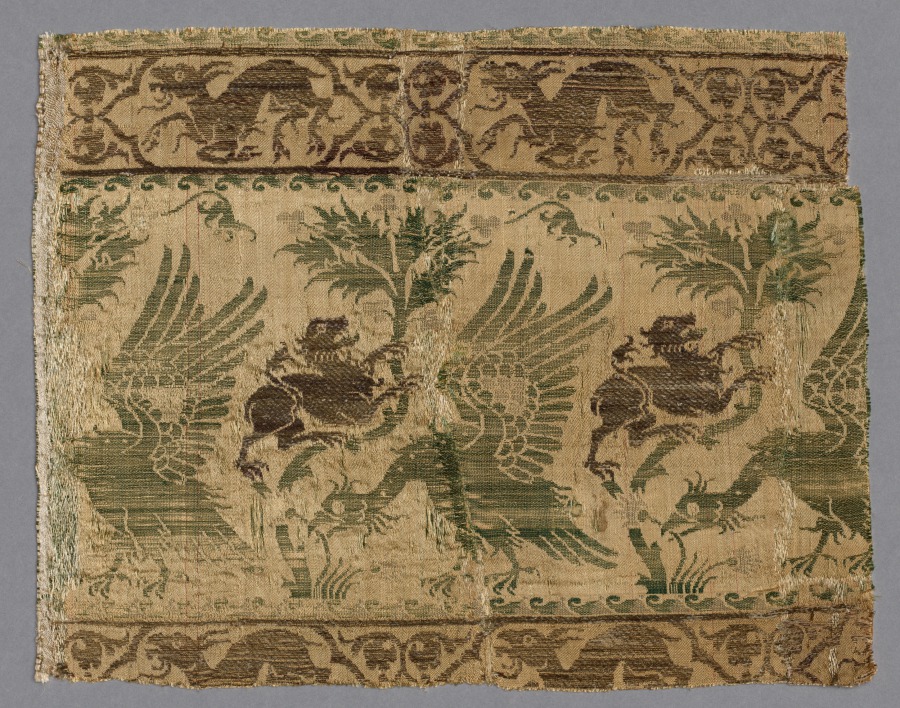
On the Material Supremacy of Imperial Silk
To consider silk is to engage with the very fabric of authority. It is not merely a textile; it is a sovereign material, whose history is inextricably woven with the exercise and projection of power. Its legacy, particularly within the imperial ateliers of Byzantium, China, and the Islamic caliphates, represents not a chapter in decorative arts, but a masterclass in strategic materiality. Here, silk was the ultimate soft power, a currency of statecraft more eloquent than any ambassador, its value derived from a monopoly as fiercely guarded as any treasury.
The Sovereign Supply Chain: A Monopoly Forged
The foundation of this authority was, of course, control. The Chinese imperial courts, understanding the principle of exclusive provenance long before the term entered the commercial lexicon, maintained a vice-like grip on sericulture and advanced weaving techniques for centuries. This was no mere trade secret; it was a state secret, protected with an severity befitting matters of national security. The Silk Roads, for all their romantic connotations, were less a thoroughfare of free exchange and more a tightly regulated pipeline for a sanctioned luxury, its flow managed to maximise diplomatic advantage. To bestow a length of imperial silk upon a tributary state or a potential ally was to perform an act of calculated munificence, a demonstration of cultural and technological supremacy that humbled the recipient even as it adorned them.
Byzantium, upon mastering the art, adopted the same playbook. The *gynaeceum*, the imperial weaving workshops within the Great Palace of Constantinople, operated as a closed loop of excellence. Staffed by the most skilled artisans, often under conditions of enforced residence to prevent knowledge dissemination, these workshops transformed raw silk—itself a controlled import—into patterns of profound symbolic weight. The supply chain, from worm to loom, was a vertical integration worthy of any modern conglomerate, designed for one client alone: the Imperial Court.
The Grammar of Power: Pattern as Protocol
The language spoken by these textiles was one of rigid, unmistakable hierarchy. This was not fashion; it was heraldry in its most fluid and luminous form. In the Chinese context, the twelve symbols of imperial authority—the sun, moon, stars, mountain, dragon, pheasant, and others—were not decorative motifs. They were a visual constitution, a codex of celestial and terrestrial mandate reserved exclusively for the Emperor’s robes. To wear them without sanction was not a faux pas; it was treason, a usurpation of divine right.
Similarly, in Byzantium, the use of specific colours, particularly Tyrian purple, and patterns such as the eagles or the quadriga (the imperial chariot), were legislated sumptuary law. The *Codex Justinianus* meticulously detailed who could wear what and when. A silk *loros*, the long, gem-encrusted panel worn by the Emperor, was as much a part of the regalia as the crown itself. Its complex weave and lavish decoration were impossible to replicate outside the imperial workshops, making the garment itself a certificate of authenticity and office.
The Alchemy of Gold: The Ultimate Enhancement
Silk’s inherent majesty was, in the imperial view, a canvas awaiting further augmentation. The introduction of gold thread—gold-wrapped silk or strips of gilt membrane—represented the apotheosis of the weaver’s art. This was alchemy upon the loom. The combination created a fabric that did not merely reflect light but seemed to generate it, a moving, shimmering aura around the wearer. In the dim, candle-lit interiors of throne rooms and basilicas, such a garment commanded the optical field, transforming the ruler into a living icon.
The technical prowess required was staggering. Techniques like samite (a heavy silk weft-faced compound twill) and lampas provided the robust ground needed to support the weight and tension of metallic threads. The resulting textiles, such as the famed *akritai* silks or the Pallo d’Oro, were less articles of clothing than architectural achievements in microcosm, their density and radiance conveying an immovable, monumental permanence. The gold was both literal and metaphorical wealth, intertwining economic power with perceived celestial favour.
The Enduring Legacy: A Benchmark of Excellence
The dissolution of the imperial systems that birthed these practices did not diminish their standard; it canonised it. The Savile Row ethos—of absolute material integrity, of cut as the paramount consideration, of a garment conferring authority upon the wearer—finds a direct antecedent in the imperial silk workshops. The Row’s dedication to a personal, measured fit mirrors the imperial garment’s role as a second skin of power, tailored to one individual’s station and physique.
The legacy of imperial silk weaving endures as the ultimate benchmark for a holistic approach to luxury. It teaches that true authority in craft arises from the unbroken command of the process, from the sourcing of the raw material to the final, symbolic stitch. It demonstrates that pattern, when imbued with meaning and restricted by protocol, transcends ornament to become identity. And it proves that the most powerful statements are often those made not through proclamation, but through possession—the quiet, undeniable assurance of a fabric that has, for millennia, clothed only the most consequential of figures. In the sheen of a pristine silk, one still glimpses the reflection of a throne.