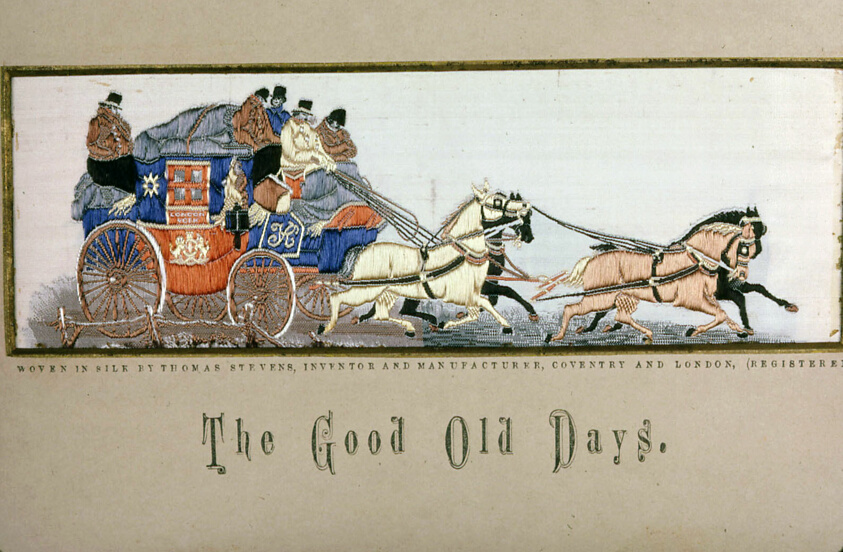
An Examination of Temporal Conveyance: The Royal Mail Coach as Artefact in Silk Brocade
The notion of "The Good Old Days" is, in the sartorial lexicon, a perilous one. It suggests a sepia-toned nostalgia, often unearned and invariably imprecise. Yet, within the ateliers of true craftsmanship, it is not a period to which one longs to return, but rather a set of principles—rigour, patience, and an unwavering commitment to material integrity—that one seeks to preserve and perpetuate. It is from this disciplined perspective that we examine our subject: the Royal Mail Coach, rendered not in paint or print, but in the supreme medium of silk, executed in plain weave with supplementary brocading wefts. This is not mere decoration; it is a deliberate act of heritage translation.
Materiality as Historical Lens
The foundation is a plain weave silk of impeccable quality—a tabula rasa of fluid elegance and understated strength. This is the equivalent of a superior wool broadcloth; it provides the structure, the hand, the dignified drape upon which narrative is built. Its very simplicity is a statement of confidence, recalling the robust, functional engineering of the Coach itself: a vehicle designed not for frivolity, but for the vital, relentless dissemination of information and authority across the realm.
Upon this ground, the narrative is inscribed via the supplementary brocading weft. This technique is the cornerstone of our analysis. Unlike a jacquard, where the pattern is integral to the structure, brocading adds a supplemental thread, laid with precision upon the surface. It is additive, deliberate, and luxuriously tactile. In the hands of our master weavers, this method becomes a tool for historical annotation. The coach is not flatly depicted; it is articulated. The brocading weft, often of a subtly contrasting sheen, picks out the intricate ironwork of the springs, the precise livery on the panels, the gleam on the harness brass. It gives volume to the team of horses, suggesting the musculature and motion inherent in their charge.
Narrative in the Thread: Decoding the Motif
The choice of the Royal Mail Coach is profoundly apt. It was, in its heyday, the absolute pinnacle of terrestrial communication technology—a network of astonishing efficiency and reliability that bound the nation. It symbolised a covenant between citizen and state: the safe, swift passage of word and parcel. In our rendering, this symbolism is meticulously encoded.
The coach is captured in mid-journey, a dynamic diagonal thrust across the fabric's field. This conveys not a static, museum-piece nostalgia, but the essence of purposeful velocity. The surrounding elements are not pastoral idylls; they are functional markers. A stylised milestone, a neat hedgerow, a distant spire—all brocaded with the same exacting detail—speak to the measured, known geography of Britain, a landscape mastered and made coherent by such regular transit. The famed scarlet livery of the Mail is rendered in a particular crimson silk thread, its depth achievable only through multiple, flawless dyeing processes, a colour that speaks of authority and instant recognition.
Craftsmanship as Temporal Dialogue
Herein lies the artefact's intellectual heft. It does not simply picture a bygone era. It uses the immutable language of classic silk craftsmanship to engage in a dialogue about time, progress, and enduring value. The "good old days" referenced are not those of slow travel, but of uncompromised standards. The brocader’s loom, with its complex setup and painstaking, slow output, mirrors the coach’s own reliance on skilled coachwrights, harness makers, and guards. Both are testaments to a ecosystem of quality, where every component, every stitch, every rivet, is accountable.
The fluid elegance of the silk base, with its inherent luminosity and sensuous fall, contrasts with and complements the precise, graphic quality of the brocaded image. This tension is deliberate. It speaks to the romance of the open road, the wind in the traces, the moonlit dash to make time—all softened by the mist and memory—yet firmly anchored by the technical, almost architectural, precision of the depicted machine. It is a balance between sentiment and engineering, between nostalgia and fact.
Conclusion: A Heritage for the Present
Ultimately, this research artifact—"The Good Old Days (Royal Mail Coach)"—transcends its decorative function. It is a manifesto in thread. It argues that heritage is not a relic to be viewed under glass, but a set of codes to be interpreted. The plain weave silk champions foundational integrity. The supplementary brocading weft celebrates the application of skilled, additive artistry to elevate function into narrative. The subject itself, the Mail Coach, is re-contextualised not as a slow and obsolete contrivance, but as a paradigm of reliability, network, and iconic design.
To drape oneself in this silk is not to wear a costume of the past. It is to align with the principles the motif embodies: the elegance of purpose, the dignity of reliable service, and the beauty inherent in mechanisms—whether of loom or coach—that perform their duty with flawless, silent proficiency. It asserts that the true "good old days" are not a bygone era, but a permanent state of mind available to those who continue to demand, and execute, the highest standards of material and craft. The coach may have ceased its runs, but the values it carried continue their journey, conveyed now not by horse, but by the timeless vehicle of exquisite silk.