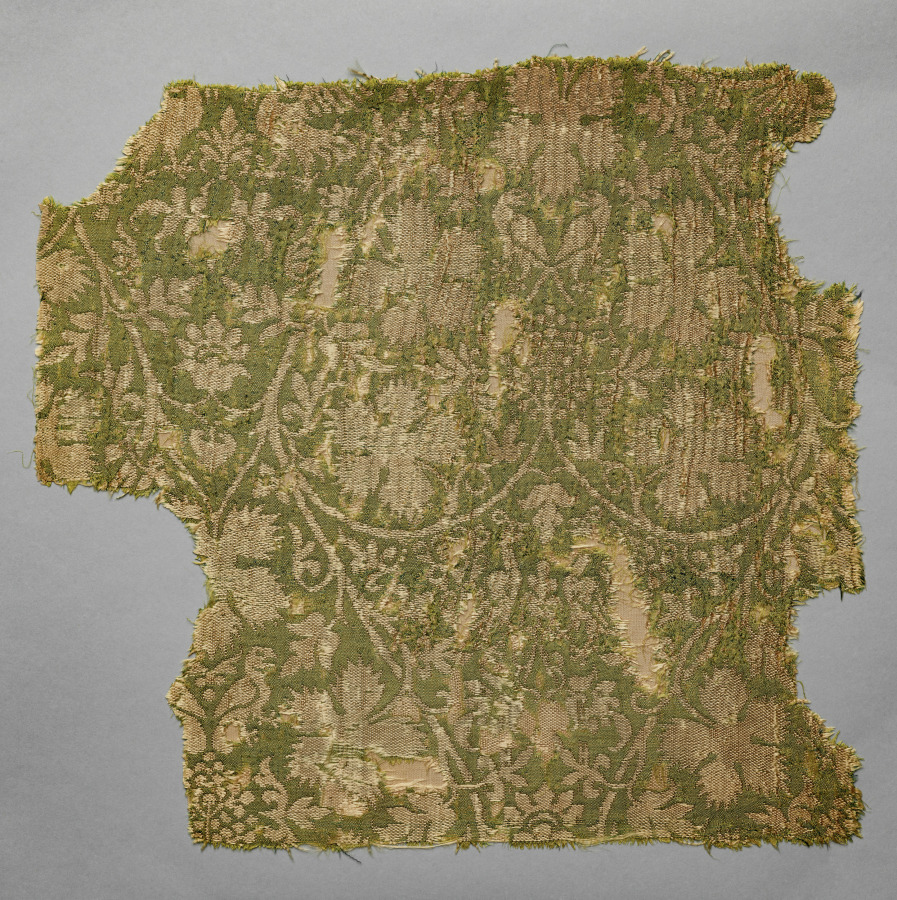
An Examination of Material Excellence: A Silk Fragment from the Imperial Ateliers
One approaches this artifact not as a mere textile remnant, but as a definitive statement of capability. It is a compact, yet profoundly eloquent, testament to a system of production where the very notion of compromise was rendered obsolete. The material, first and foremost, commands respect: a silk of such formidable density and fineness that it possesses the structural authority of a worsted wool, yet yields a lustre that can only be described as liquid. This is not a fabric that merely accepts design; it provides the essential foundation upon which grandeur is built. The hand, as it were, is impeccable—a weight and drape that speak of generations of technical refinement, a tangible heritage in every thread.
The Grammar of Opulence: Decoding the Pattern
The pattern, though confined to a fragment, articulates a complete philosophy of ornamental design. The scrolling vines are not mere flourishes; they are the architectural framework, executed with a rhythmic precision that suggests the calibrated movement of a master engine. Each line, each curve, is intentional, creating a sense of perpetual, ordered growth. This is nature not as found, but as perfected—a botanical blueprint of the highest order.
Upon this framework, the secondary elements are deployed with strategic intelligence. The grape leaves, with their serrated edges and intricate venation, demonstrate a technical prowess in weaving that rivals the most detailed engraving. The clusters of grapes themselves are rendered with a subtle variation in weave structure to suggest a dimensional plumpness, a play of light and shadow across their silken hemispheres. This is observation translated into thread with scholarly fidelity.
The Avian Element: Symbolism as Standard
The inclusion of the birds, however, elevates the composition from the simply magnificent to the symbolically significant. They are not idle decorative motifs, but active participants in the narrative of the piece. Often identified as phoenixes or songbirds in the imperial canon, these creatures represent the celestial favour and harmonious order bestowed upon the dynasty. Their integration within the vine scrolls—perched, feeding, or in flight—signifies a world in perfect balance, where nature yields its bounty under a benevolent and regulated authority. The weaver here operates as a visual rhetorician, employing a lexicon of symbols understood by the courtly audience. Every element, from the smallest berry to the span of a wing, conforms to a strict protocol of meaning, making the fragment a dense document of cultural and political ideology.
The Legacy of the Imperial Atelier: A System of Unrivalled Production
To appreciate this fragment fully, one must consider the formidable institution from which it originated: the imperial silk workshops. These were not mere manufactories; they were vertically integrated centres of research, development, and flawless execution. They controlled every variable, from the cultivation of the finest mulberry trees and the rearing of silkworms to the complex chemistry of dyes and the engineering of looms. The weavers were the elite of their craft, their lives dedicated to the mastery of technique. The designs were often commissioned from the leading court painters, making the loom an instrument for translating high art into textile.
This fragment, likely produced on a sophisticated draw-loom, represents the pinnacle of this system. The precision of the repeat, the flawless registration of colours, and the sheer complexity of integrating multiple weft threads for the polychrome pattern speak of hundreds, if not thousands, of hours of calibrated labour. It is a product of immense capital investment, relentless standardisation, and an uncompromising pursuit of an aesthetic ideal. In this sense, the imperial atelier prefigured the modern concept of the luxury house, where control over the entire supply chain is paramount to guaranteeing an unimpeachable product.
Conclusion: A Benchmark for Contemporary Practice
For the modern connoisseur of heritage and material excellence, this silk fragment serves as an enduring benchmark. It reminds us that true luxury resides in the seamless fusion of profound material understanding, technical mastery, and narrative depth. The legacy it carries is not one of nostalgic reverie, but of a rigorous standard. It challenges contemporary practice to consider its own foundations: the provenance of its materials, the integrity of its construction, and the intelligence of its design language.
In the final analysis, this artifact stands as a peerless example of how a textile can transcend its functional purpose to become an object of intellectual and aesthetic substance. It is a silent lecture on power, order, and beauty, woven with unassailable authority. Its lessons in proportion, balance, and the eloquent use of symbolic code remain as relevant to the discourse of luxury today as they were in the halls of the imperial court. It is, in every respect, a masterpiece of its kind.