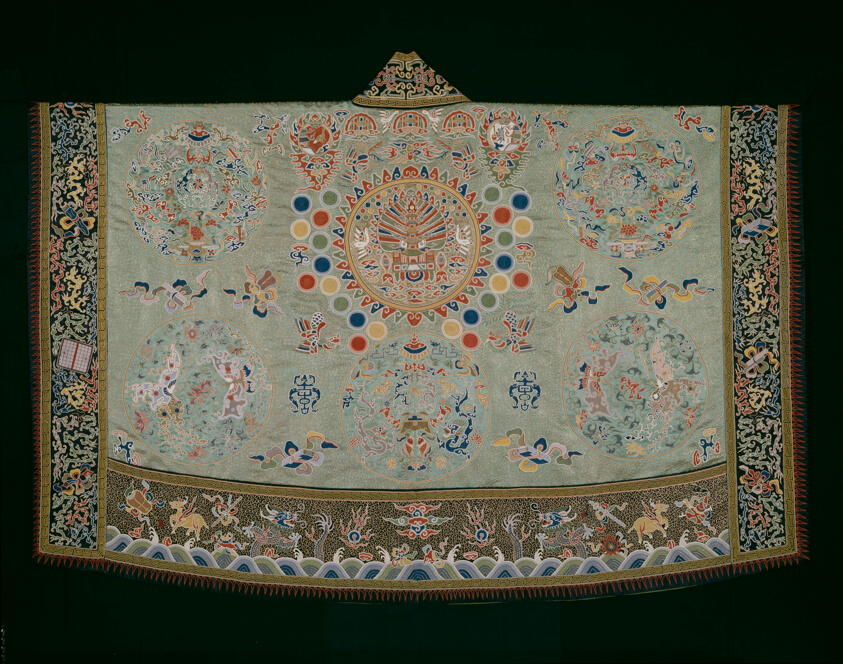
An Exegesis of Sanctified Fabric: The Taoist Priest's Vestment as an Artefact of Ultimate Refinement
To engage with the vestment of a First-degree Taoist priest is not merely to observe a ceremonial garment. It is to undertake a forensic appreciation of an artefact wherein spiritual cosmology, disciplined ritual, and the absolute apex of textile artistry achieve a state of perfect, fluid synthesis. This is not costume; it is consecrated architecture for the mortal form, a portable temple constructed from the most revered of earthly materials: silk. The materiality specified—satin weaves, twill damasks, embroideries of immense complexity—demands an analysis befitting the most exacting atelier. We are in the realm of the sartorial sublime, where every thread is intentional, every technique a language, and the final composition a testament to a heritage that understands elegance as a condition of harmony, not mere display.
The Foundation: Silk in its Most Authoritative Expression
The foundation of this vestment is an assertion of authority through substrate. Silk, the product of the Bombyx mori's meticulous labour, is here elevated beyond a simple fibre. The use of satin weaves is a deliberate masterstroke. The satin structure, with its long, unbroken floats of warp or weft, creates a surface of uninterrupted, profound luminosity. It captures and refracts light not with glitter, but with a deep, liquid sheen—a visual metaphor for the qi, the vital energy, that the priest channels and directs. This is the sartorial equivalent of a polished obsidian mirror: reflective, profound, and containing depth within its plane. The lining of twill damask silk provides a private, structural luxury, a hidden reinforcement of the garment’s status. The damask’s self-patterned texture, visible only to the wearer, speaks to an integrity of construction where excellence is maintained even in unseen aspects—a principle any bespoke house would recognise as fundamental to true distinction.
The Iconography of Metal: Laid Work and Couching as Alchemical Art
Upon this luminous ground, the narrative is inscribed not with paint, but with light itself, rendered solid. The embroidery utilising silver-leaf-over-lacquered-paper strips and gold-leaf-over-lacquered-paper-strip-wrapped silk represents a pinnacle of applied material science. This is not metallic thread in the commonplace sense. Here, precious metal leaf—the very substance of alchemical pursuit and celestial symbolism—is bonded to a stable substrate, then meticulously applied. The technique of couching, whereby these delicate, non-pliable strips are laid upon the surface and secured by minute, invisible stitches, is paramount. It allows the metal to lie perfectly flat, catching light across its entire surface area without the distortion of being pulled through the ground fabric. The result is iconography that appears not embroidered, but manifested—celestial diagrams, cosmological symbols, and talismanic script that gleam with a steady, unearthly radiance.
This is complemented by laid work, where long strands of silk are placed in parallel formations to create expansive, perfectly smooth fields of colour. The combination is critical: the solid, gleaming authority of the couched metals against the serene, fluid pools of laid silk. It creates a visual hierarchy on the garment, guiding the eye from the emblematic power of a gold-outlined Taiji symbol to the flowing, cloud-like forms rendered in silk. The craftsmanship here is one of immense patience and spatial intelligence, each element positioned within the garment’s schema with the precision of a cartographer charting the heavens.
Fluid Elegance: The Cut as Cosmological Principle
Context demands "fluid elegance," and this is where the vestment transcends the decorative to become philosophical statement. The cut of a high-grade Taoist priest’s robe, while prescribed by ritual form, is an exercise in dynamic drapery. It is not tailored to constrain the body, but to accommodate and amplify its movement in ritual dance, meditation, and the sweeping gestures of liturgy. The silk satin, with its dignified weight and fluid fall, moves with the wearer, creating a kinetic sculpture. The ties, themselves of satin weave, allow for secure closure that remains adjustable, a nod to the balance between discipline and natural flow.
This fluidity is deeply intentional. It reflects the Taoist principle of wu wei—effortless action, or going with the grain of the universe. The garment does not fight the body or the environment; it flows with them, its gleaming surfaces interacting with light and air, its sleeves becoming instruments of visual poetry in motion. The elegance derived is not stiff or pompous, but organic and authoritative. It is the elegance of a perfectly tuned system, where material, cut, and purpose exist in a state of mutual fulfilment.
Conclusion: A Heritage of Integrated Excellence
In final analysis, this vestment stands as a peerless heritage artifact. It synthesises the most advanced silk craftsmanship of its tradition—the cultivation of the fibre, the mastery of complex weaves, the alchemical embroidery techniques—into a single, cohesive statement of purpose. Its materiality is its meaning: the luminosity of silk satin for spiritual radiance, the permanence of couched precious metals for cosmic law, the fluidity of cut for harmonious action. Every technical decision, from the hidden damask lining to the public brilliance of the embroidery, serves an integrated vision.
To regard such a piece is to understand that true sartorial heritage, whether conceived on Savile Row or within the sacred precincts of a Taoist temple, resides in this very integration. It is the unwavering commitment to the finest appropriate materials, the employment of technique at the highest level of execution, and the subordination of both to a coherent, elevated purpose. The vestment is not adorned with symbols of the cosmos; through its very substance and form, it becomes one.