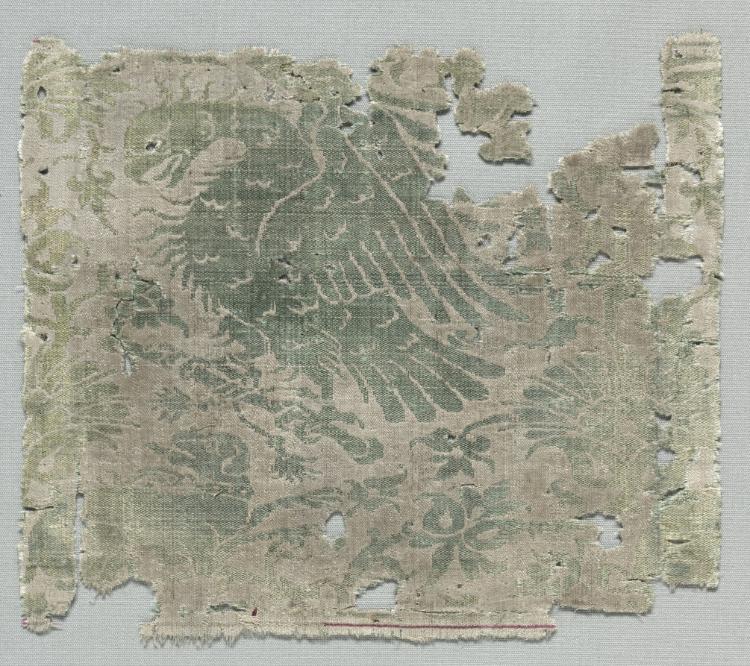
An Examination of Imperial Legacy in a Singular Fragment
One must approach this artifact not as a mere scrap of discarded material, but as a vestige of a consummate system. The silk fragment presented—its dimensions modest, its edges frayed by the relentless passage of time—belies a provenance of immense consequence. To the untrained eye, it is a delicate, if damaged, textile. To the discerning observer, it is a final, tangible testament to the imperial silk-weaving apparatus, a physical manifestation of power, aesthetics, and controlled luxury. Its very existence speaks of a supply chain perfected over millennia, a hierarchy of artisanship enforced by decree, and a language of symbolism woven as deftly as the threads themselves. We are not considering a bolt of cloth; we are auditing the assets of an empire's identity.
The Foundation: Material as Mandate
The materiality of silk is the non-negotiable first principle. This was never a matter of simple fibre selection. In the context of imperial legacy, silk was the legislated medium of authority. Its cultivation, the secret of the silkworm (Bombyx mori), was a state-protected monopoly, a piece of intellectual property guarded with a severity befitting military secrets. The fragment in hand, with its characteristically fine denier and enduring tensile strength, originates from this protected lineage. The quality of the thread suggests not merely skill, but access—access to the finest mulberry leaves, the most carefully regulated rearing environments, and the most meticulous reeling processes. This was a raw material that began its life under imperial supervision, a biological product harnessed and refined to serve a political and social agenda.
The Architecture of the Loom: A Regimented Craft
Upon this foundation of supreme material was built an architecture of creation as complex as any court bureaucracy. The fragment, when examined under appropriate magnification, reveals the tell-tale precision of a draw-loom operation. This was not the tool of the cottage weaver. It was a substantial, capital-intensive apparatus, requiring a team: a master weaver orchestrating the shedding sequence and a draw-boy, often an apprentice, managing the intricate pattern controls. The very structure of the workshop mirrored the society it served—hierarchical, specialised, and driven by a singular vision from above. The rhythmic clatter of such looms was the sound of imperial edicts being translated into tactile form. Each pass of the weft was an act of compliance with pre-ordained design protocols, leaving no room for individual improvisation. The consistency of the weave density in this fragment, even in its diminished state, attests to a rigour that was both technical and philosophical.
The Semiotics of Pattern: A Woven Heraldry
Here we reach the crux of the matter: the symbolic lexicon. While the fragment is too small to reveal the full narrative of its original pattern, traces of its design language remain. A suggestion of a cloud-collar motif, the faintest echo of a stylised lotus or a dragon's talon—these are not decorative whims. They are heraldic. In the imperial schema, specific patterns, colours, and combinations were codified with the precision of sumptuary law. The five-clawed dragon (long) was reserved for the Son of Heaven alone; certain shades of yellow were his exclusive prerogative. To wear or display such iconography without sanction was not a fashion faux pas; it was sedition. Thus, this fragment, however humble its current size, once participated in a system of visual communication that reinforced the very structure of the celestial empire. It was a badge of office, a marker of rank, and a constant, silent reinforcement of the cosmic order.
Legacy and the Modern Lexicon
The true measure of this heritage lies not in nostalgia, but in its enduring principles. The imperial silk-weaving legacy bequeaths a framework that remains profoundly relevant: an uncompromising commitment to material integrity, a reverence for process over shortcut, and an understanding that true luxury is a language spoken through details. The Savile Row cutter, selecting his cloth with a tactility learned over decades, honours the same principle as the imperial inspector grading cocoons. The meticulous canvassing of a coat, unseen yet fundamental to its drape and longevity, is the spiritual kin to the hidden precision of the draw-loom's tie-downs. The bespoke suit, with its personalised but deeply coded language of silhouette, button stance, and lapel width, functions as modern sumptuary—a quiet signal to the discerning.
This fragment, therefore, is far more than a relic. It is a benchmark. It reminds us that heritage in the realm of luxury is not a vague allusion to the past; it is the active stewardship of standards that transcend time. The imperial workshops understood that authority was woven, thread by thread, into the very fabric of society. In preserving and studying such an artifact, we acknowledge a simple, enduring truth: quality, in its highest form, is always imperial. It commands, it endures, and it speaks, even in fragments, with unquestionable authority.