An Artefact of Discipline and Refinement: The Sampler in the Lauren Fashion Heritage Lab
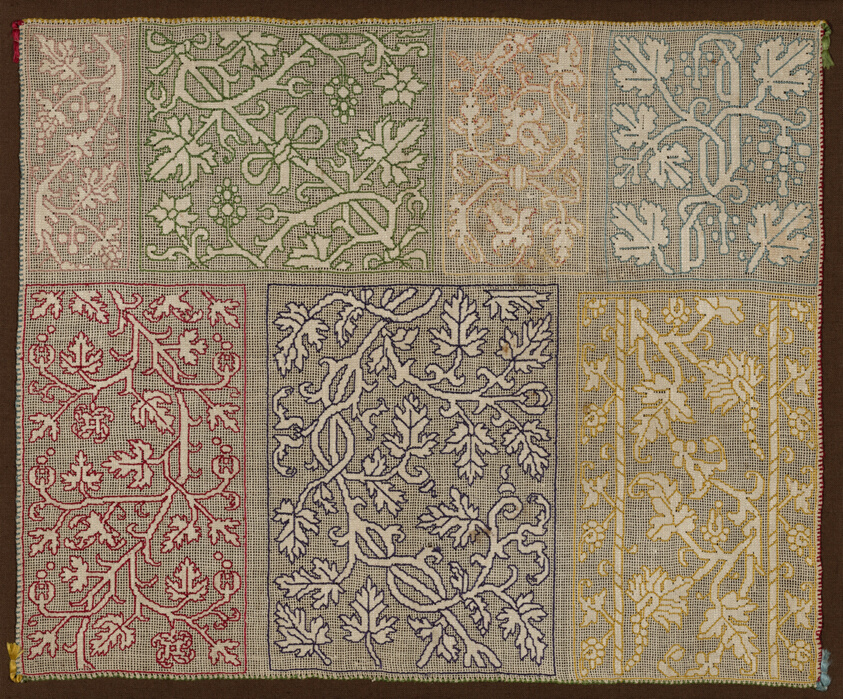
Within the curated silence of the Lauren Fashion Heritage Lab, we examine artefacts not merely as decorative objects, but as foundational documents. They are the codices of craft, the rigorous primers upon which entire sartorial languages are built. The subject at hand—a sampler executed upon a ground of linen plain gauze weave, embroidered with silk floss and linen thread—is one such seminal text. It represents not the final, flamboyant declamation of style, but the essential, disciplined grammar of the needle. Its materiality and context speak directly to the core principles of classic silk craftsmanship and the cultivated, fluid elegance that remains our house signature.
The Ground: Linen Gauze as a Canvas for Rigour
One must first appreciate the foundation. The selection of a plain gauze weave linen is a statement of intent. It is the sartorial equivalent of the finest, most resilient canvas—unforgiving in its transparency, demanding precision. Unlike a densely woven fabric that might forgive a misplaced stitch, gauze lays bare every technical decision. The weaver’s hand is evident in the regularity of the grid, a structure that the embroiderer must both respect and transcend. This choice of ground speaks to a culture of craftsmanship that values challenge over convenience, understanding that true skill is forged against exacting standards. It is a principle we recognise on Savile Row: the unseen canvas of a horsehair chest piece, the precise tension of a sleeve head—foundations must be impeccable to support elegance.
The Lexicon of Stitches: A Technical Repertoire
The embroidery itself constitutes a deliberate and scholarly anthology of technique. Each stitch is a word in a vocabulary of texture and line.
The double running stitch, often known as Holbein stitch, is the backbone. It is the epitome of controlled, reversible perfection—meticulous, linear, and producing an identical face and back. Its use denotes a mastery of discipline, a commitment to integrity in workmanship that remains unseen. This is the stitch of the hidden selvedge, the immaculate inner lining; it is craftsmanship for its own sake, a private code of honour.
The stem stitch introduces fluidity. It is the cursive script of the needle, allowing for the graceful, flowing curves of foliate motifs or elegant monograms. It transforms thread into a drawn line, demonstrating the embroiderer’s ability to impart movement and organic grace upon the geometric rigidity of the gauze grid.
The weaving and buttonhole stitches represent the expansion into texture and structure. The weaving stitch builds substance, creating dense, tapestry-like fills that play with light and shadow. The buttonhole stitch, with its locked loops, is both decorative and fundamentally sound—the origin point for eyelets, bars, and edgings that require absolute structural integrity. Together, this repertoire—from the linear and flat to the textured and raised—demonstrates a comprehensive command of the needle’s potential.
The Substance: Silk Floss as the Conduit of Elegance
Here, the material marries the technical. The use of silk floss is not incidental; it is the vital agent of elegance. Silk possesses a luminosity, a inherent depth of colour and a subtle sheen that linen thread cannot replicate. As the floss passes through the gauze, it does not merely sit upon the surface; it seems to illuminate the fabric from within. The choice to combine it with linen thread is a nuanced one—perhaps a study in contrast, exploring matte against shine, resilience against softness. This thoughtful material selection underscores a fundamental tenet of classic craftsmanship: the intrinsic quality of the material must be worthy of the labour invested. The silk floss ensures that every disciplined stitch is rewarded with a visual payoff of rich, fluid colour and a soft, beguiling lustre. It transforms the sampler from a mere technical exercise into an object of beauty, prefiguring the application of such skill to the most luxurious of garments.
The Final Accent: Applied Silk Tassels and the Gesture of Completion
The applied silk tassels at each corner are the artefact’s concluding punctuation. They are not embroidered but applied—a distinct, conscious act of finishing. These tassels introduce a third dimension, a playful yet refined gravity that animates the sampler’s edges. They signify a transition from the pedagogical to the decorative, a hint of how this rigorous vocabulary will be employed in the wider world of furnishings and dress. They are the flourish of a master’s signature, a confident assertion that the discipline contained within the frame has been thoroughly, elegantly mastered.
Context and Legacy: The Grammar of Fluid Elegance
Understood in its full context, this sampler is far more than a practice piece. It is the rigorous grammar underlying the fluid elegance of classic silk craftsmanship. Every element—the demanding gauze ground, the scholarly anthology of stitches, the strategic use of luminous silk—serves a didactic and philosophical purpose. It inculcates patience, precision, and a profound respect for material.
This is the very ethos that informs the highest levels of tailoring and luxury fashion. The fluid elegance of a Lauren silk gown begins not at the cutting table, but with this same understanding of thread, tension, and texture. The sampler teaches control, so that elegance may appear effortless. It demands discipline, so that luxury may be underpinned by integrity. In our Heritage Lab, we regard it as a cornerstone artefact: a testament to the truth that enduring style is always, and forever, built upon a foundation of unshakeable craft.