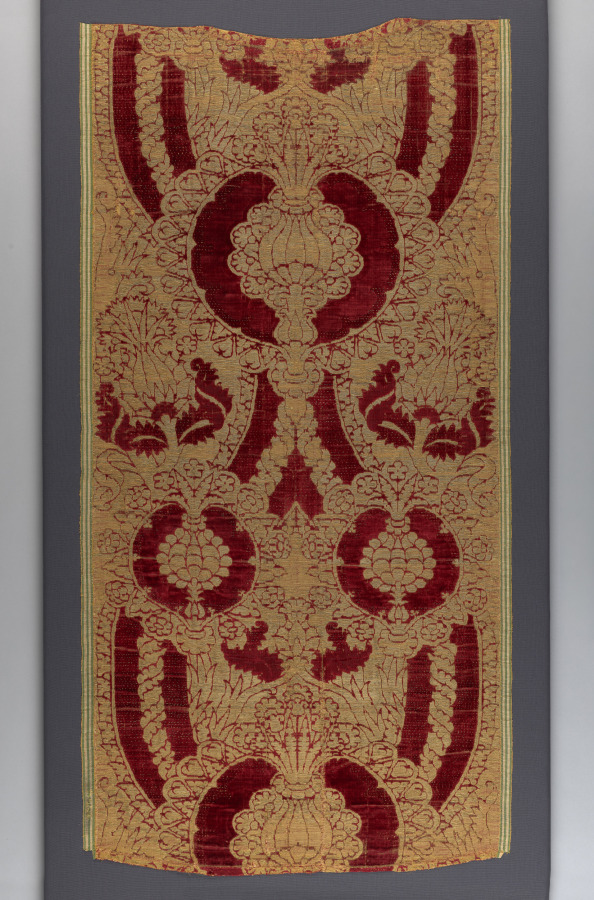
An Examination of Imperial Silk Velvet: The Pomegranate Motif in Gold
To consider the artefact in question—a length of silk velvet, voided and voided again, to form the raised, lustrous pattern of the pomegranate, its intricacies further illuminated by the application of gold thread—is to engage not merely with a textile, but with a profound statement of authority. This is not simply fabric; it is a manifestation of concentrated power, a deliberate and enormously costly exercise in technological supremacy and aesthetic intimidation. The very materiality speaks of a system, an empire of the loom, where control over such production was as vital as control over the legion or the treasury.
The Substrate of Power: Silk Velvet
Let us first address the foundation: silk velvet. The creation of velvet, with its dense, plush pile, represents one of the most complex achievements in the weaver’s canon. It requires a loom of considerable sophistication, capable of handling multiple warp systems. The ground weave forms the structural backbone, while a second set of warp threads is raised over rods to create the loops that, when cut, yield the characteristic soft, light-absorbing nap. The process is slow, demanding immaculate precision; a single error can flaw an entire ell. To master velvet was to command the pinnacle of textile technology. In the context of imperial workshops—be they the renowned kesi establishments of Ming China, the state-controlled nasij factories of the Ilkhanate, or the later European court ateliers—the production of such velvet was a closely guarded secret, a state monopoly. The cloth itself became a regulated currency of prestige, doled out as diplomatic gifts or reserved for royal vestments and altar frontals, its tactile luxury a direct, sensory expression of sovereign privilege.
The Symbolism of the Pattern: The Pomegranate, Whole and Divided
Upon this sumptuous ground resides the pattern: the pomegranate. Its adoption as a premier motif in imperial silks is a matter of deliberate iconography, not mere decoration. The fruit, with its crown-like calyx, is inherently regal. More significantly, its interior—a single vessel containing a multitude of seeds—offered a potent metaphor for unity, fertility, and dynastic continuity. An empire, after all, is one body comprising countless subjects. In the Ottoman context, where this motif reached an apogee of stylisation, the pomegranate symbolised abundance and imperial bounty. The pattern on our specimen, however, is not merely a naturalistic rendering. It is likely a formalised, repeating design, possibly of the type known as a ‘cone’ or ‘hatayi’ pattern in Eastern traditions, where the pomegranate is abstracted into a medallion form, often paired with scrolling leaves and palmettes.
The genius of the design lies in its use of voided velvet. Here, the pattern is not printed on the pile but is formed by the pile itself. In areas meant to be the design, the velvet pile is raised. The background is left as the flat, sheer silk ground weave—or, in a more complex iteration, a second, contrasting velvet pile. This creates a dramatic play of texture and sheen: the light-catching, shadow-holding velvet pattern against the luminous, reflective ground. It is a study in contrast, a visual and tactile dialogue that speaks of immense confidence. The design does not sit upon the surface; it is of the surface, an integral part of the cloth’s architecture.
The Final Ascension: The Application of Gold
Yet, the artisans did not rest here. Upon the velvet pomegranate, they applied gold thread. This would typically be in the form of ‘thread’ made by winding a narrow strip of gilt membrane—often silver gilded, then flattened—around a silk core. This filé thread would then be couched down onto the velvet pattern using a fine silk thread, stitch by meticulous stitch. The effect is transformative. The gold does not simply adorn; it illuminates. It catches the light with a different, more fiery quality than the silk pile, tracing the contours of the fruit and its leaves with a line of celestial fire. This application represents the final, superfluous layer of expense and labour—the ultimate declaration that cost was no object. The gold is both literal and metaphorical wealth woven into the fabric, ensuring that the wearer of a garment made from this cloth would quite literally carry the light of sovereignty upon their person.
Legacy and Connoisseurship
The legacy of this imperial silk weaving is a legacy of absolute standards. It established a paradigm where textile art was synonymous with political power. The pomegranate velvet is a direct antecedent to the culture of bespoke luxury we uphold today, albeit translated into a different lexicon. Where the imperial atelier used velvet and gold to signify divine-right authority, the modern bespoke establishment uses the integrity of the hand-stitch, the exclusivity of the cloth from a solitary mill, and the perfection of the silhouette to signify a different, but equally deliberate, form of authority: that of discernment, of position, and of quiet, unassailable confidence.
To examine this artefact, then, is to understand that true luxury is never accidental. It is the result of a conscious convergence of the finest material (the silk), the most demanding technique (voided velvet), the most potent symbolism (the pomegranate), and the most extravagant enhancement (the gold). It is a system of value, woven into being. Each thread, each decision, from the loom to the couching needle, was a reaffirmation of an imperial order that sought to manifest its dominion not only through edict and army but through the very stuff of splendour. In its silent, sumptuous presence, the cloth remains a formidable testament to that ambition.