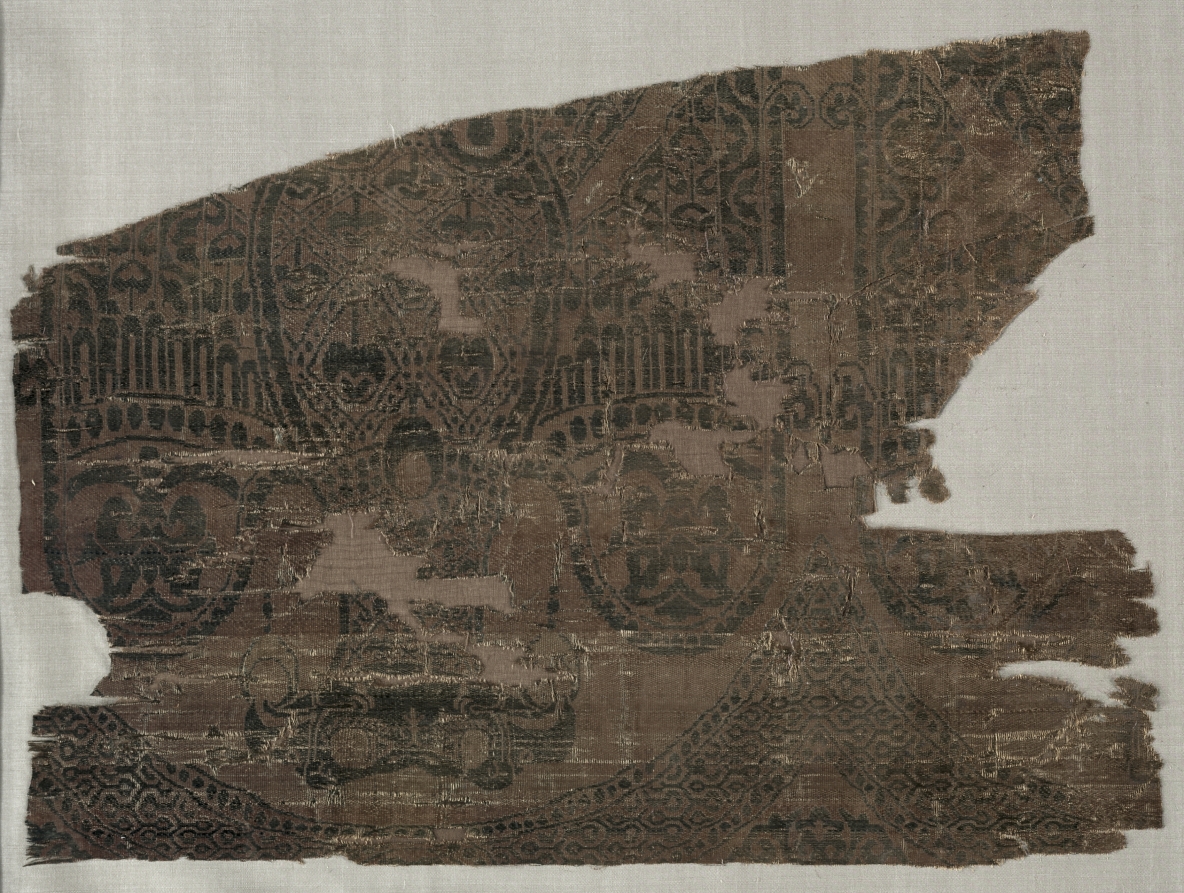
A Scrutiny of Provenance and Thread
One approaches these fragments, not as mere textile, but as a confluence of vested authority. Recovered from the sepulchral repose of Saint Bernard Calvo, the 13th-century Bishop of Vich, their very presence is a statement. The material is samite, a heavy silk weave of pronounced dignity, characterised by its weft-faced compound twill structure. This is not a fabric of fleeting fashion; it is a medium for permanence. The threads themselves, upon expert examination, betray an origin of the highest order. The density of the weave, the resilience of the filament, and the enduring lustre—somewhat subdued by centuries but indisputable—point unequivocally to the imperial workshops of Byzantium or, perhaps, those of Palermo under the Norman kings, who so adeptly co-opted Byzantine craft for their own regal theatre. This was a commodity of staggering value, a diplomatic currency as potent as any bullion.
The Heraldry of Supremacy: A Dual-Headed Charge
The motif, however, is where the narrative consolidates its power. Woven into the very marrow of the cloth is the double-headed eagle, splayed in rigid, symmetrical heraldry. It is an emblem that transcends mere decoration; it is a manifesto in thread. In the 12th and 13th centuries, this symbol was the exclusive prerogative of the Byzantine imperial house, the Palaiologoi, asserting a claim to universal sovereignty—authority over both East and West, temporal and spiritual. Its appearance here, in the tomb of a Catalan bishop, is a matter of profound political and theological implication.
We must consider the garment’s journey from the loom to the tomb. Was it a gift from a Byzantine emperor, seeking favour or alliance in the complex politics of the Mediterranean? Or was it, as some scholars posit, a spoil from the Sack of Constantinople in 1204, subsequently donated to the Church as a pious offering of immense worth? The latter theory carries a certain brutal poetry—a symbol of vanquished imperial power, repurposed to shroud a prince of the Church, thus transferring that aura of authority to the triumphant Latin faith. In either case, its inclusion in the bishop’s vestments signals an aspiration to a realm of influence beyond the local diocese, a tangible connection to the idea of a universal Christendom led by Rome.
Materiality as Testament: The Weave of Legacy
The legacy of imperial silk weaving is not one of mere technique, though the technical mastery is absolute. It is a legacy of controlled spectacle. Byzantine and later Sicilian *ergasteria* were state institutions, as guarded in their secrets as any mint. The production of such silks was a tightly held monopoly, with patterns and quality legislated by imperial decree. To possess such a textile was to be admitted, however fractionally, into that rarefied sphere of sanctioned power. The samite’s weight and drape would have conferred an immediate physical authority upon the wearer, a stiffness that dictated posture and movement, demanding a gravitas commensurate with its cost and iconography.
For Bishop Bernard Calvo, a figure involved in the Reconquista and the political machinations of the Crown of Aragon, this garment was armour of a different sort. It armoured him in legitimacy, in a connection to ancient, unbroken lines of sacred and imperial authority. In his tomb, it served not as a shroud of obscurity, but as a final, definitive statement of his office’s place within a grander, divinely ordained hierarchy. The silk, resilient and slow to decay, was chosen precisely for this permanence—a final, enduring testament in a language of luxury that his peers and successors would understand implicitly.
Conclusion: An Enduring Grammar of Power
These fragments, now silent and still, speak with a formidable eloquence. They articulate a world where commerce, diplomacy, faith, and propaganda were inextricably woven on the same loom. The samite is the foundational syntax, the double-headed eagle the potent verb. Together, they form a complete sentence on the nature of medieval authority. To study them is to understand that heritage in luxury is seldom about mere aesthetics; it is about the codification of influence. The legacy they represent—of the imperial silk weaving tradition—is one where every thread was counted, every colour symbolically charged, and every motif a calculated declaration. It is a legacy that informs, albeit distantly, the modern appreciation for materials of integrity and emblems of substance. In the hushed confines of the tomb, these fragments continue their silent work, asserting a pedigree of power that nine centuries have failed to unravel.