An Analysis of Avian Comportment and Sartorial Parallels
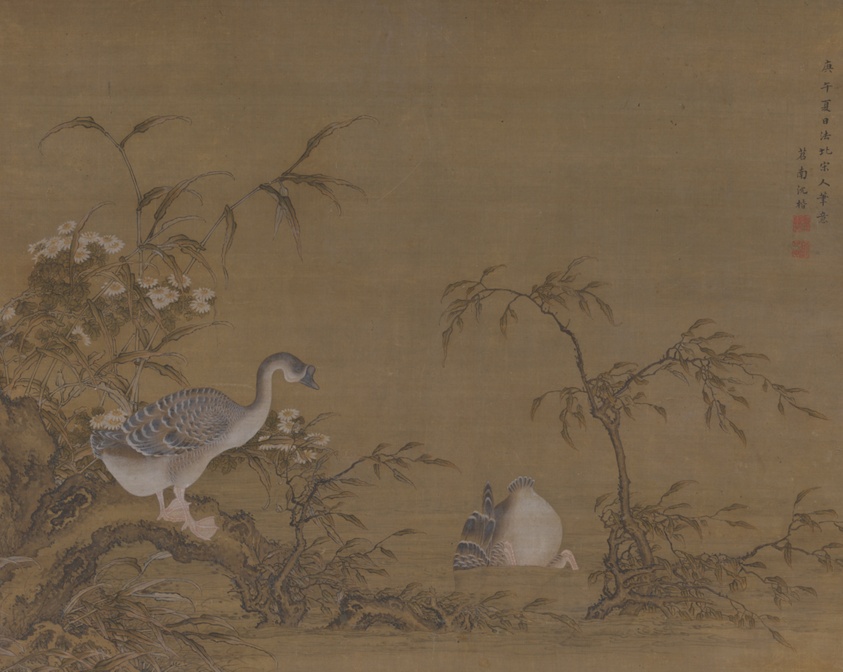
Upon first inspection, the artifact presents a scene of pastoral tranquillity: a congregation of geese upon a riverbank, rendered with a masterful economy of line and a restrained yet deliberate application of colour upon a ground of the finest silk. To dismiss it as a mere decorative exercise in naturalism, however, would be to misunderstand its fundamental proposition. This is not a snapshot of rural life, but a profound meditation on order, hierarchy, and the silent language of collective elegance—principles as germane to the ateliers of classic tailoring as they are to the natural world. The work demands to be read not as a picture, but as a treatise on composed existence.
The Ground: Silk as the Ultimate Bespoke Canvas
The selection of silk as the foundational medium is the first and most critical declaration of intent. Unlike the absorptive, forgiving nature of paper, silk is a demanding and exacting surface. It tolerates no hesitation; each stroke of the brush is a permanent commitment, its fluidity captured forever in the delicate weave. This is the sartorial equivalent of the pristine broadcloth that arrives at a Savile Row cutting table—a material of inherent nobility that must be approached with respect and absolute technical certainty. The silk here does not merely receive the image; it collaborates in its creation. The way the dilute ink bleeds slightly along the warp and weft to suggest the softness of plumage or the shimmer of water is an effect born of a deep, generational understanding of the material’s character. It is a partnership between artist and medium, mirroring the relationship between a master cutter and his cloth, where the material’s natural drape and behaviour inform the final, seemingly effortless, form.
The Composition: Hierarchy and the Quiet Authority of the Lead
Observe the arrangement of the geese. This is no chaotic gaggle. A clear, unspoken hierarchy structures the group. One figure, often slightly larger and rendered with a more assertive, confident line, assumes a position of quiet leadership—perhaps with its neck arched in a vigilant curve, surveying the environment. Surrounding it, other geese adopt poses of attentive repose, their forms angled subtly towards the central authority, creating a narrative of cohesive unity. The composition speaks to the very essence of a well-ordered ensemble or a harmonious household.
Consider the parallel: in a perfectly fitted suit, there is a lead element—the jacket. Its shoulders establish the architecture; the drape of the chest commands attention. The trousers, the waistcoat, the shirt, all play supporting roles, their lines and proportions carefully calibrated to complement without competing. Each element knows its place, contributing to a singular, authoritative silhouette. The geese on the riverbank embody this same principle of cohesive hierarchy. Their individual beauty is secondary to the elegance of the collective whole.
Line and Colour: The Grammar of Fluid Elegance
The artist’s use of line is where the principle of "fluid elegance" finds its purest expression. The contours of the geese are not rigid outlines but suggestive, calligraphic gestures. A single, sweeping stroke defines the powerful curve of a neck; a softer, drier brush suggests the downy texture of the breast. This economy and confidence of line is the visual counterpart to the skill of a hand-sewer, where a single, continuous thread, pulled with consistent tension, creates a seam that is both strong and invisible, allowing the garment to move with the wearer. The line here is alive, implying movement, breath, and potential energy even in stillness.
Colour is applied not as blanket pigmentation, but as strategic accentuation—a subtle wash of ochre at the base of a beak, a hint of grey to model the form. This restrained palette underscores the sophistication of the piece. It understands that true luxury often lies in omission, in the confidence to allow the quality of the silk and the mastery of the line to carry the narrative. It is the aesthetic equivalent of a perfectly chosen pocket square or a discreet tie knot: an accent that reveals a deep understanding of convention and taste, rather than a loud proclamation.
Context and Legacy: The Patina of Timelessness
The hanging scroll format itself confers a ritualistic, timeless quality. It is an object designed for contemplative viewing, to be unfurled and appreciated in a moment of reflection, then carefully stored. This cyclical engagement mirrors the care accorded to a heritage garment—brushed, stored in breathable cloth, and brought out for appropriate occasions, acquiring not damage but a dignified patina over time. The scene of geese, a classic subject in the East Asian artistic canon, connects the work to a long lineage of craftsmanship and philosophical inquiry. It is, in its way, a "classic model" that has been interpreted by generations of artists, much like a two-button single-breasted suit or a cavalry twill overcoat—forms that have been refined over decades into timeless icons.
In conclusion, this artifact, Geese on a Riverbank, transcends its nominal subject. Through its demanding silk ground, its hierarchically structured composition, its calligraphic and fluid line work, and its context of contemplative legacy, it articulates a philosophy of elegance that is deeply congruent with the highest principles of bespoke craftsmanship. It demonstrates that true elegance, whether in nature, in art, or in attire, is never a product of accident or ostentation. It is the result of order understood, material respected, tradition honoured, and execution achieved with a quiet, confident mastery. It is, in the final analysis, a study in the permanent virtue of the composed gesture.