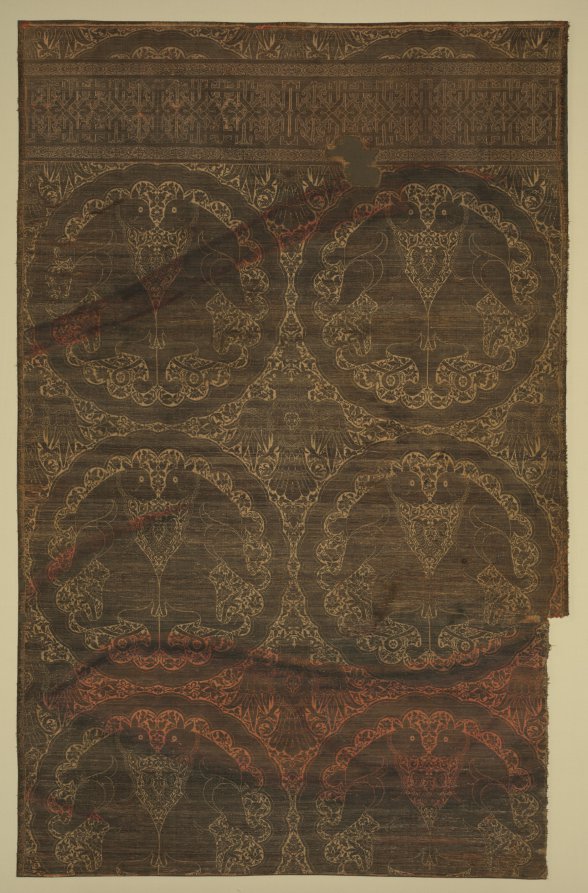
An Examination of Imperial Authority Woven in Thread: The Cloth of Gold with Felines and Eagles
To comprehend the full measure of this artifact—a fragment of cloth of gold depicting felines and eagles in intricate confrontation—one must first appreciate the profound materiality of its foundation. We are not discussing a mere textile; we are in the presence of silk. This is the ultimate, non-negotiable substrate of power for over a millennium of Eurasian imperium. Its acquisition, from the secretive sericulture of China to the guarded ateliers of Byzantium and later, the state-sanctioned workshops of Europe, was a geopolitical endeavour of the highest order. The fibre itself, a continuous filament of protein, possesses a innate luminosity, a refractive quality that transforms colour and metallic thread into something living, something that interacts with light and movement in a manner wool or linen never could. It is, in essence, liquid light given form. Upon this rarefied canvas, the true narrative of authority is inscribed.
The Grammar of Power: Iconography as Imperial Protocol
The design schema—felines and eagles engaged in a timeless, stylised combat—is not a casual bestiary. It is a deliberate, heraldic language, a grammar of dominion understood from the Palatine to the Forbidden City. The eagle, aquila, needs little introduction. It is the unassailable symbol of celestial authority, of Zeus and Jupiter, of Rome’s legions, and later, of imperial double-headed aspirations stretching across continents. It represents sovereignty, far-sighted vision, and the uncompromising dominion of the air.
The feline, however, offers a more nuanced dialect within this language. Whether rendered as a panther, a leopard, or a lion, it embodies terrestrial majesty, brute strength tempered by regal poise, and the silent, lethal authority of the apex predator. The confrontation between the two is not a scene of chaos, but of orchestrated balance—a visual representation of the natural order, where competing supreme powers exist in a state of dynamic tension, each defining the other’s realm. To drape one’s person or one’s court in such imagery was to cloak oneself in the very essence of world-ordering power. It declared that the wearer existed at the apex of this symbolic hierarchy, the arbiter between the celestial and the terrestrial.
The Alchemy of Weaving: From Thread to Treasure
The technical execution elevates symbolism into the realm of the miraculous. "Cloth of gold" is a term often used loosely; here, it is precise. This would likely be a compound textile, a lampas or a velvet, where a ground of finest silk supports a supplementary weft of gold-wrapped membrane—thin strips of gilt leather or paper spun around a silk core. The effect is not merely decorative; it is transformative. The metallic threads catch the light with each subtle movement, causing the eagles to seem to beat their wings, the felines to ripple with muscle. The silk ground, dyed with perhaps cochineal or kermes for a profound crimson—a colour historically reserved for the highest echelons—provides a depth, a luxurious darkness from which the gold narrative erupts.
The weaving itself, conducted on a complex draw-loom, was an act of immense labour, skill, and time. The pattern, encoded in a labyrinth of cords and leashes, was a form of pre-digital data. Each passage of the shuttle was a calculated decision, each lift of the warp threads a pixel in the emerging grand image. The weavers were not artisans in the common sense; they were highly disciplined technicians executing a state-sanctioned design, often within the walls of an imperial factory where patterns were protected as fiercely as state secrets. The resulting fabric was, by any measure, a form of concentrated capital and a testament to an empire’s ability to marshal and control the most advanced technology of its day.
The Legacy Tailored: From Imperial Robes to Contemporary Continuity
The legacy of this imperial silk-weaving tradition is not confined to museum vitrines. Its principles—the unyielding pursuit of the finest material, the symbolic weight of iconography, the reverence for consummate technique—echo directly in the most rarefied corridors of contemporary craftsmanship. Consider the ethos of a Savile Row cutter. The selection of a length of cloth—a rare, undyed worsted from a specific mill in Huddersfield—mirrors the imperial selection of silk. The cut is not merely functional; it is an iconography of its own, with roped shoulders, a suppressed waist, and sweeping skirts communicating lineage, authority, and tradition as clearly as any heraldic eagle.
The construction, hours of silent, focused labour by a single craftsman, is the direct descendant of the draw-loom weaver’s disciplined art. Both understand that true luxury is not in ostentation, but in integrity of construction and clarity of purpose. The imperial cloak woven with felines and eagles was armour for the theatre of state; the bespoke suit is armour for the theatre of modern leadership. Each is a testament to the enduring human need to articulate status, identity, and authority through the medium of cloth, employing the very best materials and minds of the age.
In conclusion, this fragment of silk is far more than a historical textile. It is a consolidated statement of imperial ideology. From the strategic cultivation of the silkworm to the complex iconography locked in battle across its surface, every element was a calculated expression of power, control, and celestial mandate. It reminds us that the most enduring legacies are often those woven not just into the fabric of history, but literally, and with impeccable technique, into the fabric itself. The thread of imperial silk, from the workshops of Constantinople to the ateliers of modern masters, remains unbroken—a continuous filament of excellence, demanding the same reverence for material, symbol, and craft that it did a thousand years ago.