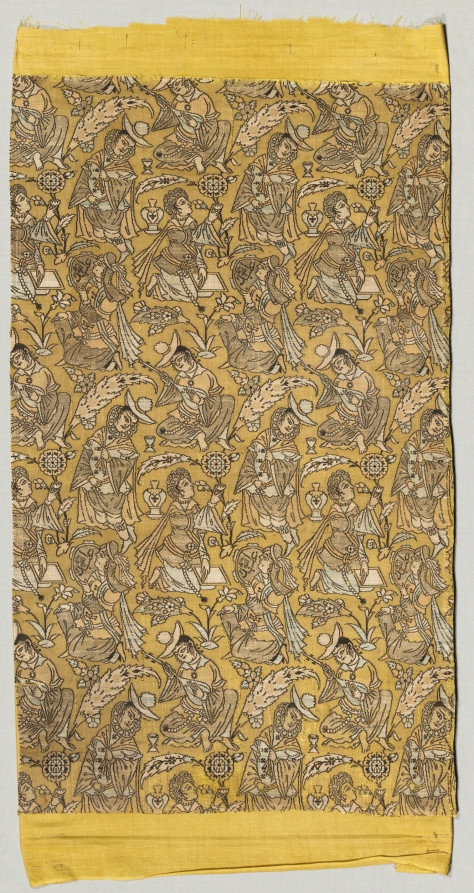
An Examination of Imperial Lampas: The Symphony of Silk
To comprehend the object before us—a fragment of lampas silk depicting dancers and musicians—is to engage not merely with a textile, but with a profound statement of power, aesthetics, and technical supremacy. This is not simply fabric; it is a woven empire. The very materiality, pure silk, establishes its pedigree. Silk was, for centuries, the ultimate luxury fibre, a tangible manifestation of cultural and economic hegemony whose production secrets were guarded as fiercely as state secrets. The deliberate choice of silk for such a complex weave as lampas speaks of a commissioning body for whom cost was immaterial and impact was everything. The fibre’s innate luminosity, its capacity to hold dye with unparalleled depth and clarity, and its formidable strength despite its fineness, made it the sole acceptable medium for conveying imperial iconography. It transforms light into a participant in the narrative, ensuring the figures of dancers and musicians are not static, but alive with a shimmering vitality as the wearer moves.
The Architecture of Opulence: Deconstructing the Lampas Weave
The technique, lampas, represents the pinnacle of the loom-bearer’s art. It is the sartorial equivalent of a grand architectural edifice, employing multiple warp and weft systems to create a polychrome, patterned textile of substantial weight and exquisite detail. Unlike simpler weaves, lampas allows for a clear, painterly delineation of complex scenes. The ground and the pattern are woven simultaneously yet independently, often with contrasting types of silk thread—perhaps a fine, tight twist for the background, and a looser, softer twist for the figures to grant them subtle texture. This technical bravura is the silent, essential foundation upon which the narrative rests. It is what allows the curvature of a dancer’s arm, the intricate strings of a lute, or the delicate features of a face to be rendered not as embroidered afterthoughts, but as intrinsic, structural elements of the cloth itself. The result is a fabric of formidable durability and breathtaking artistry, a dual achievement that separated imperial workshops from merely commercial enterprises.
The Narrative Loom: Decoding the Motif of Revelry
The subject matter—dancers and musicians—is a deliberate and sophisticated motif, far removed from mere decoration. In the context of imperial legacy, this scene of cultivated leisure is a potent ideological tool. It projects an image of the court as a centre of harmony, refinement, and celestial order. The dancers, captured in mid-movement, embody grace and discipline, their prescribed patterns mirroring the structured harmony the empire sought to impose upon the world. The musicians, with their precise instruments, represent the mathematical and artistic precision fostered under imperial patronage.
This is not a snapshot of a spontaneous celebration; it is a meticulously composed vision of the ideal state. The repetition of these figures across the fabric’s repeat creates a rhythm as deliberate as the music they depict, reinforcing the message of endless prosperity and perpetual cultural flowering. It communicates that under the imperial aegis, the arts flourish, peace reigns, and life is a continuous, elegant performance. This silk, therefore, would likely have adorned the walls of a palace or the robes of a high official, making the wearer or the space a literal embodiment of this perfected world order.
A Legacy in Thread: From Imperial Loom to Modern Consciousness
The legacy of such imperial silk weaving is profound and twofold. Firstly, it set an unimpeachable standard of quality and ambition that defined luxury for subsequent centuries. The technical patterns, dye recipes, and design sensibilities developed in these workshops became a coveted inheritance, fought over, stolen, and emulated across continents. The very existence of this fragment connects us to a supply chain of power: from silkworm cultivators and master dyers working with rare pigments, to the elite designers and weavers executing the pattern, all orchestrated by a centralised, imperial authority with the resources to command such a protracted, labour-intensive endeavour.
Secondly, and perhaps more critically for our contemporary understanding, this artifact challenges the modern divorce between art and craft. Here, the medium is inseparable from the message; the technical mastery is the very language of the narrative. It refuses to be categorised as merely ‘decorative art.’ It is a historical document, a economic indicator, and a philosophical treatise woven in thread. To study it is to understand that imperial power was exercised not only through edicts and armies but through the control of beauty and the monopoly on splendour. The lampas with dancers and musicians is, in the final analysis, a symphony of control—over nature, over technique, over image, and over perception. It remains, centuries later, a definitive statement of what it meant to reign supreme.