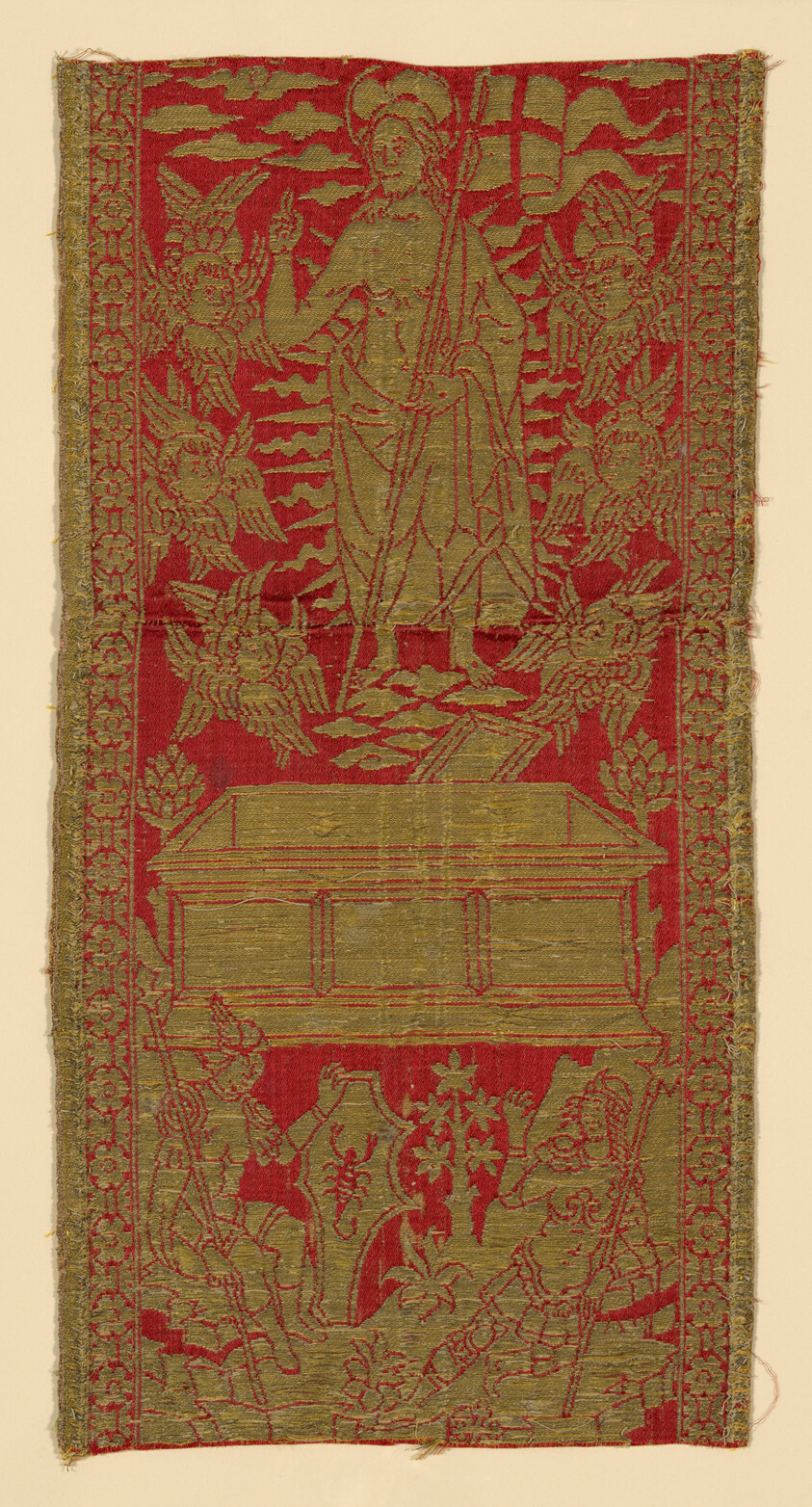
A Discreet Fragment: Interrogating the Orphrey
One does not, as a rule, begin an assessment with a fragment. In the rarefied atmosphere of true craftsmanship, the complete garment—the drape, the line, the finished statement—is the object of study. Yet, here we are presented with an artefact that defies this principle: a solitary band, severed from its canonical context. It is, in the parlance of our own trade, a bespoke suit bereft of its gentleman; a sleeve-head without its shoulder. This very incompleteness, however, is instructive. It compels a forensic focus on the material fact of the thing, a scrutiny of construction so intimate that it reveals not merely technique, but philosophy.
Substance and Substrate: The Hierarchy of Materials
The specification—silk and gilt-animal-substrate-wrapped linen—is not a mere list. It is a deliberate statement of hierarchy and intent. The foundation, the ground against which the drama plays out, is silk: the undisputed aristocrat of fibres. Its selection for the warp-float faced satin weave establishes a field of unparalleled visual depth and tactile sublimity. Satin, in its highest form, is not merely shiny; it is a light-capturing engine, a continuous plane of reflected luminance that speaks of controlled opulence.
Yet, the true narrative flourish lies in the supplementary element: the gilt-wrapped thread. Note the precision of the description. It is not simply "gold thread." It is an animal-substrate—presumably fine membrane—wrapped around a linen core, then gilded. This is technology in service of artistry. The linen provides tensile strength, the substrate offers a pliable binding surface, the gilt confers majesty. This composite thread is inherently less malleable than pure silk; its use is therefore a calculated risk, demanding from the weaver a masterful tension to prevent buckling or breakage. Its presence announces that this band was designed for impact, for moments of illumination under candle or sun, where the gilt would ignite against the silk’s quieter glow.
The Architecture of Interlacings: A Weaver’s Protocol
The technical heart of the fragment is its weave structure: a warp-float faced 4:1 satin weave with twill interlacings of secondary binding warps and supplementary patterning wefts. To the layman, a garble of jargon. To the connoisseur, a blueprint of profound complexity. Let us dissect this protocol as one would a garment’s inner canvas and felling.
The 4:1 satin base (where a warp yarn floats over four wefts before interlacing) creates that essential, unbroken silk ground. It is the equivalent of a flawless broadcloth, the perfect foundation. Upon this, the operation becomes three-dimensional. The secondary binding warps are the hidden infrastructure, the functional threads that secure the elaborate patterning wefts without allowing them to dominate the reverse. They work in twill interlacing—a diagonal, robust structure—acting as an unseen anchor, the internal tailoring that ensures the surface elegance remains undisturbed from behind.
Then, the supplementary patterning wefts. These are the narrative agents, likely the very vehicles for the gilt-wrapped threads. They are not integral to the cloth's integrity; they are applied, inlaid, dancing over the satin ground according to the dictates of the loom’s programme. They are the embroidery without the needle, the embellishment woven *into* the fabric’s soul at the moment of its creation. This is the pinnacle of the weaver’s art: integrating decoration and structure so they are born as one.
Context and Connoisseurship: Fluid Elegance as a Standard
The provided context—Classic silk craftsmanship and fluid elegance—is less a description than a benchmark. "Fluid elegance" is the outcome of the technical bravura detailed above. The fluidity arises from the supreme flexibility and drape of the fine silk ground, unimpeded by the patterning, which is locked into its matrix rather than applied atop it. The elegance is the result of absolute control: the gleam is disciplined, the gold is integrated, the pattern emerges with the inevitability of a natural phenomenon.
In our world, we speak of a garment that moves with the wearer, where the shoulder does not buckle and the sleeve falls with gravitational certainty. This textile fragment aspired to the same principle on the vertical plane of ecclesiastical or ceremonial vestment. It was designed to flow over the curves of an altar or a shoulder, to catch light dynamically, to confer dignity through its very motion. The craftsmanship is "classic" because it adheres to the immutable laws of material integrity: the right thread in the right place, executing a precise and demanding technique to achieve a specific, sophisticated effect.
Conclusion: The Fragment as Testament
This orphaned orphrey band, therefore, stands as a profound testament. It is a relic of a system where textile was architecture, where ornament was structure, and where luxury was defined not by mere abundance, but by the ingenious, disciplined application of supreme materials. It reflects a supply chain of singular quality—from silkworm to master dyer to thread-spinner to weaver—each link operating at its peak. There is no corner-cutting here, no concession to the merely adequate.
To hold such a fragment is to be reminded that true heritage in any craft, from the looms of historic workshops to the tailoring benches of Savile Row, resides in this unyielding commitment to material truth and structural honesty. The language may differ—satin weave versus hand-padded lapel, supplementary weft versus pick-stitching—but the philosophy is contiguous. It is the pursuit of an ideal, where every element, seen and unseen, is compelled to perform its duty with silent, flawless excellence. The fragment, in its eloquent silence, speaks volumes of that lost, whole garment, and of the elevated mind that conceived it.