An Examination of Provenance and Power: The Lampas with Griffins from Siguenza
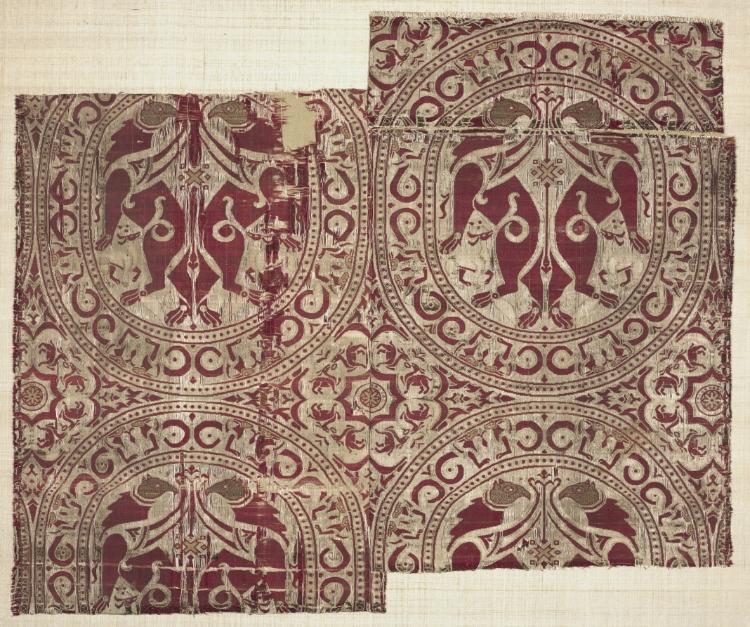
To engage with this artifact—a fragment of lampas silk depicting griffins enclosed within pearl-bordered roundels, drawn from the Reliquary of Saint Librada in Siguenza Cathedral—is to handle not merely a textile, but a dossier of imperial ambition. Its materiality, silk, is the first and most critical datum. This is not a fabric of mere adornment; it is a substrate of statecraft, a medium through which power was articulated, legible to courts from Constantinople to Córdoba. The piece demands an assessment not unlike that of a bespoke garment from a premier atelier: one must consider the origin of the cloth, the authority of the maker, the language of its pattern, and the statement made by its ultimate client.
The Loom as an Instrument of Empire
The context, as succinctly noted, is the legacy of imperial silk weaving. This situates our fragment immediately within the orbit of the Byzantine and, subsequently, the Islamic caliphal workshops. These were not commercial enterprises in any common understanding; they were gynaecea and tiraz factories, state-controlled monopolies where the production of such lampas was a guarded secret, as crucial to geopolitical projection as any treaty or legion. The very possession of patterned silks denoted a connection to these epicentres of sacred and temporal authority. To wrap a saint’s relics in such cloth was to make a definitive claim of orthodoxy, prestige, and divine favour, aligning one’s own sacred treasury with the imperium of the East.
A Heraldry of Hybrid Vigour: The Griffin Motif
The iconography is precise and potent. The griffin—leonine body, aquiline head and wings—is a creature of synthesis, a guardian of the numinous. In the classical and Byzantine traditions, it was an emblem of vigilant, divinely-sanctioned power, often associated with Christological majesty. Its enclosure within a roundel, a clipeus, frames the beast as a shield emblem, a personal standard translated into thread. This is not a casual decorative repeat; it is a systematic assertion. The symmetrical, confronting pairs of griffins within the medallions speak a formal, heraldic language, suggesting a programme of order and controlled strength. The pearl border, a ubiquitous motif in both Sassanian and Byzantine regalia, further emphasises the roundel as a jewel, a bestowed insignia of rank.
Technically, the lampas weave itself is a testament to superior capability. The structure allows for a clear, detailed rendering of such complex zoomorphic forms, achieving a clarity and colour saturation that simpler weaves could not. This technical mastery was inseparable from its symbolic value; the difficulty of execution was a barrier to entry, ensuring that only the most resourced and connected patrons could commission or acquire such works.
Provenance and Placement: The Reliquary of Saint Librada
The artifact’s later life in Siguenza is where its narrative acquires a particularly compelling twist. Enshrining the relics of a virgin martyr in a silk of imperial provenance was a standard practice for elevating a local cult to a wider stage. However, the Iberian Peninsula in the early to high Middle Ages presents a unique confluence. This region was a frontier and a fulcrum between the Christian north and the Islamic south, the Umayyad and later Almohad caliphates. While the initial weaving of this lampas likely originated in a Byzantine or early Islamic context, its journey to a cathedral in central Spain could have been via several channels: diplomatic gift, war spoila from the Reconquista, or purchase through the intricate networks of Mediterranean trade.
Its use in Siguenza, therefore, performs a complex sartorial diplomacy. For the Christian bishops and monarchs of Castile, employing such a fabric was a multilayered statement. It was, firstly, an assertion of parity—they clothed their saints in the same raiment as emperors and caliphs. Secondly, in a land so recently marked by Islamic rule, it could act as a deliberate appropriation of the visual language of the prior sovereign power, subsuming its authority into the Christian reliquary. The griffin, a potent symbol across cultures, was a suitably ambivalent vessel for this transfer of meaning.
Conclusion: A Fabric of Enduring Statement
In final analysis, this lampas fragment from Siguenza transcends its function as a reliquary lining. It is a concise manifesto woven in silk. From its genesis in an imperial workshop to its final resting place guarding the bones of a saint, every aspect of its existence speaks to the use of textiles as instruments of soft, yet unassailable, power. The quality of the silk announces economic reach; the sophistication of the lampas weave demonstrates access to guarded technology; the griffin motif declares a claim to vigilant, hybrid vigour; and its sacred deployment sanctifies these temporal ambitions with divine association.
To appreciate it fully requires the discernment one applies to a masterfully cut garment: an understanding that the true worth lies in the confluence of impeccable material, flawless construction, symbolic depth, and the stature of both maker and wearer. This lampas does not simply decorate history; it was an active participant in the theatre of empire and faith, a silent yet eloquent herald of the enduring legacy of imperial silk.